
Sitting and looking at 4-5 open source intelligence maps and they are all different right now – it’s messy but it will probably clear up in a few weeks.
What is not messy, however, is that RU is attacking broadly everywhere – they are probably burning some resources which is good because at some point there will be a low point.
Ukraine is trying to turn off the lights and pull down the blinds in Russia – I have only logged liberation acts against refineries but now Ukraine has expanded it to substations, power plants, and pump stations after the major campaign against oil storage facilities and gas/oil pipelines.
It is an ambitious project to disrupt critical societal services for Istvan and Slobodan on the street and very good. There were idiots among us who said that Ukraine would not do this as criticism of my bold proposals earlier in the war.
Ukraine is pragmatic, smart, and makes the right decisions but it is clear that the USA and Europe held them back for far too long – they should have done this much earlier.
I would go back to the Ukraine war but have to take the detour below, those of you who feel it’s getting tedious raise a hand so I know who you are 🧐
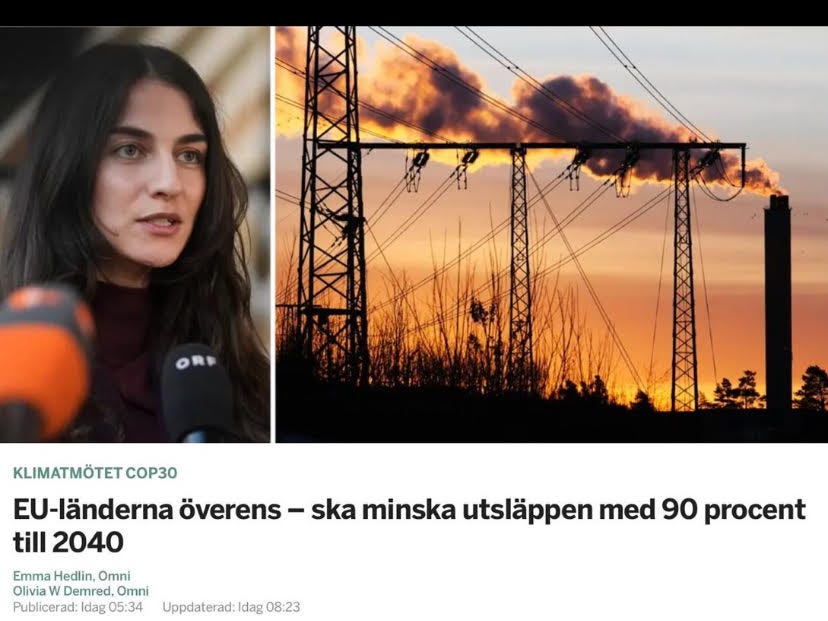
The EU has just agreed on a binding deal to reduce emissions by 90% by 2040. Everyone alive today and thinking freely knows that we have already taken care of the low-hanging fruits, so what remains will become very expensive. It will probably also lead to higher electricity prices since power plants and fossil fuels for electricity production are obvious targets for this attempt to make us world leaders in destroying ourselves.
That carbon capture for 20 billion SEK suddenly became a well-invested money when they legislated it into a business model, I wonder if they had insider information?
Then we have our heavy industrial production and if emissions need to be reduced by 90%, quite a lot of it probably needs to be shut down – for example, the production of wind turbines and solar panels that we will probably have to buy from China in the future so we can continue to be environmentally friendly.
Or the automotive industry and the arms industry – buy Chinese and save the environment ✊
Since it has now been approved but manufacturing cannot be legislated away since we have not yet become a full dictatorship, it is usually solved through fees and taxes until it becomes so expensive that buyers stay away – then some people toast with champagne that we have once again saved the world from climate collapse.
China accounts for a large part of the increase in emissions even though this may be the first time they are not increasing emissions in a year, but they have a long way to go before they start decreasing like Europe has done so far – and no one really believes that we can influence China because we can’t.
The same goes for the USA – we have taken on this essentially by ourselves without bringing the rest of the world with us and where the other players just thank and accept for the products we no longer manufacture, but now are forced to buy from them.
No one thinks about the fact that overall emissions do not decrease because the products are still being manufactured, just not by us and now they also have to be transported to Europe.
The electricity price in the EU is 3 times higher than in the USA and China, right, and now China has just launched a national strategy to lower electricity prices in the country.
The reason is AI – they want to win the AI race. Yes, AI is the next big technology area and China has already pulled ahead of us along with the USA.
Everyone in the world also knows that no country achieves prosperity without access to very cheap energy – first you needed slaves, then it was oil, and now energy production in all its forms. But yes, if we shut down all electricity production, our joy of life will be a bit like that of galley slaves from ancient times, so the circle closes.
Our damn EU politicians are instead working at the other end with REGULATION of AI – does any free-thinking person believe that we can regulate China and the USA or will we just crush our own companies in a cloud of incomprehensible regulations?
I got through a few pages before collapsing and starting to write this post.
When you don’t manufacture or offer a service yourself, then you have to buy it from someone else.
Europe is well on its way to devouring itself from within, Stegra became a business idea because we legislated it, but they are heading towards bankruptcy so not even legislating a business idea helped there.
No one wants to talk about Northvolt, but I recognize this because I’ve been through this before – last time it was Nuon, coal power plants, and nuclear power plants in Germany that Vattenfall today has almost completely written off as our politicians stonewalled completely. Now they are accompanied by a united media because Northvolt was environmentally friendly and therefore worth the sacrifices of pensioners – what is a hungry pensioner with last year’s false teeth compared to really trying to save the world.
The mismanagement is monumental and it’s our money being wasted – the USA has private financing that sieves investments rigorously and China has a state-controlled competition that surprisingly works well, unfortunately.
In Europe, politicians sprinkle our tax money as soon as the word environmentally friendly is included in the business plan – and a not insignificant number of business plans have the hidden goal of just trying to grab said tax money.
Jens Nylander’s mapping of charging stations should have earned him the Nobel Peace Prize but the media has avoided Jens Nylander’s all corruption revelations like the plague.
I think a lot about Finland, seeing that they have high unemployment in addition to the mosquitoes now and it can’t be easy for them.
The most important books in my white bookshelf, which I assembled myself with glass doors and top cabinet from IKEA where both doors, top cabinet, and the bookshelves themselves are a bit crooked, are Väinö Linna’s trilogy about the tenant farmers and Unknown Soldier.
We have an incredible living room upstairs with huge windows for light and then one wall completely covered in a row of bookshelves like authors usually have, just that they are as straight as the Ents in the Lord of the Rings, and since I didn’t have enough books, my wife took the opportunity to put all sorts of things in them together with my old bribes I received from the Chinese from previous projects – different sculptures or plaques. The flagship is the silver coins from the 2010 Olympics.
Since sometime in my 20s, I have started reading the trilogy a few times and can’t stop until all four books are plowed through, when the last page is finished, you have to have a few beers to calm down – it leaves a void.
Yes, there are Swedish classics too but Finland went through its revolution, a Winter War, and then a Continuation War to finally live in the shadow of the Soviet Union throughout the entire Cold War. It’s a bit more gripping reading than the coal sack toiling in the port of Stockholm.
Then they not only have too many mosquitoes but good candy as well – green candies are mandatory for my mother on Christmas Eve. It may not be what one associates with a Finnish worker, that he sits and munches on colorful pick-and-mix candy in the evenings, but that’s how it is, apparently also licorice.
Not everyone in Finland was a criminal when the country was poor, and not everyone is a criminal today even though the country has higher unemployment than Sweden – the whole damn discussion about it all being society’s fault and that we need to be taxed more so the bombings stop is so endlessly dishonest.
The political conversation in Sweden will continue to derail until the election – that’s something we just have to accept and live with, even though I’m starting to get tired of it already in November 2025.
However, Marxism mixed with identity politics and political Islam is starting to emerge in a toxic cocktail here and there in Europe, and it has rarely ended well – ask the Soviet Union, Iran, Lebanon, Venezuela, or Cuba, even though it will never go that far in Sweden, of course.
Even though the USA contributes to locking up and crashing communist countries, that should not be overlooked.
I’m not so foolish as to not understand that all politicians promise big and deliver small, but we used to have some kind of honesty – now the election promises are “more of everything for you for free if you vote for us and tax the rich.”
When it should be “we shall together build up the country through hard work – we create the jobs together, and it’s the private companies that provide you with your job, or you can become a private entrepreneur.”
Instead of the Finnish toil with the stone blocks and the draining of the marshes among the mosquitoes or in the deep snow, today we have a not insignificant group of unemployed people of all ages who are not willing to work but want free money, and if they don’t get it, they become damn sour and blame all sorts of versions of being victims.
The shipping industry is crying out for sailors, asbestos removal is in need of personnel, the annual berry picking is probably on hold, and so on – there are plenty of jobs available.
People are not willing to move, and they don’t want physical jobs.
I have been working a six-day week since 2006 and have lived in over half the world – wherever there are jobs, I move there either with my family or alone, and then we figure it out.
Now we have settled in the Caribbean after a shaky start and things are going quite well, but of course, everything will be turned upside down again next year in the eternal rat race.
The whole EU is starting to become hostile to businesses and envious of “those with money,” coupled with the belief that they are entitled to their money, is gaining ground where parties run for election on raising taxes so that everyone can have the same standard of living.
The problem is that “the rich” are those who own a house and are full-time working middle class/working class. Sometimes when revealing the salaries of the “rich” who are supposed to pay more taxes, they are between 40,000 SEK-60,000 SEK, depending on the party.
Everyone in Sweden can become like these “rich” – education is free, and everyone has food and a roof over their heads.
Those who can’t be taxed are the ones who are truly rich, they plan their taxes or move elsewhere. S understood this when they were a pragmatic workers’ party until the late 80s sometime before the Bommersvik mafia took over and they completely lost their way.
Politicians who constantly give themselves higher salaries and better benefits while claiming to fight for the poor in the country will never be held accountable – charlatans.
There is envy towards functioning families who work like crazy to give their children the best possible start in life.
Two full-time working parents with all the chores around the house and children have an absolute hell – they deserve everything they have and then some.
Not a single one of our eight parliamentary parties has proposed the best for the less fortunate – make the first 250,000 SEK-300,000 SEK of your income completely tax-free. Those with lower incomes would then get proportionally much more in their wallets than those with higher incomes.
One side lowers taxes for everyone in %, and the other side wants to raise taxes for everyone and redistribute them instead – both are equally worthless.
By the way, have you heard of the housing career?
You live with your parents – you move to a friend’s couch – you rent an apartment – you buy a studio apartment – you move in with your girlfriend to a three-room apartment, and finally, you buy a house in a “child-friendly area” = you won’t be shot to death in an underpass when taking your son to the Skärholmen pool.
Now, the parties left of center have launched the winning concept “shortcut in the housing career for those who vote for us funded by increased taxes for those who work.”
We have priority and various fast tracks for everything today, but the problem is that we have woven identity politics into this and polarization in the whole EU is on the rise at rocket speed.
I see Zohran Mahdami’s career as mayor of New York as an excellent test of how it will go if one runs a city based on political Islam and left-oriented democratic socialism if we are to believe the promises he has made. Everything will become cheaper, everyone will get more for free, and the rich will be taxed more to finance this upswing for everyone who votes for him.
At least one person got upset, but Zohran absolutely mixes ISLAM and POLITICS, however, the worst accusations that he wants to introduce Sharia laws seem to have been a shady campaign strategy from his opponents and thus false accusations.
How political Islam will work together with the LGBTQ+ and transgender movement that he also supports remains to be seen.
What happens if the “rich” in New York register in neighboring states, will the tax revenue decrease then?
If nothing else, neighboring states have already picked up that ball – it didn’t even take a day.
Did you know that Poland is among the world’s fastest-growing countries for millionaires to settle in, they have an attractive flat tax, and apparently some people like how Poland operates despite all their mistakes.
In the 80s, London was legendary, and until BREXIT, the UK received free money as the financial center of all of Europe, but they chose to shoot themselves in the foot and sank like a stone.
Everything has gotten worse in the UK after BREXIT, and they only have themselves to blame, and Russia, who worked like animals to get it through.
There are examples of countries that have shot an economic torpedo into their own side entirely on their own initiative – most recently, the German automotive industry is starting to shake considerably because they can’t produce cars at prices people are willing to pay with the high electricity prices in the country, which is a direct consequence of all the decommissioned electricity production.
This was not what I wanted to discuss at all, it was about China.
I see no willingness from Europe to try to deal with China, our leaders have sent national representatives to Beijing who have promised Xi Jinping eternal serfdom. It hasn’t happened with trumpet fanfares directly because it goes against the EU’s tough line, so they sneak in the visits a bit.
China has managed to break the back of the European electric car industry, and the EU’s solution to everything was high tariffs, so we as consumers end up paying dearly for the privilege of driving a car now made in China.
We buy Chinese because we don’t produce any of our own, but the EU imposes sky-high taxes, making them expensive for us to purchase.
The EU has tariffs and taxes on everything, so a European is somewhat of a low-income earner globally in developed countries, but we had an enviable welfare system as compensation.
Over the past fifteen years, we have put so much pressure on this welfare system that it will probably be dismantled gradually, which has probably already begun.
At least pensions have gradually deteriorated so that we can all have it better, however that works out.
I’m looking at universities that have medical programs all over Europe for our daughter, and a significant number of them now have annual fees ranging from 9,000 EUR to 30,000 EUR. I’m pretty sure that a whole bunch of the million readers who usually read my daily posts still believe that Europe had free higher education.
The USA had its “American dream” until sometime before the turn of the millennium, even if it was running on fumes in the last fifteen years?
Sometimes I watch old movies from the 80s, and the USA had all the services we are used to today with enormous shopping malls and all fast food chains already back then.
What was there in Stockholm in the 80s – not much.
In the USA, you could afford a big house, car(s), and all the gadgets you could possibly want on an average salary. Old refrigerators from the 60s are technical masterpieces.
I grew up in a detached house in Bromma, and we had a tiny black and white TV for quite a while, which later became a small color TV.
Yes, a Volvo 240, but we first had an Amazon, and after that a 245 before switching to a better used Toyota Corolla.
We used to go to Vällingby, which was an outdoor center, or into Drottninggatan. The mall was kind of one of the wonders of the world.
When I was studying in Ames, Iowa in the early 2000s, the infrastructure was quite exciting – the university was extremely well-equipped, and there were massive ice rinks and outdoor arenas – and there were 70,000 people living in the city plus students. As a Swede, I felt that the infrastructure was massively oversized and everything was bigger.
Unfortunately for Americans, even all the food packaging was bigger, with 2kg jars of peanut butter that were photographed as if they were exotic, and at Burger King, you got a one-liter soda cup with free refills as standard.
Now in 2025, people are hesitant to even have a layover in the USA, and a 75-inch flat-screen TV is laughed at if you don’t have one at home, so maybe we’ve caught up a bit?
But China…
You can buy a decent electric car for under 100,000 SEK there now, and the standard of living is rapidly rising for broad segments of the population.
The country is reclaiming desert areas that are being reforested, an area the size of Sweden has already been replanted.
They have the high-speed rail we would like to have in Europe, they are building iconic bridges, they are building electricity production, and now they are going to keep electricity prices down.
Many cities are starting to look really exciting, and they like to build tall and stylish.
Their research facilities are becoming ridiculously large, following the American model, with restaurants, gyms, and everything that makes it attractive to hang out there.
Gone is the chain-smoking Chinese man in a tight shirt who looked old already in his 40s, whom I worked with in 2006.
Today, it’s about social skills, confidence, and they win with technical solutions – they won the project here in competition with the French, Americans, and a South American company.
China dominates in Asia, Africa, and South America, while Europe and the USA are withdrawing.
There is a not insignificant risk that China is still on the upswing here and can continue to expand internationally even in a tougher climate with the USA.
I believe the USA will do what is right for the USA, and if you have read my previous posts, you know that the USD is now rising, and then they will switch to gold and crypto with a strong currency, devalue, and pay off the national debt when crypto and gold skyrocket. The losers will be all with USD national debt in a few years, but I’m happy because now my salary is increasing again after a significant crash for almost a year.
Europe is becoming a production desert that needs to buy critical raw materials, products, and services from the USA or China, and now we are going to sabotage even more for ourselves by reducing emissions by 90% in 15 years.
This will take over, and the huge, consuming swarm of EU bureaucrats will then spend all their waking hours chasing companies in Europe instead of creating the next wave of industrial production here, which I hoped would come now if we started getting tough on China.
Now in 2025, I have started to take an interest in the stock market – I mean, I study it but don’t have a penny to spare as usual, and the recurring theme is that those who show big profits in their tweets have shares in US companies. Mostly AI or nuclear power companies have done well for them.
Then the closest you come to communism is where the workers actually own their companies in the USA, right?
All tech companies have stock option programs that make employees rich, while we in Europe work for just a salary with a few exceptions.
An employee who has been loading the milk cooler at COSCO for twenty years has a pension of 3-4 million dollars to look forward to – can you name someone working at the checkout at ICA who got the same deal and can retire with 40 million SEK?
I’ve noticed in discussions that it’s mostly the old guard who appreciate my texts, and those who have taken the step to a paid subscription also seem to have a bit more life experience.
Somewhere, what I write resonates with the perception one has of the state of affairs, perhaps?
Everything goes in cycles, and we are not wrong at all, but we also have to deal with the fact that new generations are pushing from below without any life experience, so they can easily be manipulated – and they will eventually land in positions of power.
Since authorities have been somewhat bad in the last 15 years, especially if they were men whose parents were born and raised in Sweden, old truths have been blurred, and everyone can now be influenced in the direction that pulls hardest on them.
When I was growing up, I was fed all the rhymes and sayings by my parents and their acquaintances, which later turned out to be true, as one discovered when one became old enough to think for oneself.
I often sit with customer knowledge at banks and others due to my situation, where some younger talent starts asking about everything. I then have to push back, and you can tell when he has gone and asked his boss, who explains that he has crossed the line, and then everything is approved. But they are unpleasant to the point.
Everything is arbitrary and subjective, and everyone can do pretty much as they please – it’s not often that a country’s prosperity is built on something like that when everyone can tell you what you can and cannot do even if it goes against the law.
Like the Swedish Transport Agency and revoked driver’s licenses for example – now they backed down on that.
When I write “the country with the world’s highest taxes” there’s always the counter-comment “you’re lying” and yes, we might be number 20 or something but shouldn’t we still have the world’s 20th best welfare?
Or top 20 in cancer care, electricity supply, and so on?
Because we can afford to spend the resources on other fun things – those that are a bit higher up in the hierarchy of needs?
China is absolutely steamrolling ahead with higher living standards and social services for increasingly larger groups in the country – they are still on the upward curve to provide everything that we already think we have so we can spend the money on something else.
When I worked at TK in Stockholm, they had a huge portfolio of bridges to maintain but the maintenance budget was anorexic – on the other hand, bike lanes and parks received huge additions and the engineers who screamed about bridges from the 60s starting to collapse were ignored, we were the undesirables who were tolerated.
Sergel Square in Stockholm is built on top of a dozen underground structures and when they built the tramway that runs there, they checked all the pillars.
It turned out that you could drive a rebar straight through pillars that had corroded from road saltwater infiltrating over time but they only cared about reinforcing the top floors despite the consultants’ wild protests.
This problem is now so unattractive that it is being pushed forward and every five years a consultant is paid for an investigation. Then they realize that they are in deep trouble and park the problem again for five years to then let it be investigated by a consultant again.
Many bridge structures handled in this way in Stockholm, like in the city center, are many floors of underground structures in very poor condition – so our portfolio included all the deck structures in the city center as well, those built when the term “national pit” was coined.
There is no plan on how to address this now that housing has been built everywhere – can’t access them.
They ignore the core mission that citizens expect to be taken care of and spend the money on other fun things instead. We were 40 out of 400 working on the core mission, the rest made up tasks for us that were completely meaningless and internal meetings were rampant – because a unit manager can’t have their rightful status if they don’t have a plethora of meetings with their unit about everything except the core mission for which there were no resources.
Recently, China introduced visa-free entry into the country and 1, 2, 3… they will start attracting people who want to start living in China instead of the USA and Europe along with qualified workforce who get higher pay and more status in China than in the USA and Europe.
There are cities where you have access to more luxury than in Dubai today and can live like a prince cheaper than in the West.
Australians have started to tour in China.
In fact, some researchers in Europe have already left for the USA and now a bit to China as they get to research, get paid well, and gain status.
One becomes a bit resigned because instead of the EU developing into the world’s focal point, we are in the process of regulating and prohibiting ourselves to total destruction.
I had imagined that we would follow the USA and push China around to then bring back manufacturing to us and start spreading in Africa with FAIR trade agreements – the road to happiness and eternal prosperity.
Now there will be a stranglehold on all manufacturing and electricity production for another fifteen years instead – maybe it’s time to accept the fait accompli and move to China, I have always liked the family’s fine dining at the local Chinese buffet so I am absolutely not hostile towards China, the only criticism I’ve had is that the buffet stopped serving fish in its sushi a year ago.


Don't forget to donate, Ukraine's cause is ours! Support Ukraine!


AFU’s morning report for the past 24 hours indicates a significantly calmer front following the previous day’s massive offensive across the entire front, with attack peaks on several fronts, not least the wild storming of Pokrovsk with 100 attacks (third highest), which has now rested with only very strong 58 attacks in the past 24 hours. Even Lyman, which for the first time in a long while exceeded 20 attacks (27), fell back in this morning’s report. The same goes for Huliapil and Kramatorsk. However, Kupiansk has been more active in the past 24 hours.
Out of a total of 169 attacks, 147 were presumably mainly Russian attacks along the front as shown below. The remaining 22 presumed Ukrainian attacks are not located, but in Pokrovsk, according to AFU themselves, they are actively conducting counterattacks.
Kupyansk 12💥↗️
Pokrovsk 58💥💥💥↘️↘️
The total losses of the Russian invaders in the past 24 hours amounted to 1,170 individuals. Ukrainian soldiers have also destroyed a tank, two armored vehicles, 13 artillery systems, an air defense weapon, 248 tactical drones, 65 vehicles, and two units of special equipment belonging to the occupiers.
Yesterday, the enemy carried out 1 missile attack and 62 air strikes, used six missiles, and dropped 144 guided bombs. Additionally, they conducted 4,916 shelling incidents, including 134 with rocket systems for salvo fire, and used 5,525 kamikaze drones to target objectives.
The aggressor conducted air attacks, including in the areas of Vidradne, Orestopil, Pokrovske, Malynivka in the Dnipropetrovsk region; Dobropillia, Ternuvate, Zaporizhia, Shiroke, Soniachne in the Zaporizhia region; Olgivka in the Kherson region.
In the past 24 hours, the air force, missile forces, and artillery within the defense forces have eliminated an artillery weapon and three areas where the enemy personnel were concentrated.
Ah, apologize, missed your report about the losses, hadn’t refreshed the page.
Not at all, maybe I didn’t see yours. I posted then because I didn’t know if you would be able to post in the early morning.
“No one thinks about the fact that the overall emissions are not reduced because the products are still being manufactured, just not by us, and now they also have to be transported to Europe.”
Food for thought
Well, on the other hand, quite a few actually devote one or two thoughts to it.
This is one of the reasons why the cheap Chinese online stores are criticized. Unfortunately, people don’t really care about the environment to such a large extent, so it mostly becomes a question of lacking electrical safety, dangerous chemicals, etc., because they have a greater chance of influencing consumer behavior.
At the same time, that’s exactly it, we let someone else make the emissions.
Then it’s used as an argument that we don’t need to do more “it’s all China’s fault and as long as they emit so much, it’s pointless”.
If no one bought from China, their emissions would decrease drastically.
Unfortunately, it’s almost impossible to influence China through protests (and a lot of anti-environmentalists try to claim otherwise).
It’s only by applying the same environmental requirements to their production as we have on our own that we can get somewhere. But we can’t demand anything from China if we don’t live up to the requirements ourselves.
In fact, authorities, municipalities, etc., have a certain power there where they set requirements in their procurements.
A large part of individuals and companies otherwise tend to buy as cheaply as possible.
But essentially everything we buy is either manufactured in China or built from raw materials or products from China?
So if we stop buying made in China, will it be difficult to get hold of anything?
One can always set CO2 requirements for example but China will just cheat their way around it – their authority will issue certificates and guarantees that are false.
No one will ever be able to get China to behave.
Yes, Transportation is too cheap, Oil is too cheap.
And.. We buy more than we really need.. Yes, if we don’t consume, the money stops flowing, and with that the economy, but if we instead buy less often, but with quality and European brands, we have at least reduced emissions and dependence on China a bit.
It’s almost impossible to buy something that is completely China-free, but at least we can reduce the percentage from China.
A poor person can’t afford to buy cheap.
👍
Report, Russian losses in the war in Ukraine 2025-11-07
Glory to Ukraine!
Thank you, interesting reading about Finnish literature, China, EU, and the USA. Also sounds like Stockholm’s infrastructure is a house of cards in decline, quite literally.
Regarding underground infrastructure and what you mention about the various maps of OSINTers, I listened to David D yesterday and something he brought up is something that doesn’t appear on maps: Pokrovsk is a mining town. David reminded us of what led to the fall of Avdiivka: penetrating Russian troops through underground tunnels. Pokrovsk has plenty of tunnels as I understood it. Could that partly explain the mosaic? Did the AFU learn the lesson from Avdiivka, and have they exploited these lessons and the underground infrastructure? We also remember the Azov Battalion’s fortification of underground infrastructure at the steel plant in Mariupol, in the early stages of the war. Perhaps this factor in the equation should be considered? An extra dimension (3D)…
Update:
David doesn’t seem to be completely off track (below). But the lessons seem to have reached the Russians as well…
Update:
Thank you for the “powerslide,” Johan no 1. Also, thank you 205 for all the info.
I understand that Johan is annoyed with Stegra. I have a different opinion on that. I don’t understand Northvolt, so I’ll leave that aside.
My only comment on Stegra and Hybrit is that we must keep up with the development if we are to have steelworks in the future.
Let me give you a few examples. 10-12 years ago, the Royal Navy ordered two aircraft carriers and a number of frigates. The steel mill in Scunthorpe (south of Hull) expected to receive the order for the ship steel as they needed the order to secure employment.
The order went to Oxelösund.
There were big protests in England, of course, but the English Minister of Industry commented that English steel mills are not capable of producing the steel needed for the ships. Today, the steel mill is losing £700,000 a day. The English government has bought out the steel mill from the Chinese Jingye to save jobs. Tax money for a doomed steel mill, in other words.
In Port Talbot, Wales, one of Europe’s largest steel mills, owned by Tata Steel, two blast furnaces must be closed to save the factory. 2000 out of 4000 workers must leave. Otherwise, they cannot afford the green transition.
The USA has not had to touch its outdated steel mills as it has such a large domestic demand. If there is a crisis, Trump solves it with tariffs.
Ssab (Americas) has had great success with its establishments in the USA. I think they have a market share of 30% when it comes to heavy plate and some special steels. The list could go on, but I’ll stop at these examples.
The Swedish steel industry must be at the forefront to survive!
Rising is therefore exactly the same steel as before but CO2 free and costs 20%-25% more.
There is no other quality improvement than that.
Yes, that’s correct and is part of the mix
Thank you Johan, interesting post in all its parts!
As a resident of Stockholm, the information you provide is somewhat alarming to say the least… Perhaps that part could be further developed and become a debate post in DN or similar? I think it needs to be highlighted…
This thing with all the investigations that are then shelved to be redone with the next administration is a bad habit that only costs a lot of money and wastes time.
And all these administrators, communicators, etc… I believe that about half of them could be removed and the positions could go to the core activities instead. Administrators have a knack for inventing new reports that need to be filled in every which way because they have to keep themselves busy and justify their salary.
Then I think that nurses, doctors, teachers, police officers, etc. should focus on their core missions and not be busy with all the reporting left and right. Make sure to get proper digital systems that work smoothly for the users and that minimize the administrative burden for the doctor, etc. instead of increasing the workload.
It would be quite interesting to study how the relationship between core tasks and administrative tasks looks today compared to, let’s say, 30 years ago for teachers, doctors, police officers, etc.
We are busy administering and investigating our country to pieces instead of ensuring the maintenance of infrastructure, organizing housing policies, schools, healthcare, etc.
Off topic. Can’t help but convey these lines. One Sunday in 1970 in Seattle, the captain of the ship I was employed on ordered me to take a walk and check out the Westinghouse facility. “You, being from Halland, should see where they’re going to manufacture Ringhals 2-4.” Since I always did as he said (it was the calmest way), I marched there. Kilometer after kilometer of red broken planks met me. Could this be a high-tech industry? Yes, it was. Reminded me of Aronsson’s scrapyard in the harbor of my hometown. Only the angry German Shepherds were missing. The captain obviously knew what it looked like and later asked what I thought, but I don’t remember what I answered. Much later, I saw the ASEA Atoms facility in Västerås. It is now owned by Westinghouse. It should have been the other way around. They were two completely different worlds, with the finer world in Västerås.
👍
You are absolutely right. There is nothing as effective as an understimulated administrator when it comes to deteriorating operations.
What true words 👍
Thank you too.
Yes, the “administrator plague” has spread to almost every organization and it’s world wide.
When I started, engineers were the kings that everyone else served – finance, administrators, reception, secretaries, legal.
Then at some point they started to become more like someone who tells others what to do.
And now they tell me how to do my job.
The absolute worst I experienced was at TK in Stockholm because there they were too many and lived their own lives.
It went so far that when we engineers called around to get the help they were supposed to offer according to their job description, we were considered to be a nuisance – life would be easier if we didn’t call and nag about things.
They fill their day with completely irrelevant things that have zero relevance to what is important, but if there are enough of them, it becomes safety in numbers.
Then when it’s time for layoffs, it’s always that group that takes care of it and then it’s easier for them to get rid of those who are a bit troublesome in the company – those who are considered a little annoying.
The connection to the core business no longer has ground contact
Haha, yes, as a project engineer in the electrical industry at a large company, I can agree that in the name of efficiency, many side functions have been rationalized away, so we have to take care of it ourselves, for example, booking trips and hotels. For every update of the programs that are supposed to help our operations, it requires a few extra clicks to do the same thing. And for the project managers, it’s even worse, their total effective time between monthly reports is at most two weeks. The reports from SAP are not enough for the management, as they want to see different numbers, so magic in Excel is necessary. And so on.
For the customers, it’s the same, 20 years ago, a request for a quote for a control system for a small power plant was 25 pages of straight information, now some consultant has prepared a 150-page document, with vague wordings about all the technical aspects in order to not be held accountable for any potential errors.
Well, it is seriously a scourge in many different forms. Everything from pure administrators and bureaucrats who complicate things unnecessarily (as they secure their jobs and appear important) to narrow-minded nerds who think that their special interest is the most important in the world without considering the costs it leads to in society.
⚡️ Ukraine’s envoy in Washington says negotiations on acquiring Tomahawk and other long-range missiles are “rather positive.”
https://united24media.com/latest-news/ukraine-in-positive-talks-with-us-to-acquire-tomahawk-cruise-missiles-13193
“The discussion is still ongoing, but we have a lot of delegations working to scale up the available financial resources to procure more military capabilities from the US,
..It is not only Tomahawks but different types of other long-range and short-range missiles, and I can only say that it’s rather positive.”
Ukraine’s envoy in Washington, Ambassador Olha Stefanishyna
Trump can’t refuse forever 😀
Should we make a bet?
Frustrating 😩. At the same time as the page updates itself shortly after loading, both Twitter and Facebook are doing the same thing, so when you go back to retrieve the text that disappeared, that post is also gone. So, I’ve learned that it’s important to save it first.
You live my life 👍
Yes, Johan is good. He writes fluently and easily and can definitely have a place as a columnist in one of our larger media outlets. The magazine Fokus, for example.
Thank you for your kind words, yes it would be fun, it’s on the list to try to circulate posts to the media and see if anyone bites.
Well, today’s weather was actually good, unfortunately I arrived a bit late to the game.
Johan!
I agree regarding the climate and most other things as well. I was thinking about asking to supplement or rather refer to a supplement regarding how greenhouse gas emissions look and have looked in the EU and the rest of the world.
https://www.fokus.se/opinion/jan-weiner-orimligt-med-hogre-klimatmal-an-eu-kraver/
(Regarding Fokus, see above)
In the EU, emissions have decreased significantly since around 2006. In the rest of the world, they are increasing very dramatically during the same period, see figure 1 in the article linked above.
Despite the significant decrease in EU emissions over the past 20 years, EU legislation requires that the rate at which emissions are reduced must be greatly increased – roughly more than doubled, see figure 2 in the linked article. One wonders if it is possible. As you noted above, it is hard to believe that the difficult parts have been started and the easy ones are left.
Regarding Sweden, we will have difficulty meeting the goals imposed on us by the EU. This applies especially to the storage target, see figure 3 in the aforementioned article.
And regarding the idea that the EU would have a bright future thanks to climate laws, it is rather the opposite. It is China that seems to be heading towards a bright future as a result of EU’s climate laws, see for example FIGURE 7 page 48 (in pdf) in Draghi’s report. Very telling.
https://commission.europa.eu/document/download/97e481fd-2dc3-412d-be4c-f152a8232961_en?filename=The%20future%20of%20European%20competitiveness%20_%20A%20competitiveness%20strategy%20for%20Europe.pdf
Regarding major investments in Sweden, like Stegra. Yes, we probably need to be able to handle the Stegra initiative. After 2039, no more CO2 emission allowances will be issued for industries such as iron and steel within the EU (see ETS). The issuance of emission allowances will gradually decrease until then. Either we manage the transition to a fossil-free steel industry by 2039 or the EU decides that we must shut down operations. Right?
Received a tsunami of comments on bluesky that it probably wasn’t that dangerous so thank you Jan W for clarifying it with numbers.
Especially the one about emission rights, heavy industry…
Everyone sees the same world as us and then starting to defend even more is exciting.
Nuclear power, several shouted that it should be built but good luck with that when 90% of emissions are supposed to decrease during the construction period.
Those who do not want nuclear power now have powerful binding legislation on their side.
I have zero knowledge of social media like bluesky. Otherwise, I would gladly support you there.
A correction only. 90 percent down in 15 years, i.e. by 2040 means 90 percent down compared to 1990.
By the way, they are quite wonderful at the EU. I was curious about when the EU legislation on emissions, which now applies to Sweden and several other countries, was decided. I sent an inquiry to the EU’s information office in Sweden. Got a fairly quick response. They replied that they had forwarded the question to the EU central office (in Brussels, I believe). I haven’t heard anything since. It’s been a while.
I’ve sent an inquiry to the office before as well. At that time, it concerned which measure of net emissions was applicable for the legislation. At that time, Eurostat reported three different measures, depending on whether international aviation and maritime transport were included.
Same thing. They forwarded it. That time, at least I got a response. To me, the answer was cryptic. They responded with references to regulations. Regulations from which I, at least, couldn’t figure out the answer.
Otherwise, they could have simply stated that it is variant X of net emissions that the legislation is based on.
A certain signal about the competence of those making decisions that affect hundreds of millions of citizens in the EU.
Policymakers cannot foresee consequences.
Companies are a little better when it’s shareholders’ money.
The best system you can have is when companies lead and politicians follow with controls but have a clear goal.
Like my district heating – The County Administrative Board can take 3 years to make a decision apparently for a 20m long ditch that is 0.8m deep.
If you have a system where no response within three months automatically means approval, it becomes much easier.
All our legislation and practices have been largely overinterpreted in my opinion, and one must have a very clear line on what takes precedence.
In my case – there should not be any kind of guideline that allows someone to lay pipes in their house and that takes precedence?
Now something completely different takes precedence, the County Administrative Board considers itself understaffed and unable to resolve the backlog of cases for several years, so everyone has to wait.
We have completely lost our way but it has major consequences.
When a landowner wants to clear forest and some activist manages to find a damn frog so there is no clearing – it’s not entirely uncommon.
There are no clear guidelines.
If you were to compare it to the worst system where politicians try to do business with taxpayers’ money, whatever it may be.
I remember the diesel and an entire automotive industry that got a cold shower.
And apparently new investments in wind power are completely out – why is that if it’s the future?
Very good that it leads to more religious believers 👍
Thank you for your kind words
I wonder in my quiet mind how much slavery China has to increase the standard of living….?
And does that standard really apply to everyone?? I suspect that there are one or two groups that do not benefit from it… thinking about China’s point system for “good” citizens…
Just some Friday thoughts…
Google AI had a lot of numbers.
China in the 80s was basically a desert, so things have moved quickly.
When a country is on the rise, it often automatically gets better for everyone, which it seems to have done?
Then the money always centers around the attractive cities and it’s poorer in the countryside – I give you the inland of Norrland.
Haha so profound that if you agree with the political views, today’s message is that you are old.
Thanks for that! 😉
Ready for palliative care 👍
Don’t know at what age the breaking point really is, maybe I generalized a bit 😀
50 is the new 40 nowadays?
That’s just the way it is.
Probably around the same age, was young in the 80s, in “Kekkoslovakia”
-First color TV -76, 26 inches
-We bought our first car with seat belts when I was 12, leather prices were good, so we switched from Opel rekord -68 to a used Audi 100, they were so rare that Audi owners would greet each other when passing by.
I see a big problem with the cheaper version of Skynex – fastened to the ground.
Skynex needs to be mounted on mobile vehicles, not necessarily blast protection.
https://www.ukrinform.net/rubric-ato/4056318-rheinmetalls-skynex-proves-effective-not-only-against-shahed-drones-but-also-kh101-and-kalibr-missiles-defense-express.html
Kenneth Gregg today:
”07.11.2025 update. First, I want to thank yesterday’s participants in my Pokrovsk seminar. You asked very intelligent questions. I hope you gained an understanding of my own stance on the situation at Pokrovsk, and why it differs so much from others.
Many are currently criticizing the Deep State map, but they have realized what I have been trying to explain for a whole week now; due to the new combat situation with drone warfare and very little manpower, the traditional line division of maps no longer works.
In today’s update, I will try to provide a simpler answer to why Ryzz will not take over Pokrovsk/Myrnohrad.
Analytical overview: Why Russia cannot take over Pokrovsk/Myrnohrad
The Russian offensive in the Pokrovsk area has been one of Moscow’s most prioritized operations during 2024–2025, both militarily and in terms of propaganda. Despite several months of intense attacks, the operational breakthrough is missing. When studying this case more closely, four main explanations emerge: terrain characteristics, Ukraine’s tactical advantage, Russian structural limitations, and inadequate logistics.
1. Terrain structure creates systematic obstacles for attacks
Pokrovsk is located on an elevated plateau and is surrounded by ravines, forest belts, urban terrain, and several parallel defense lines. This geography eliminates the possibility of rapid advances and forces Russian forces to use narrow attack corridors.
The consequences are clear:
• every small forest grove or field turns into a firing trap,
• Russian forces are exposed to crossfire,
• the attack speed decreases to a minimum.
Empirically, this can be seen in Russian troops getting stuck for weeks around the same forest belts and gravel roads.
2. Ukrainian drone superiority in the sector
Pokrovsk is one of the most UAV-monitored zones in the entire war. Several brigades — including Kara-Dag, parts of the 14th brigade, and units from the Dnipro corridor — maintain continuous real-time monitoring and coordinated use of FPV drones, mortar sensors, and mobile firing groups.
This provides Ukraine with:
• precise and rapid target detection,
• the ability to destroy Russian advances at the beginning of each attack,
• the ability to counter Russian tactical gains within hours.
As a result, Russian forces cannot consolidate the smaller positions they sometimes take.
3. Disproportionately high Russian losses
OSINT indicators show that the Pokrovsk front since spring 2024 is one of the most personnel-costly sectors for Russia:
• daily losses of 300–500 men,
• continuous loss of armored vehicles,
• very high artillery ammunition consumption.
Russia manages to take isolated strips of forest, field edges, and basements, but cannot hold them due to Ukrainian counter-pressure. This reflects a structural inefficiency where the tactical gains of the offensive do not interact with operational control.
4. Urban triangle Myrnohrad–Pokrovsk–Rodynske complicates advancement
To hold Pokrovsk, Russia must first penetrate three interconnected urban centers:
• Myrnohrad — high and compact, • Rodynske — heavily fortified,
• Ukrainian — controlling the flank terrain.
In addition, there are mining areas and old industrial zones that create a defense environment with a high density of protected positions. This urban complexity significantly exceeds what was observed, for example, in Avdiivka, Chasiv Yar, and Marinka.
5. Ukrainian reserves and logistical proximity
Unlike in previous critical situations (e.g. Chasiv Yar and Avdiivka 2024), the defenders in the Pokrovsk area have a stable and rotating reserve system.
• Several Ukrainian brigades are grouped in depth, • reinforcements can be moved within minutes thanks to dense local infrastructure,
• the region is close to major railway junctions, hospitals, and logistics hubs (including Dnipropetrovsk and Pavlohrad).
This logistical advantage shortens Ukrainian response times and increases defense sustainability.
6. Russian lack of effective artillery and counter-battery capability
Ukraine’s counter-artillery fire — reinforced by American target designation and modern UAV reconnaissance — has significantly degraded Russian artillery capability in the area. Russia largely fails to knock out Ukrainian guns, loses its own artillery quickly, and is forced to attack without sufficient fire support.
This goes against the basic principles of urban offense: without dominant artillery, there are no conditions for successful storming operations.
7. Loss of morale in Russian assault units
Interceptions and reports from Russian military bloggers indicate that assault troops suffer from low morale. Typical indicators:
• soldiers are sent into narrow corridors without adequate support, • reports of losses “worse than Avdiivka,”
• lack of rotation system,
• attacks carried out by light infantry without armor support.
According to Ukrainian frontline observations, Russian assault waves often do not survive longer than 40–90 minutes before breaking.
8. Systematic Ukrainian disruption of Russian logistics
Daily drone attacks on ammo depots, fuel depots, artillery positions, and support vehicles force Russia to gradually move its logistical nodes further back. The effects are clear:
• longer supply lines,
• decreased attack rate,
• impaired coordination between weapon types. This undermines Russian attempts to maintain operational continuity.
Overall assessment
Russia can maintain high pressure in the Pokrovsk sector but lacks the ability to translate tactical advances into operational control.
They cannot:
• create a breakthrough,
• hold newly gained territory,
• protect their logistics,
• carry out mechanized and coordinated attacks,
• or match Ukraine’s drone and counter-artillery superiority.
Altogether, this means that Pokrovsk requires a level of combined combat capability — in terrain, artillery, and leadership — that Russia currently does not possess.
🇺🇦 Ongoing actions (Ukrainian defense)
1. Continue targeting logistics nodes with drone attacks and precision munitions.
2. Strengthen decentralized C2 authority and shorten decision cycles at brigade level.
3. Maintain rotation capacity and mobile reserves close to the front.
4. Protect critical rail and hospital hubs from sabotage; establish mobile “fallback depots.”
5. Maintain the artillery reserve and invest in counter-battery sensors for better survivability.
Conclusion (analytical)
The Pokrovsk sector represents a systemic defensive success when combined elements (terrain, ISR, C2, LOG) interact. Russian deficiencies in artillery, logistics, and C2 make attacks tactically intense but strategically ineffective — a classic demonstration of how technology (UAV/ISR) and flexible defense logistics can neutralize numerical pressure point strategies.
Now, I want you to think if you have seen the video of street fighting in Pokrovsk? Then think back to the many videos that came from the street fights in Bachmut. Now you will realize the difference!
Tomorrow we will start our new fundraiser for robot No. 5. Then more information will be provided on who will receive it and donation channels.
SLAVA UKRAINI”
Positive reading! 👍
Puh, another stressful day! Time for a Nemiroff while I go through all the posts!
It always seems to be a good time when I stay away and don’t argue! 😂🍻
Typical Russians trying to sell their oil and gas! 😂
“Thousands of lobbyists connected to the fossil fuel industry have participated in the latest four years of climate summits, reports The Guardian based on a list from the network Kick Big Polluters Out. According to the newspaper, there are 5,350 lobbyists from over 1,000 companies, organizations, and foundations. 90 of the entities that sent representatives last year accounted for over half of global gas and oil production. – The place that should be about science and people has turned into a trade fair for carbon trading, says activist Adilson Vieira. Next week, the COP30 climate summit begins in Brazil.”
https://omni.se/a/Mnxd7K
I’ll put this in quickly before 6 pm, unless it’s going to be banana beer:
Information: More than 1,400 African soldiers are fighting for Russia. More than 1,400 citizens from around 30 African countries are fighting for Russia in Ukraine. This was reported by Ukraine’s Foreign Minister Andriy Sybiha, according to Reuters.
https://www.dn.se/direkt/ukraina/2025-11-07/uppgifter-fler-an-1-400-afrikanska-soldater-strider-for-ryssland/
Thank you No.1 for yet another fantastic post. There are so many wise words that one feels like a newly converted believer several times a week. This of course also applies to MXT, 205, and many others who contribute with very sensible points of view. The humorous little elements make you look forward to reading more every day. If you were to form a party, you would definitely have my vote.
But, now it’s Friday and then we know what applies!
👍
Seems like Johan has abdicated as king in the bar, considering how he seems to dream himself back to bygone times and thinks that everything was better back then, one can sense that he is starting to get old and needs to go to bed early. Or is it simply the absence of Mariestad that is haunting him?
The rest of us who still have a young spirit are fighting to keep the Friday intoxication somewhat alive!
Cheers! 🍻
Can Kenneth Gregg handle the map question here?
07.11.2025 update. First, I want to thank yesterday’s participants in my Pokrovsk seminar. You asked very intelligent questions. I hope you gained a foundation for understanding my own stance on the situation in Pokrovsk, and why it differs so much from others.
Many are currently criticizing the Deep State map, but they have realized what I have been trying to explain for a whole week now; due to the new combat situation with drone warfare and very few troops, the traditional division of lines on the map no longer works.
In today’s update, I will try to answer more simply why the Ryzzen will not take over Pokrovsk/Myrnohrad.
Analytical review: Why Ryzzland cannot take over Pokrovsk/Myrnohrad
The Ryzka offensive against the Pokrovsk area has been one of Moscow’s most prioritized operations during 2024–2025, both militarily and in terms of propaganda. Despite several months of intense attacks, the operational breakthrough is missing. When studying this case more closely, four main explanations emerge: the nature of the terrain, Ukraine’s tactical advantage, Ryzka structural limitations, and inadequate logistics.
1. The terrain structure creates systematic obstacles for attacks
Pokrovsk is located on an elevated plateau and is surrounded by ravines, forest belts, urban terrain, and several parallel defense lines. This geography eliminates the possibility of rapid advances and forces Ryzka forces to use narrow attack corridors.
The consequences are clear:
• every small forest grove or field turns into a kill zone,
• Ryzka units are exposed to crossfire,
• the attack speed drops to a minimum.
Empirically, this can be seen in Ryzka troops getting stuck for weeks around the same forest belts and gravel roads.
2. Ukrainian drone superiority in the sector
Pokrovsk is one of the most UAV-saturated zones in the entire war. Several brigades — including Kara-Dag, parts of the 14th brigade, and units from the Dnipro corridor — maintain continuous real-time surveillance and coordinated use of FPV drones, mortar sensors, and mobile firing groups.
This provides Ukraine with:
• precise and rapid target detection,
• the ability to destroy Ryzka advances at the beginning of each attack,
• the ability to push back Ryzka tactical gains within hours.
As a result, Ryzka units cannot consolidate the smaller positions they sometimes take.
3. Disproportionately high Ryzka losses
OSINT indicators show that the Pokrovsk front has been one of the most personnel-costly sectors for Russia since spring 2024:
• daily losses of 300–500 men,
• continuous loss of armored vehicles,
• very high artillery ammunition consumption.
Ryzzland manages to take isolated strips of forest, field edges, and basements, but cannot hold them due to Ukrainian counterpressure. This reflects a structural inefficiency where the tactical gains of the offensive do not interact with operational control.
4. The urban triangle Myrnohrad–Pokrovsk–Rodynske hinders advancement
To hold Pokrovsk, Ryzzland must first penetrate three interconnected urban centers:
• Myrnohrad — high and compact,
• Rodynske — heavily fortified,
• Ukrainian — controlling the flank terrain.
In addition, there are mining areas and old industrial zones that create a defense environment with a high density of protected positions. This urban complexity significantly exceeds what was observed, for example, in Avdiivka, Chasiv Yar, and Marinka.
5. Ukrainian reserves and logistical proximity
Unlike in previous critical situations (e.g., Chasiv Yar and Avdiivka 2024), the defenders in the Pokrovsk area have a stable and rotating reserve system.
• Several Ukrainian brigades are grouped in depth,
• reinforcements can be moved within minutes thanks to dense local infrastructure,
• the region is close to major railway junctions, hospitals, and logistics hubs (including Dnipropetrovsk and Pavlohrad).
This logistical advantage shortens Ukrainian response times and increases defense sustainability.
6. Ryzka lack of effective artillery and counter-battery capability
Ukraine’s counter-artillery, reinforced by American target designation and modern UAV reconnaissance, has significantly degraded Ryzka artillery capacity in the area. Ryzzland largely fails to knock out Ukrainian guns, quickly loses its own artillery, and is forced to attack without sufficient fire support.
This goes against the basic principles of urban offense: without dominant artillery, there are no conditions for successful storming operations.
7. Morale decline in Ryzka assault units
Interceptions and reports from Ryzka military bloggers indicate that assault troops are suffering from low morale. Typical indicators include:
• soldiers being sent forward in narrow corridors without adequate support,
• reports of losses “worse than Avdiivka”,
• lack of rotation system,
• attacks carried out by light infantry without armor support.
According to Ukrainian frontline observations, Ryzka waves of attack often do not survive longer than 40–90 minutes before breaking down.
8. Systematic Ukrainian disruption of Ryzka logistics
Daily drone attacks on ammo depots, fuel depots, artillery positions, and support vehicles force Ryzzland to gradually move its logistical nodes further back. The effects are clear:
• longer supply lines,
• decreased attack rate,
• impaired coordination between weapon types.
This undermines Ryzka attempts to maintain operational continuity.
Overall assessment
Ryzzland can maintain high pressure in the Pokrovsk sector but lacks the ability to translate tactical advances into operational control.
They cannot:
• create a breakthrough,
• hold newly gained territory,
• protect their logistics,
• carry out mechanized and coordinated attacks,
• or match Ukraine’s drone and counter-artillery superiority.
In total, this means that Pokrovsk requires a level of combined combat capability — in terrain, artillery, and leadership — that Ryzzland currently does not possess.
Ongoing actions (Ukrainian defense)
1. Continue targeting logistics nodes with drone attacks and precision weapons.
2. Strengthen decentralized C2 authority and shorten decision cycles at brigade level.
3. Maintain rotation capacity and mobile reserves close to the front.
4. Protect critical rail and hospital hubs from sabotage; establish mobile “fallback depots.”
5. Maintain the artillery reserve and invest in counter-battery sensors for better survivability.
Conclusion (analytical)
The Pokrovsk sector represents a systemic defensive success when combined elements (terrain, ISR, C2, LOG) interact. Ryzka deficiencies in artillery, logistics, and C2 make attacks tactically intensive but strategically ineffective — a classic demonstration of how technology (UAV/ISR) and flexible defense logistics can neutralize numerical focal point strategies.
I now want you to think about whether you have seen the video of street fighting in Pokrovsk? Then think back to the many videos that came from the street fights in Bachmut. Now you realize the difference!
GLORY TO UKRAINE
Difference between online comments and reality
https://x.com/VideosVuvu/status/1985931543466951068/video/1
https://x.com/LibertyPillMeme/status/1983553529600958851/video/1
🎯😆👍
🦊 & 🐶
https://x.com/15_Stellar/status/1831582019618500971/video/1
🐕 & 🐈
https://x.com/doge_albania/status/1784121840375320637/video/1
😂 The dog’s diversionary maneuvers didn’t quite work as intended!
🛑
Waiting for the stop sign to turn green
https://x.com/GigglingGanon/status/1985572718763479320/video/1
Facepalm….
High as a kite!
🎶
https://x.com/AndrewPerpetua/status/1986157491433185639/video/1
Definitely facepalm!
Sure thing!! Friday Madness (TM)!!!
Cat VS German Shepherd
https://www.youtube.com/watch?v=cSD0DaoNUjE&list=WL&index=1
Failed robbery…
https://www.youtube.com/watch?v=V7g2wmzkdRs&list=WL&index=3
Another word for mouse pad…
https://www.youtube.com/watch?v=o4iTv2Iuymg&list=WL&index=8
Click area
Firefighters = BadAss!
https://www.youtube.com/watch?v=w0FXvc2Ekvs&list=WL&index=15
What is it??
https://www.youtube.com/watch?v=UkrK6NsVQKw&list=WL&index=18
Well, that’s how you charge a Tesla while driving… um…
https://www.youtube.com/watch?v=-BDGv6smiZY&list=WL&index=20
Tesla, environmentally friendly and great!
Flying car…
https://www.youtube.com/watch?v=ta1cSk6Ap6M&list=WL&index=21
Fniss…
https://www.youtube.com/watch?v=U67mhGysZPg&list=WL&index=24
The art of bathing an ANGRY cat…
https://www.youtube.com/watch?v=LCRrNcLlgNU&list=WL&index=31
Rally drivers should become something in the forests of Värmland 👍
Oh, typical cats!
It’s important to keep the drawing right…
https://www.youtube.com/watch?v=K8Sta0sb42Q&list=WL&index=36
Karl-Alfred…
https://www.youtube.com/watch?v=lbTBYRuWyls&list=WL&index=41
Kindergarten in the 50s:
https://www.youtube.com/watch?v=CZ07tMy1yIU&list=WL&index=43
What a beautiful simulator!
So we learned fire control in an artillery simulator.
Cats who… don’t know they are cats…?
https://www.youtube.com/watch?v=Hnu6g3ij0us&list=WL&index=46
Cartoons were more fun before!
https://www.youtube.com/watch?v=abiOi2Gk7uE&list=WL&index=45
https://www.youtube.com/watch?v=gt_NSIRN4aQ&list=WL&index=59
Military madness…
https://www.youtube.com/watch?v=wCoNpvC36NI&list=WL&index=48
Okay girls, now you know HOW!
https://www.youtube.com/watch?v=HYzN9BeYPxA&list=WL&index=62
Pranks like… äääh, you’ll see…
https://www.youtube.com/watch?v=a-WCq_Z3lyc&list=WL&index=69
British humor… black model..
https://www.youtube.com/watch?v=-k29Jbp7aCM&list=WL&index=71
Dad 👍:-)
Ouch 🚌
Hero dad, but British humor is the best!
WTF??
Is it just you and me, 205???
Embarrassing… Fine humor for… ONE person… oh well…
😲
https://m.youtube.com/shorts/bZdpihF44R0
I really appreciate your Friday jokes. Unfortunately, I’m not very good at finding all the fun stuff online. I should have been a runic carver and lived in the 10th century instead. I simply haven’t kept up with the times. But I can contribute with a true story from real life if you don’t mind. The story is more true than funny, however, but here it goes: I worked on a small boat that sailed along the Swedish coast. I was 15 years old and signed on as a cook’s assistant. That means I cooked and helped on deck. There were only four of us on board, the captain, the chief, a mate, and me. The captain sent me ashore in a port to “provision food and a little brandy.” Since I know the captain as well as myself, I returned on board with 7 liters of brandy and a loaf of bread. When the captain saw what I had bought, he was dismayed. The captain said: “Are you completely mad, Johansson. What are we going to do with so much bread.” As I said, the story is more true than funny. But perhaps, after all, it’s good enough for Friday drinks. Have a nice evening!
A true sailor’s tale!
😂👍
😄
Environmentally friendly and good!
I found some almost empty bottles of rum in a closet in the garage. I took with me the one with the label Rhum Negrita Bardinet, a Caribbean rum made by Bardinet SA Bordeaux. Not bad. 🍹
👍
“Please, you must not stop us who love Russia from buying cheap oil!”, said Hungary!
“Of course not!” said Trump.
“Hungary is exempt if the USA imposes new sanctions on countries buying Russian energy. That promise was made by US President Donald Trump during Friday’s meeting at the White House, according to Hungary’s Prime Minister Viktor Orbán, as reported by AP. Even before the meeting, Orbán stated that such sanctions would be a hard blow to Hungary’s population, which is dependent on Russian gas. – We have been granted a full exemption,” said the Prime Minister. It has not been officially confirmed by the USA.”
https://omni.se/a/4BnWGE
✌️✌️✌️ DroneBomber
https://bsky.app/profile/maks23.bsky.social/post/3m534a47vts2l
🤬 Dnipro, Shahed hit a high-rise building.
https://bsky.app/profile/theukrainianreview.bsky.social/post/3m535atprlk2l
Ukrainian defender delivers powerful speech after winning MMA tournament.
https://bsky.app/profile/united24media.com/post/3m533mb7h432s
Very well written. Unfortunately, I believe that Europe is in a steep decline.
China can do what Europe and later the USA have done and buy raw materials cheaply from Africa, South America, and others. With control over them and production capacity, China can leave the rest of us behind.
I have some hope for the younger voters when looking at school elections. Otherwise, we will have extremely expensive energy, laws against everything, and extremely high crime and unemployment.
Very well written. Unfortunately, I believe that Europe is in a steep decline.
China can do what Europe and later the USA have done, and buy raw materials cheaply from Africa, South America, and others. With control over them and production capacity, China can leave the rest of us behind.
I have some hope for the younger voters if we look at the school elections. Otherwise, we will have very expensive energy, laws against everything, and extremely high crime and unemployment.