
Russia continues its nightly attacks on the civilian population and infrastructure in Kyiv while the temperature hovers around 34 degrees below zero. Article at Kyiv Independent and post from Kyiv Post.
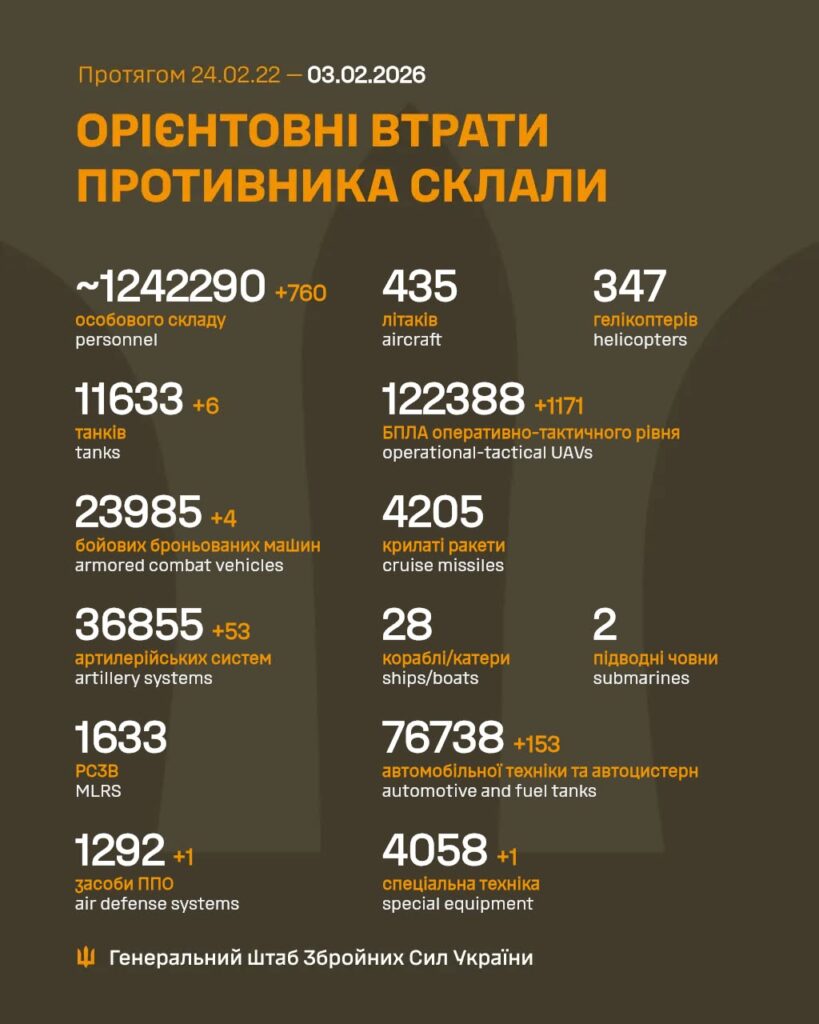
Russian losses 2026-02-03
- 760 KWIA
- 6 Tanks
- 4 AFVs
- 53 Artillery systems
- 1 Air defense system
- 1171 UAVs
- 153 Vehicles and Fuel tanks
- 1 Special equipment
SLAVA UKRAINI


Don't forget to donate, Ukraine's cause is ours! Support Ukraine!


The total decreased further, mainly driven by a lower number of unlocalized (possibly Ukrainian) attacks. Barely one unlocalized attack per three localized (Russian).
N Slobozhansky-Kursk 1
S Slobozhansky 10💥
Kupyansk 6
Lyman 10💥
Slovyansk 12💥
Kramatorsk 1
Kostjantynivka 12💥
Pokrovsk 48💥💥💥↗️
Oleksandrivskij 6
Huliaipole 19💥↘️
Orikhivsk 1
Prydniprovskij/Dnipro 1
Sum sectors 127
Unlocalized 40↘️
Total 167↘️
AFU reports:
219 KAB
3 790 shells (101 from MLRS).
🇺🇦 NATO Secretary General Mark Rutte has arrived in Kyiv for a visit and is currently speaking in the Verkhovna Rada.”
https://bsky.app/profile/maks23.bsky.social/post/3mdx2tkloa22l
“🇺🇦 Zelensky: Maidan Nezalezhnosti. The People’s Memorial of National Remembrance. A memorial honoring our heroes, warriors. Together with Mark Rutte, we honored the memory of fallen Ukrainian defenders today. Eternal honor to our warriors.”
https://bsky.app/profile/maks23.bsky.social/post/3mdx2pg2u6c2l
4/4 Zircon, see comment by K Gregg below.
On the night of February 3, Russia launched a massive air attack targeting Ukraine’s critical infrastructure. The aggressor used 521 air attack assets: 4 Zircon/Oniks missiles, 32 Iskander-M/S-300 ballistic missiles, 7 Kh-22/Kh-32 cruise missiles, 28 Kh-101/Iskander-K cruise missiles, and 450 Shahed-type UAVs.
Ukrainian air defenders shot down:
◾️ 4 Zircon/Oniks missiles
◾️ 11 Iskander-M/S-300 ballistic missiles
◾️ 3 Kh-22/Kh-32 cruise missiles
◾️ 20 Kh-101/Iskander-K cruise missiles
◾️ 412 enemy UAVs
We continue to defend our skies. Stand With Ukraine! 🇺🇦
#UkrainianAirForce #AirDefense
4/4 Zircon
9t: Now Zircon missiles are also coming. What is such a thing?
When Russia is currently firing Zircon at Ukraine, it is not because they need it to win on the front lines. They do it because Kyiv has become something much larger than a city: it is a measurement station in a global war between weapon systems.
Zircon – Russia’s hypersonic prestige weapon – is developed for one purpose: to penetrate the Western world’s air defense. Not in Donetsk. Not in Pokrovsk. But against American aircraft carriers and NATO bases. When it is now used against Ukraine, it is not a sign of desperation, but of experimentation.
Zircon flies at Mach 8-9, at 30-40 kilometers altitude, and then dives almost vertically towards its target. This means that even the most advanced air defense systems – Patriot, SAMP/T, NASAMS – only have seconds to react. In theory, Patriot can shoot it down. In practice, it is a game with margins so small that each firing becomes a lottery.
This is exactly what Russia wants to measure.
When Zircon is fired at Kyiv, Moscow measures how quickly the Patriot systems react, which radar profiles are visible, how many interceptor missiles are required, what gaps arise in the air defense bubble. Each attack is not just a strike – it is a data collection mission.
And this is where the true depth of the war becomes visible.
Russia knows that they cannot break through Ukraine’s defense with Zircon in any operational sense. They are produced in too small series. They are too expensive. They cannot saturate a defense. But they can do something else: they can map how the Western world’s defense functions when pushed to the limit.
Ukraine pays the price in concrete and blood. Russia gets the answers in databases.
Therefore, Zircon is almost always aimed at Kyiv or other high-value targets: government quarters, military headquarters, communication nodes. Not because these must be destroyed at that moment – but because these places are protected by the densest Patriot zones. There, you get the most data per missile.
This is the real air war of 2026.
Not just an attempt to strike Ukraine – but to calibrate future wars against NATO.
At the same time, Ukraine and the West cannot afford to let these attacks pass. Each successful Zircon hit is not just a military damage – it is a political and psychological breakthrough for Russia. That is why Patriot missiles are often fired for millions of dollars against a single incoming Zircon. It is expensive, but the alternative is worse.
And this is where the economic absurdity of the war becomes clear: Russia fires one of its most expensive missiles to force a defense that costs even more to use. It is a strategy of attrition – not in soldiers, but in budgets and stockpiles.
So, Zircon is not just a weapon. It is an instrument in a much larger game: to see how long Ukraine and the West can keep their air defense bubbles tight when each interception costs more than the attacker.
That is why Kyiv today is not just the capital of Ukraine.
It is the front line in a hypersonic war that has not yet officially begun.
🔗 https://www.facebook.com/share/p/1AWn1ggQNd/?mibextid=wwXIfr
3/7 Kh-22
10t: Kh-22 When Russian bombers take off from their bases in the Saratov region and head towards Ukraine, it is not always to strike military targets. Often, it is about something completely different: to inject terror into a society already living under constant aerial warfare. At the center of this stands the Soviet relic Kh-22 – a weapon that has practically become a strategic terror instrument.
Kh-22 is not a modern precision missile. It was designed in the 1960s for a completely different war: a Cold War scenario where Soviet bombers would sink American aircraft carriers with nuclear warheads or massive conventional warheads. The weapon was built to hit large targets on open seas, not to distinguish between residential buildings, hospitals, and transformer stations in a European city.
Yet, this is exactly what Russia is using it for now.
The missiles are fired from the Tu-22M3 bomber, often from Russian airspace. They climb to over 20 kilometers altitude, accelerate to more than four times the speed of sound, and then dive almost vertically towards their target. When a Kh-22 hits, it is not a “hit” in military terms – it is an impact comparable to a tactical bombing raid. Almost a ton of explosives detonates in a matter of milliseconds. A residential building disappears. A shopping center becomes a crater field. A power plant ceases to exist.
The problem is that in practice, Kh-22 does not know where it hits. Its guidance system is based on old inertial navigation and rough radar scanning. It can miss its intended target by hundreds of meters. When Russia still fires it towards densely populated areas, it is not a mistake – it is a method. The weapon’s technical limitation has become part of its political function: maximum physical destruction with minimal precision.
And here, the real logic of war emerges.
Russia uses Kh-22 not despite its lack of precision, but precisely because of it. It creates unpredictable terror. No one knows which house will be next. No one can protect themselves by “not being a target.” It is psychological warfare in its rawest form.
At the same time, the missile is extremely difficult to shoot down. It flies high, fast, and dives steeply. Most air defense systems simply do not have time to react. In practice, only Patriot systems and some European long-range systems have a realistic chance – and these are too few in number to cover the entire country. The result is that almost every Kh-22 fired almost always reaches its target.
That Russia still relies on this 60-year-old weapon in 2025-2026 also says something important about the war’s industrial dimension. The modern precision missiles – Kalibr, Iskander-K, Kh-101 – are expensive, complex, and difficult to produce in large quantities under sanctions. Kh-22, on the other hand, is in stock, technically easy to keep flying, and provides maximum effect per ruble – not militarily, but psychologically.
This is why we see this pattern: when Russia wants to strike against Ukraine’s energy, against major cities, against civilian resilience – that’s when the Kh-22 emerges from the arsenals.
It’s not a sign of strength.
It’s a sign of a system that increasingly relies on terror instead of military precision.
And that’s precisely why these missiles have become one of the clearest indicators of the type of war Russia is actually waging today: a war against society itself, not just against the front line.
🔗https://www.facebook.com/share/p/18EK393ku1/?mibextid=wwXIfr
Visit NATO Secretary-General Rutte.
3t: “Also interesting is the timing of the attack, today Kyiv is visited by the NATO Secretary-General. The relatively small damages after the massive missile attack make Putin’s war machine a laughingstock in the eyes of NATO. We should also not forget the miraculous job done by our air defense and air force. Most of the drones were shot down already at the border, even a bit into Russian territory.”
🔗 https://www.facebook.com/share/p/1FMib2WhAC/?mibextid=wwXIfr
Interesting. Thank you!
Interesting from Gregg, not impossible that it is as he writes.
👍👍👍
“✈️ A powerful air strike on an enemy dugout in the Oleksandrivske direction, within the area of responsibility of the 110th Separate Mechanized Brigade! 💥 The footage shows multiple guided munitions hitting the enemy shelter.”
https://bsky.app/profile/maks23.bsky.social/post/3mdxbfrwwt22g
“Ukraine war latest live: Denmark, Sweden to help Kyiv ‘develop an air defense battalion'”
https://kyivindependent.com/ukraine-war-latest-update-2026-02-03/
“In largest missile attack of winter, Russia targets Ukraine’s power plants amid brutal freeze”
https://kyivindependent.com/russia-launches-mass-attack-across-ukraine-signaling-end-of-energy-ceasefire/
The terror continues. Russia hopes that winter will save them once again. Keeping fingers crossed that Ukraine has a plan to turn off the lights in Russia.
“💥👊”Alpha” SBU set a record for shooting down enemy aircraft-type UAVs The crews of interceptors eliminated 2,220 enemy drones during the year – this is the highest indicator of effectiveness in this segment of air combat.”
https://bsky.app/profile/maks23.bsky.social/post/3mdxnkq26gs2r“
More of that.
Death to the slime monsters 🔥 ⛽️
I recently saw a Tridon.
Felt really good. Send.