
Happy New Year, my year started with a bang where the return trip to the Caribbean became a bit chaotic.
An easy peasy Portugal – stopover – Madrid – Caribbean where, as usual, I had booked everything well in advance and planned down to the smallest detail with a lot of single points of failure.
On January 3rd, I received an SMS that the flight to Portugal was canceled and quickly understood that the problem was Schiphol in Amsterdam, which had been thrown into chaos by 1mm of snow. It apparently is still ongoing and they now seem to have a veritable Armageddon that has also spread to several central airports in Europe because a few snowflakes are swirling in the air.
KLM customer service, as expected, did not work on the weekend, so I had to assume that the trip was doomed and look for alternative solutions.
Meanwhile, a real big-boy snowstorm hits Sweden, affecting trains, roads, and airports – it still seems to be ongoing as the kids were supposed to take the train home from where we live the other day, and there were lots of canceled departures.
The canceled flight was supposed to depart from Linköping, which is closer to us than Arlanda, and since the weather forecast suggested that Arlanda would be snow-free first, I found a ticket from there on the same flight day as the canceled one, but in the evening to give the snowplows some extra time. Now the problem was that I had to get to Arlanda instead, and of course, the first booked train was also canceled. I had a plan B where I thought of driving up to Arlanda and leaving the car, but the gamble with SJ paid off for the first time in the history of the freight train.
The main problem is that we had a separate ticket from Madrid to the Caribbean on January 6th, costing 35,000 SEK and of course was non-changeable since I always live life in the passing lane. I am now seriously considering starting to pay that extra five hundred for changeable tickets as standard procedure after this adventure.
At T-Centralen, we maneuver the snake with suitcases out to the taxi stand, which is a sea of freeloaders and “meter on, brother.” I’m not in Stockholm that often, but I’ve learned the hard way that it means a hefty taxi cost, but Taxi Stockholm has hidden well.
The flight to Lisbon is delayed, so we land around midnight, and my last-minute hotel booking was so-so. I have to cancel previous train, flight, and hotel bookings in Sweden and Lisbon as best I can and am now out of so much money that my account is starting to run low.
The stopover in Portugal is because we have to pick up documents in a small town north of Lisbon, so the next day it’s a bus up, bus down, and late back to the hotel – when I try to relax with a few cold beers from the hotel, they only have Spanish beer brands, isn’t that a high crime in Portugal? I was really looking forward to a Super Bock and not the Spaniards’ radioactive colored water. 😡
The arrival form for the Caribbean, which burned me last time because I missed it, is filled out. The first five hits on Google are identical scam sites that take your money, but the sixth is the immigration page and free – I know because I filled in all the scam sites and paid the last time I was at the airport, but luckily the card didn’t work, and after two hours, they gave me the correct link with a broad smile. The page only crashed four times and took no more than an hour to complete, but I had a lot of Spanish beer, so it went well.
The travel day with a capital D – before we know it, we are cruising across the Atlantic on our way to the Caribbean because the airports have reopened over there after Trump’s kidnapping of Maduro. That was the real cloud of concern, the snowstorm in Sweden was just the runner-up.
Just when I thought the sun was shining on me again, there is, of course, a terrorist attack at the airport just before landing, so we are directed to a new airport that I know is four hours away by car. Before we even land, they had apparently solved the problem (shot everyone?) and we are back a little delayed but the airport is a sea of special forces, so luckily I don’t look like a terrorist.
All’s well that ends well, I now think more than a bit naively before immigration discovers us again with a broad grin – after I proudly showed the arrival form correctly filled out in four copies, they cut to the chase with a “do you have the return trip, show me, brother.”
We have a one-way ticket because we never know when we will fly home half a year later. After trying to rebook a couple of times and finally forgetting about the trip, so I had to buy a new one, it almost feels like a religious revelation when I realize that I can buy one-way tickets instead, and no one ever asks you about the return trip because you look like a dollar burner.
As an honest Swede, I first tried to trick them by quickly showing the inbound trip, and when that didn’t work, I lied that I didn’t have internet access, so I couldn’t show anything, which of course ends with me surrounded by a ring of uniformed and well-armed customs officers having to buy a one-way ticket to Miami at the end of January if I don’t want to be deported – not very welcoming at all to that tourist destination, in Hawaii, you get a flower wreath, and here it’s aggressively waving with a Kalashnikov. 😐
I have never had a whole chain that has completely collapsed multiple times before, when we arrived at the apartment, I immediately got a six-pack of Stella to calm down, and by the fifth beer, much to my wife’s great relief, I gave up obsessing about being pursued by some kind of biblical disaster and accepted that it was the weather and Trump’s fault.
Now, as you are starting to be disappointed that this has turned into a five-star travel blog, let’s go back to the Ukraine war and the associated global escalation where Donald Trump has just gone full dictator. I will try to clarify the concepts so that you end up in the right place and can beat up Lunchroom Jesus again, who is now starting to smell the morning air as he thinks everyone has forgotten the humiliation you caused him last fall.
In fact, in the winter of 2024, I wrote a post about Trump possibly becoming a dictator, which I didn’t believe myself, but received many comments proclaiming it the most important thing I had written – I say like Stefan Löfven, we have been naive, especially MXT.
I believe that the USA has now begun an active defense of the petrodollar, where Venezuela was part of it and in order to make a strong statement against China and Russia. Trump has also been up to something in Nigeria, now it’s Iran’s turn (again), and he has sent the fleet back to the Panama Canal (again).
I saw that the dollar strengthened after Maduro was kidnapped – the world is really strange, and we are now back to a reality where the most firepower wins. Low-intensity response never worked against the gangs in Sweden, so we already knew that, but now it’s global that if you can’t defend yourself, you risk being overrun and having your country plundered without anyone caring – the international legal order has at least started to lean considerably.
Venezuela is not a shining democracy that has been violated, Maduro is a full-fledged dictator and just the fact that his bodyguard was Cuban should tell you all you need to know.
But that doesn’t give Trump the right, for a gratification to the family, to be a president for sale and then use the military as a judge when it suits him.
We may not like the damn Danes, but we don’t let our corvettes bombard the crooked, draughty houses in Copenhagen with their 57mm for that, and then kidnap Mette for a perp-walk along Vasagatan.
Probably it is in Putin’s interest for Trump to turn to the dark side and become a Sith. A bit like the Emperor’s constant attempts to corrupt Luke – if the USA realizes they can start doing as they please, and they do, then life becomes easier for Russia and China to do as they please.
One might guess that the USA bribed and promised favors so that key individuals did not give the order to open fire?
If the Venezuelan military had shown up in its entirety, it wouldn’t have gone so smoothly like this, and instead it would have been a hunt for Maduro, similar to Saddam, presumably with accompanying American losses.
+30 fallen Cubans right in the middle of a Venezuelan military base full of Venezuelan soldiers is also interesting – why were there no casualties from Venezuela?
What we do know, in any case, is that there is much we do not know.
Apparently, the USA fired off an EMP – that is interesting and something Europe should take note of because if you can disable an entire air defense with a couple of EMPs, you’ve practically won the first battle.
I wonder if they did the same with Iran last time, they talk about EW but maybe they actually fired EMPs?
Worth looking into.
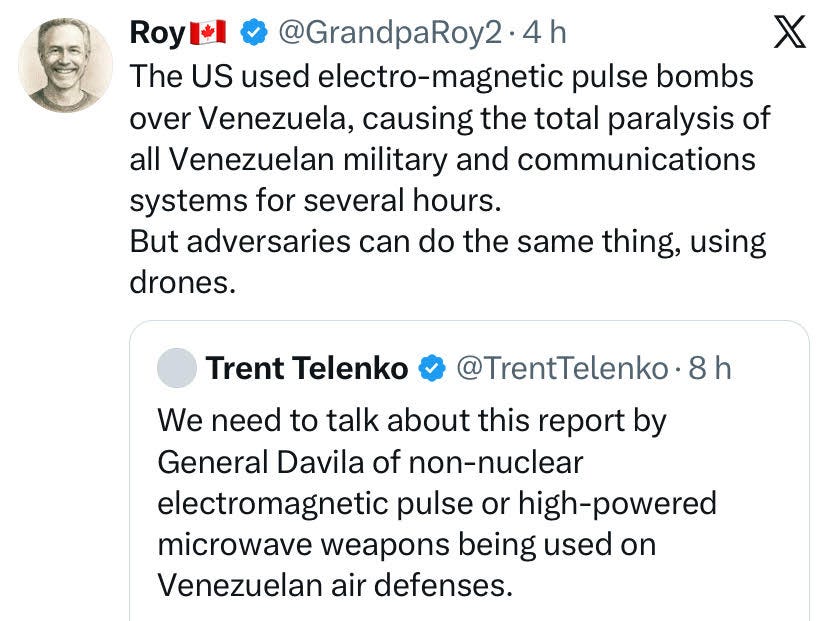
Something that supports the idea that there were bribes and promises behind it is that Venezuela had a lot of MANPADS and about twenty low-flying helicopters are easy targets, but only a few were fired.
The military should reasonably have been on high alert, especially at an army base?
Now it will probably become politically uncertain, and various groups are considering how they can seize power – a high risk that the country will be further destabilized if we go by the USA’s previous attempts at democratization that haven’t gone so well.
Trump is obviously lying so he becomes even more orange in the face about the reason for the raid – the reason was to threaten their way to Venezuela’s natural resources, exactly as the USA has been doing since the 60s and up to the Iraq wars.
The whole of South America is collectively sighing with recognition right now, and everyone over 60 is getting acute anxiety when they remember the unpainted blood-stained concrete walls in the interrogation rooms and the waterboarding.
Absolutely rule-breaking, unethical, pitch-black, and everything else that we really didn’t need now that Russia and China have started with it.
But the USA has made a strategic move that is very good for the USA – it’s hard to get away from, no matter how frustrated you are with the USA and Trump.
My guess, which I’ve been airing for a while, is that the USA, China, and Russia have divided the world among themselves. This doesn’t mean they are all in agreement, just that they have each chosen geographical areas of interest that the other two have promised not to go to war over.
Trump has already been very clear that Russia can have Ukraine and that China can have Taiwan, and evidently China and Russia did not go to war over Venezuela.
Venezuela was not just any country – it was a country in the USA’s backyard where China and Russia had built up a lot of capability and which has the world’s largest oil reserves – high strategic value.
The troika will still have harsh rhetoric towards each other that is just hot air, and then give each other a pinch where they get away with it to maintain the myth of a great threat.
All of this together allows them to go to the voters in each country and proclaim war laws and sacrifices that give them greater power.
In the midst of all this stands the EU, and what you are now seeing from Trump is an attempt to bully the EU into silence. It is truly transparent, and Europe has gradually begun to realize it.
But it doesn’t end there – the USA has initiated a major build-up of capabilities in Europe and MENA, which should mean further efforts.
Nobel Peace Prize, peace president, and the constant “I want to end the war in Ukraine and FREED” from Trump vs. starting new wars in parallel certainly chips away at credibility a bit.
The FIFA Peace Prize apparently means nothing, hypocrites…
Trump’s negotiations about Ukraine are war tactics, and he’s playing on Team Red – that’s how it stands.
Probably it will be Iran that will be targeted, and the citizens there seem ready to get rid of the Islamist rule of the mullahs – that’s good.
But the USA should obviously stay out of it.
No sitting dictator or other elected official can survive a full popular uprising – the citizens can handle this themselves as long as they feel they have the support of the international community, even though all revolutions have a third party backing them up in secret. A bit like short sellers in the stock market – if the sitting regime is so hated, it’s easy to bring them down by pulling a few strings, and there’s always someone who wants you gone. Vultures are also an important part of the ecosystem.
The reason it failed in Belarus was that Russia sent in massive internal troops that quashed the people’s celebration, and the same happened in Georgia.
In Venezuela, Maduro had Wagner, Hezbollah, Iran’s Revolutionary Guard, and many other guns for hire, so one could argue that the USA intervened when everyone else was already there. BUT it wasn’t for democracy and light that Trump kidnapped Maduro, it was to be able to plunder Venezuela for oil.
You have to hold two thoughts in your head at the same time, and that’s what the scripture says happened – amen.
Another thing we have also predicted is that the USA will make various moves that are good for them and not so good for all their Western allies.
They have done everything they can that is good for Russia while at the same time undermining us in Europe, which is absolutely astonishing, but they have also bowed to China with the tariffs where we got a worse deal and more threats than they did, I remember, don’t remember all the twists if I’m honest, and then all the smoke laid to confuse.
Probably the recession will come in 2026, and China, Russia, the USA will try to push it over to Europe with a Russian black swan – that’s how I think they reason because anything else would be a dereliction of duty when Europe has shown itself to have great difficulty in parrying and making counter moves.
Now it seems that the Russian operation to turn off the lights in Europe has started at least, and it’s easy to understand why they started with Germany because Merz has become an angry German chancellor who is now casting glances eastward.
When did left-wing extremists last sabotage electricity infrastructure in Europe?
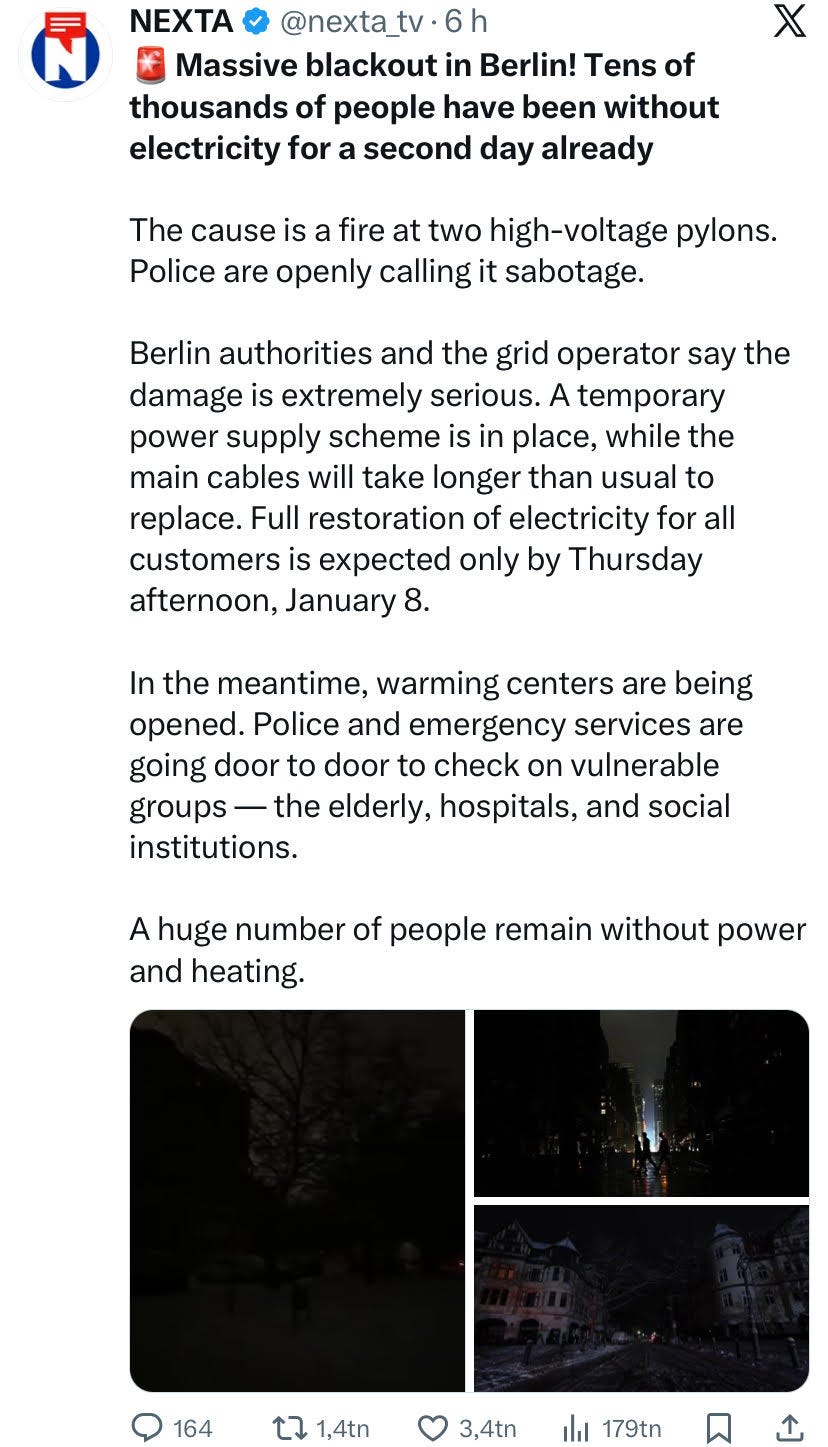
Blaming Russia for the snowstorm might be a stretch, but the power outages conveniently occurred just as it got colder and snowier. I’ve suspected major IT issues in the background while dealing with all my rescheduling.
Our European leaders are elected with not-so-strong mandates and an opposition always ready to stab them in the back.
Russia has paid politicians, parties, and extremist groups that they activate at the right moments, and they threaten and do not hesitate to commit murder.
Employees at Belgian Euroclear were threatened not to release the frozen Russian funds to Ukraine – it was so sensitive to Russia that they increased the pressure, and the arrogant Belgians caved in immediately.
Even Belgian politicians folded like a house of cards, and I think there should actually be a post-discussion because Russia threatened that a country in the EU sabotaged an important decision by going after individuals in the country directly.
Just like the scenario I often talk about where gangs in Sweden could act for payment from Russia, or where your partner receives direct payments into their newly established company, a million per lecture once a month, and the Tax Agency only cares that you pay taxes, then everyone is happy.
So right I was, again… 😶
All politicians, key personnel, and important officials have a family, children, a house, and quite a few would probably feel that 10 million SEK would be a big boost even after the Tax Agency has taken its share – that’s how Russia has managed to lock us in for almost four years now.
Belgium doing Russia’s bidding is very worrying, but no one likes a hairy Belgian, that’s an old saying.
Trump is also trying to bully us into silence – this time it’s Macron who’s taking a hit.
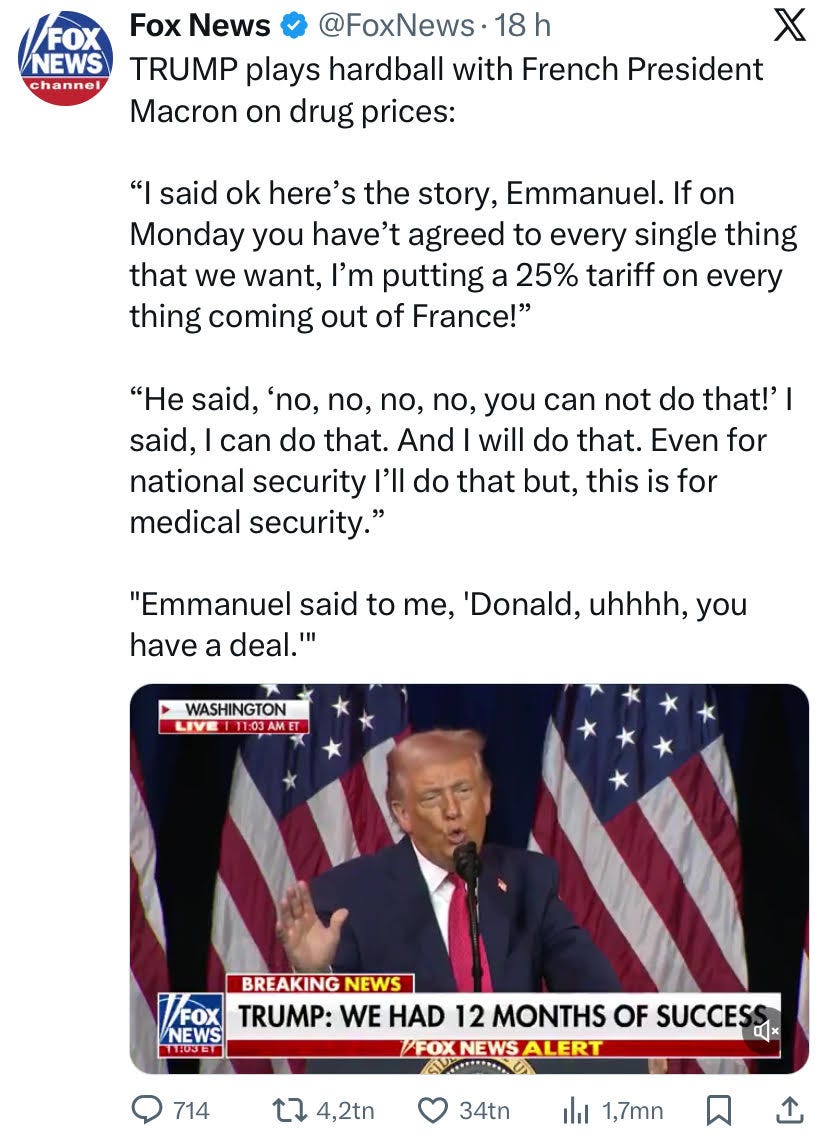
Trump is part of Russia’s influence operation against Europe.
However, despite all this, several leaders in Europe have now found their inner Viking – Merz recently came out in a way only a German can and promised that Europe will rise. Let’s pray to the gods that he means it in the right way because Germany has a long tradition of suddenly capsizing and starting to consider how to execute as many people as possible with new untested technology.
Macron has seriously upset Trump, so he’s probably doing the right thing too, it might have something to do with the truce with his wife.
The Vikings in the north already had their inner Viking in place and they collaborate with all others who have found their inner Viking, and we are right on track – Sweden, Finland, and Denmark are leading the way as Vikings.
My conclusion is that Trump will increase his efforts against us to try to pacify us, Greenland is a suitable example, if he can start a big fight over Greenland, it will shift the focus from Ukraine.
More trade wars, he’s threatening Macron with more trade tariffs anyway?
And direct attacks on politicians like Starmer, Macron, and Merz?
Now that troika has just signed a very tough agreement with Zelensky, so that should be interesting 😀
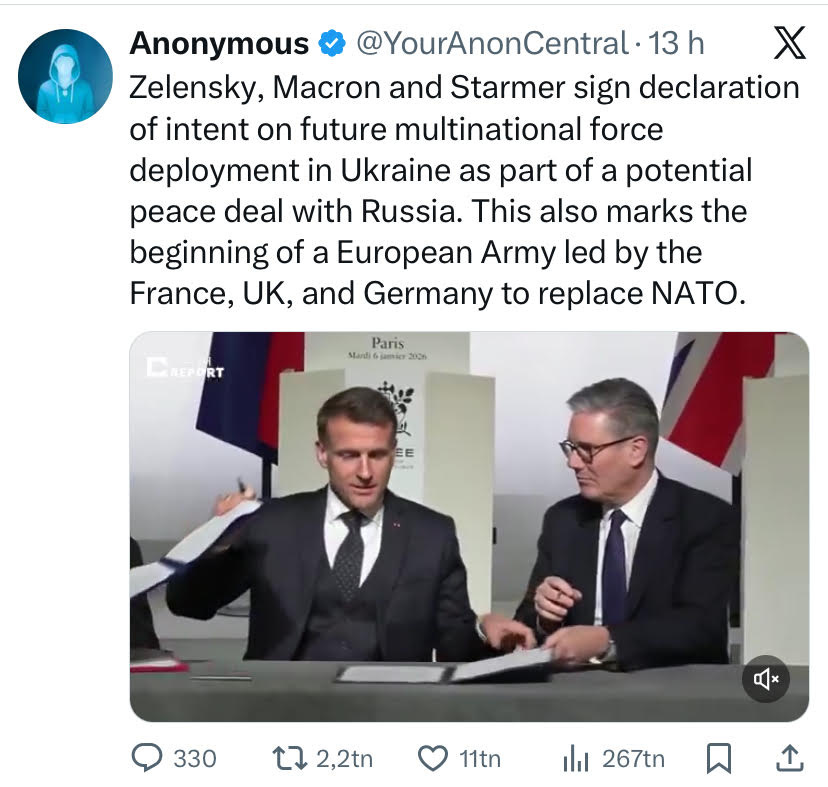
If you, like me, have been following this, you’ll remember how Trump accused us of not doing enough for Ukraine and that we should pay for our own weapons. Now that we are doing it, he’s even more upset, which says everything you need to know about his loyalties.
There’s a lot happening right now, so the war in Ukraine is almost fading into the background, but for the observant, Ukraine continues its series of counteroffensives and it’s going extremely well – the war is won unless Europe allows itself to be talked out of it. Show me who can push back against a German who has found his inner Prussian together with a Frenchman with a Napoleon complex and a Japanese person sniffing out national revival and sharpening samurai swords.
I have a big worry cloud in my otherwise gray, rain-laden sky – that Europe chooses the easy way out and takes Africa in exchange for leaving the USA, China, and Russia alone. I’m not sure if that option exists, but it would make everything much easier for us.
Easier but not right, then we would also have become a Sith, and right now the world needs a force for good as the dark side grows stronger. Europe is currently the rebel base on Hoth, and Macron’s wife is a Hoth wampa.
A conclusion, not entirely clear to me, has struck me like lightning, and that is that the problems we have in Europe are also the guarantee that we will not turn into a full dictatorship – fragile democracy is the last barrier against dictatorship, and we’ll see if the dams hold.
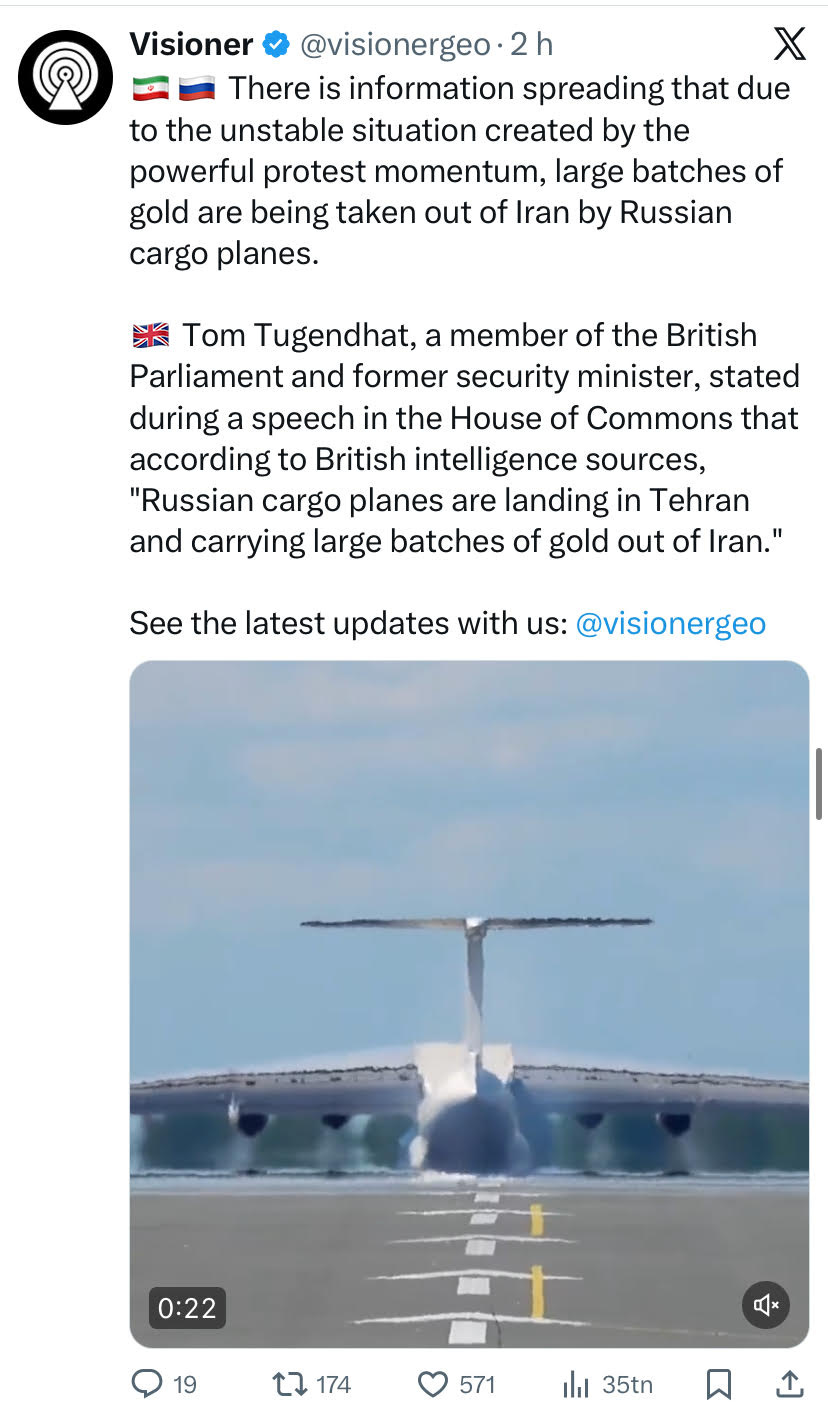
Iran is otherwise very exciting because it’s starting to gain momentum seriously, and transport flights from Russia and China are landing in a streamlined manner.
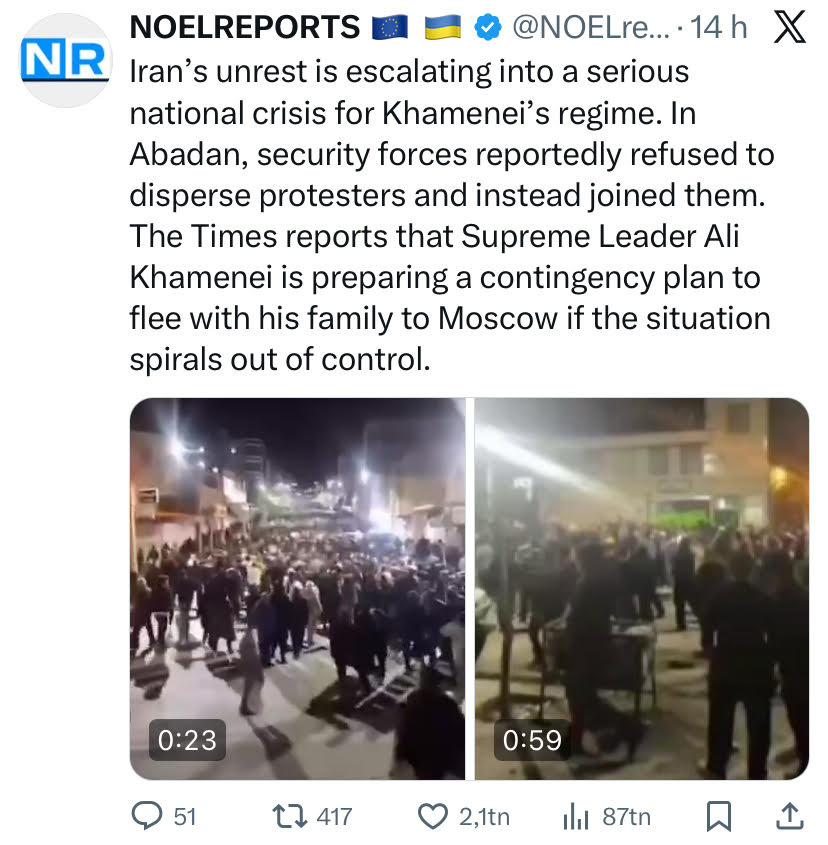
It even seems like they are moving the gold to Russia – did they fall for the easy trick.
Russia and China’s investment in Venezuela is probably hundreds of billions of dollars that have now gone up in smoke – good, and the same could happen in Iran, even better.
Yes, I’m a bit jaded and don’t believe that the USA is about to dismantle the axis of evil at all – it’s all for show to try to get Europe to remain passive.
Ukraine is still the linchpin preventing this from spiraling out of control, and we will delve into the battlefields in the next post.
Also, don’t forget to subscribe to a paid subscription – it’s very good for the environment, and by contributing 80 SEK per month, you can prevent sea levels from rising, which can be considered a reasonable price for so much goodness.
Since it’s about saving the environment, there may be compelling measures ahead if environmental interest proves to be too weak – we simply must protect the environment.
Since I complained about the electricity prices all last year, I have to admit that the average price for December was a godsend, and the electricity bill was quite manageable – hats off.
It’s been a bit of a low season over Christmas and then the trauma of the trip, but next week we should be back to normal with a few posts per week again.
Lunchroom Jesus is blissfully unaware of what’s to come, a real hammer blow that you will be able to use, again.


Don't forget to donate, Ukraine's cause is ours! Support Ukraine!


When it comes to Venezuela, I initially swallowed the bait and thought it was wrong, etc. Once I gained some perspective and realized that those who scream the loudest are, ryz, China, Iran, Cuba, and North Korea, I start to waver. Is Maduro-gate actually a good thing, if the USA punctures “the evil ones” investments in the country, then it should be good. Then you can always talk endlessly about world order and the Monroe Doctrine, but in the end, it’s probably only us in the West who care about this, because for “the evil ones” it’s only important that we meet all the requirements while they can behave as they please.
There is a lot of war, poverty, and corruption in Africa.
I think that Europe should step in and take over countries where they believe it will get better.
We will manage them with European administration 👍
We can also provide transportation for the unemployed to agriculture in Europe so they have jobs, and to prevent drowning accidents on the boats, we chain them up
The traitor Donald’s clear statement about taking over Greenland may have more reasons than just preventing Russia or China from taking the island, which according to the liar himself is the reason why the US must own the island. The traitor also says that it is MENTALLY important for him to own Greenland, it is not enough to have virtually unlimited defense capabilities in cooperation with Denmark and the existing agreements. The demented man himself thus confirms that he is in need of a psychologist!
He has previously announced his desire for Canada to also belong to the US. Canada is a loyal ally in NATO for the rest of us, a reason for seizing Greenland could be to drive a wedge between Canada and Europe to then, in the next steps, perhaps within a year, also take over Canada. Then he will have control over all of North America just as he has expressed he wants. Panama will likely be targeted before that, as well as Colombia, the warships are already in place following the attack on Venezuela.
I would imagine that the People and Defense Conference in Sälen starting tomorrow will have no trouble filling the agenda.
Donald has the same pure power ambitions as Putin
Great to see that you’re back at work again so you have time to paint yellow walls! 👍👍👍
Today’s post was a kickstart, not just a yellow wall but more like a yellow road, almost as if taken from the Wizard of Oz!
I wrote that book too, how did you know that 😳
Russian losses in Ukraine 2025-01-10
SLAVA UKRAINI
AFU reports:
“🛢️📉 Russia’s crude oil production in December dropped to its lowest level in the past year and a half, reaching 9.326 million barrels per day. By the end of December, more than 185 million barrels of Russian crude were stored in tankers. Read more 👀”
https://bsky.app/profile/theukrainianreview.bsky.social/post/3mc2ppaxsk22g
https://theukrainianreview.info/russias-oil-production-falls-to-an-18-month-low/
Isn’t it time to put a stop to the rust heaps?
“No flag No insurance No problem! Rustbucket zombie-tanker ARCUSAT/TAVIAN/TIA will enter Baltics in ~3 days. This will be her third fetch of Russian oil since October. No flag, no state, no identity and no registry -> she is basically lawless. Some would even argue states have obligations here.” https://bsky.app/profile/auonsson.bsky.social/post/3mbzp36hk6s2o
“From zombie tankers to fake IMO numbers: the identity frauds now playing out at sea”
https://www.lloydslist.com/LL1155512/From-zombie-tankers-to-fake-IMO-numbers-the-identity-frauds-now-playing-out-at-sea
The USA does what we in Europe could not do.
“🇮🇷 Protests in Iran gaining momentum. A key difference from previous protests is the availability of satellite internet, more weapons, and greater organization.”
https://bsky.app/profile/maks23.bsky.social/post/3mc2oq75wf22g
I think the country is falling this time
The Arctic could become a problem. In the USA, only Alaska has a coastline along the Arctic Ocean. Russia has the upper hand here. Even Norway (with Svalbard) faces the Arctic. But Canada and Greenland have long coastlines along the Arctic Ocean… 🤠🫣
And here there is oil. China is completely offside here but compensates by sending large fishing vessels and polar research vessels there. The ice is melting rapidly in the Arctic Ocean now and soon it will be time to start drilling. China is most interested in flexing its muscles but there is a great need to hunt for proteins for its large population. The South China Sea is soon to be completely devoid of fish. So it is probably oil that drives Trump’s interest in Greenland (and Canada).
Partial response to Johan’s nice post.
Good that you bring up the issue of fishing, not something one thinks much about but the oceans are starting to struggle to meet the needs and besides searching for new areas, people have also gone deeper.
Canada was probably on the verge of completely ruining the fishing for several years, but after strict regulations, they managed to help the fish stock recover (faster than one dared to hope for).
China seems to have no inhibitions at all, which they have received a lot of criticism for (among other things from environmental movements, which some try to blame for not protesting against Russia and China). There is a risk that they will completely deplete the oceans if left unchecked.
If the USA were to take over Greenland, it might be a positive side effect that China is forced out, on the other hand, the USA has started to dismantle everything related to the environment, not certain it will be better.
Good travelogue ⭐️⭐️⭐️⭐️⭐️
The rest is Hypocrisy!
“But that doesn’t give Trump the right to, for a gratification to the family, be a president for sale and then use the military as a judge when it suits him.”
What right?
By what right did the Allies land in Normandy and “judge” in Vichy-controlled France? We barely had the UN/FN back then. But Maduro’s regime, supported by Russia, had the same legitimacy as the then Vichy government, or as the Danish occupation government which also fell in the aftermath of the military intervention in Europe led by external nations, which, according to your, MXT’s and many others’ reasoning, completely lacked legal basis.
And which international right and legal authority are you referring to today? The Security Council, where Russia and China can veto?
And here…
Reports: Over 200 dead in Iran
Protests against Iran’s regime continue in the country. The newspaper Time has been in contact with an anonymous doctor in Tehran, who says that 217 dead protesters have been confirmed in six different hospitals in the capital. Most are said to have been killed by live ammunition according to the doctor.
The number of casualties has not been verified. Human rights groups have previously reported around 50 civilian deaths during the protests in the country.
…you sit, MXT and others, with your pants halfway down and hope that Trump will militarily intervene?
As I said, Hypocrisy!
Good that you speak up when you disagree! 👍👍👍
I understand your point of view but I believe I have been clear about why I hold the position I do, but maybe I need to elaborate further. I’ll get back if I come up with a better way to explain it.
(By the way, I think there is a certain difference between sending troops to help a country attacked by an external enemy, compared to when it’s internal conflicts.)
The problem is that for there to be an “international law,” there must be institutions that uphold it. Just as the government in a country is tasked with ensuring that laws are enforced. Such a thing does not exist. Has never existed.
Feel free to refer to the Cold War, but then I mention Lech Walesa, the Prague Spring, etc. It did not provide protection. It was the law of the jungle.
The order after that was the USA as the world’s policeman: Former Yugoslavia, Libya, Iraq, the Philippines, and more or less the European countries in the former Eastern Bloc (Warsaw Pact) during the Cold War: Poland, the Baltics, and others. Also the law of the jungle. Russia was weakened.
Everything would have been considerably easier if the UN worked as imagined from the beginning. Despite that, there are still agreements, etc. that many countries have agreed to follow.
And one of the agreements is Responsibility to Protect (R2P) which clearly places a responsibility on all(!) countries to intervene if a country does not protect its own citizens.
Meaning of R2P
According to the principle of R2P, all sovereign states have a duty to protect their own population from genocide, war crimes, ethnic cleansing, and crimes against humanity, and to take necessary measures to prevent such crimes. When a population is subjected to severe suffering, and the state in question does not want or cannot stop the suffering, the responsibility to protect falls on the international community. R2P consists of three elements; the responsibility to prevent, the responsibility to react, and the responsibility to rebuild. (UN).
Neither the government of Venezuela, Iran, nor for that matter Russia are protected by any international laws or agreements. According to R2P, it is the opposite. They have become the target of R2P.
Yes, a rule of law state can hardly exist without a monopoly on violence. Difficult to translate into international relations. The UN has never had a monopoly on violence, not even a mandate for it.
The USA does not have a monopoly on violence and is a rule of law. On the contrary, the authors of the US Constitution argue that the right to bear arms is in the interest of a free state.
Through its constitution, the USA has a population that has the right to bear arms that collectively can defend itself against a dysfunctional state or external enemy.
This can be transferred internationally. R2P does not assume that the UN has a monopoly on violence but that the international community acts/reacts to uphold international law/R2P. Thus, acting collectively.
“🇫🇷🇺🇦 Macron has discussed the deployment of around 10,000 soldiers to Ukraine as part of a European security guarantee, – Les Echos. During a closed meeting, he discussed with his party colleagues the deployment of two brigades as part of a multinational force.”
Too little
“Trump sees Putin as an obstacle to peace and is reportedly “tired of his games,” according to The Telegraph. His recent support for seizing a Russian oil tanker and backing tougher sanctions was meant as a warning. A source close to Trump said, “He’s out of carrots. Only the stick is left.””
Hot air
“Protests raged through the night in Iran. Crowds reportedly torched the Al-Rasul mosque in Tehran, a symbol of the Islamic regime, and set fire to the municipal building in Karaj. Public anger is exploding as the crackdown gets bloodier, and more are calling for the regime to fall.”
https://bsky.app/profile/noelreports.com/post/3mc2qehldys2t
https://bsky.app/profile/theukrainianreview.bsky.social/post/3mc2qaspfc22g
“Ukraine faced another drone and missile attack overnight. Russia launched 121 attack UAVs and an Iskander-M ballistic missile. Air defense shot down or suppressed 94 drones, mostly Shaheds, across the north, south, and east. At least 15 locations were hit.”
https://bsky.app/profile/noelreports.com/post/3mc2pzkaehk2t
205 and Maggan – the Cold War was the USA and the Soviet Union dividing the world, suppressing Europe, and having proxy war arenas.
Roosevelt gave Eastern Europe to the Soviet Union despite Churchill’s protests, and the USA had its heyday during the Cold War.
The USA has clearly shown that they want to return there, so it’s quite difficult to see why we should support such a development?
Under Biden, the USA betrayed Ukraine, and under Trump, it’s even worse – the USA is NOT our friend.
Venezuela is just an American land grab, just like Greenland is, and as Colombia will become.
If the USA were our friend, the Ukraine war would have been over by 2022 when the entire VDV was trapped west of the Dnieper, but the USA stopped that victory.
We are heading towards a global conflict, and the risk that even Europe will join in is probably higher than we realize, but we should probably keep the conflicts separate.
I think Africa is poor, with wars and dictatorships – do you think Europe should go in there and straighten things out a bit?
Once we have taken over, maybe we can offer the workforce transportation?
Is it dangerous to drown, so to protect them, do we chain them to the galley?
The USA in South America AGAIN is 100% a crappy idea.
Now, the fact that the USA is doing things that are very good for them is another story, and now it’s probably only MXT left who doesn’t want to believe that it’s true.
The Era of the Cold War, the USA’s heyday.
It is Europe that has castrated itself that is the problem. The law of the jungle has always applied. Despite the lessons of World War II and that Roosevelt ran over Europe and let the Soviet Union take over Eastern Europe (Lex Cold War), we let the USA act as the world’s police after the end of the Cold War without a hint of building up our own military. Instead, we surrendered to becoming economically dependent on Daddy Russia. The USA grew tired of Europe long before Trump. Not so much because Europe whored itself out to Russia, but more because the USA was not allowed to be our pimp, as during the Cold War.
Admittedly, there was a time in 1939 and in the 17th century when Europe did not castrate itself, and the risk of us getting there exists.
If the USA had been on our side, Ukraine would have won in 2022.
Now in 2025 ONLY because Ukraine refused to give up, Europe has gotten its act together – that’s good.
We will crush Russia, Belarus will fall, and Kaliningrad will be demilitarized – we will get there.
We will probably help the USA in their war against China, but not existentially and not on our territory.
We shall have fair agreements with Africa.
Just like with the economy, it is never new and old crashes always repeat themselves, but we do not need to be completely blinded by speed, and right now things are clearing up significantly around Ukraine.
The USA WANTED us to be dependent on them and buy security at five times the market price – that’s why they gave Eastern Europe to the Soviet Union.
If the USA had wanted what’s best for us, wouldn’t they have allowed the Gripen to go to Ukraine in 2023 and not waved around contracts?
When will the USA stop because now it’s Cuba and Colombia’s turn, and then Mexico, do you think the rest of South America will bend like a reed or stand up against the USA?
The USA will get everything they want in South America now after this show of power, and that’s good for the USA.
“do you think the rest of South America will fold like a blade of grass or stand up against the USA?”
Not if Europe steps up and such efforts have just yielded results:
Breaking News: The EU agreed to a sweeping trade pact with four South American countries that would create one of the largest free-trade zones in the world.
https://www.nytimes.com/2026/01/09/business/economy/european-union-mercosur-trade.html
There is a certain difference between South and Central America today and 50 years ago. Back then, the Monroe Doctrine showed its true face with military dictatorships appointed by the USA/CIA.
Today, there are democracies, albeit with varying quality, but the development is moving forward. Especially in Costa Rica and Uruguay. Venezuela is the exception, along with a couple of countries in Central America. Venezuela was “low-hanging fruit” for Trump. Dealing with the others will be a challenging task.
👍
Considering all the countries falling like ninepins now – isn’t it soon Belarus’ turn?
Do you think there could be a streamlining of toppled dictatorships instead of world wars?
Is the Mercosur agreement good or bad?
Cheaper bananas🍌
Iran will fall 🤩🤩
👀 Ukraine hit a key Russian fuel hub overnight.
A targeted drone strike struck the Zhutovska oil depot in Russia’s Volgograd region — a site used to supply Russian troops fighting in Ukraine, the General Staff says.
https://bsky.app/profile/united24media.com/post/3mc3cjf4dng2j
🧵 Thread: Greenland Will NOT Be Bought — Not by Denmark. Not by the U.S. 🇬🇱🔥
Follow & RT — this is global resistance. 👇
1/ 🇬🇱 “We do not want to be Americans. We do not want to be Danes. We want to be Greenlanders.”
All five political parties in Greenland’s parliament united to throw down at Trump’s imperial threats. Every. Single. One.
https://x.com/anno1540/status/2010037617723625712?s=46
Interesting and sounds in line with Johan’s. Is it just speculation or is there substance?
The same week Donald Trump bragged that Vladimir Putin “fears the United States of America as led by me” but not Europe, the Russian president tried to prove exactly why Europe matters.
Moscow lobbed the nuclear-capable Oreshnik at western Ukraine—close enough to the Polish border that Europeans could have heard the sonic boom if they stepped outside. In Kyiv, Russian drones and missiles spent the night turning apartment blocks into iceboxes just as a blizzard arrived, cutting heat and light for hundreds of thousands of people.
Thanks for reading! Subscribe for free to receive new posts and support my work.
Subscribe
Trump, meanwhile, was pitching oil executives on a $100 billion “New Deal” for Venezuela, musing about taking Greenland “whether they like it or not,” scolding defense contractors—and assuring everyone that snatching Putin the way he snatched Nicolás Maduro “won’t be necessary.”
If you looked only at the cinematic pieces—the hypersonics, the commando raid on Caracas, the U.S. Coast Guard seizing Russian-linked tankers—you could think this war is about which leader does something wild on Wednesday. You’d miss the machinery in the background—the treaties, contracts, and committees that decide who wins. The real contest is missiles versus memos—whether the institutions of power can outlast two men who’d rather rule by spectacle than law.
The Missile and the Memo
Russia’s Oreshnik missile sounds like something dreamed up in a Pentagon PowerPoint: an intermediate-range, nuclear-capable ballistic missile marketed as state-of-the-art. The marketing department clearly won that fight.
It has now been used in combat twice. The first time, in 2024, it hit central Ukraine with dummy warheads—a live-fire demonstration, a warning dressed up as a test. The second was this week, when Moscow fired one from its Kapustin Yar test site toward Lviv oblast, roughly forty miles from the European Union’s border.
According to Ukrainian officials, it punched through a couple of floors, burned up an archive in a basement, and looked more like an expensive jackhammer than the end of the world.
So why fire it?
Officially, the Defense Ministry called the strike payback for a supposed Ukrainian drone attack on one of Putin’s residences in late December. Western intelligence agencies and Kyiv agree the drone strike never happened, which means the Kremlin used a flagship system to answer a threat it invented.
Oreshnik isn’t primarily aimed at Ukrainian archives. It’s aimed at European and American nerves.
Just days before the missile flew, U.S., Ukrainian, and mostly European officials met in Paris to talk through long-term security guarantees for Ukraine. Moscow’s response was to underline the threat in red pen: If you put boots on this map, we remind you we have missiles that can reach every capital on it. It was a missile as a memo, and like most passive-aggressive office emails, it advertised how nervous the sender really is.
For Putin, the spectacle—a nuclear-capable arc on a radar screen—has to substitute for Europeans quietly turning promises into written obligations.
The Paris Paper Wall
Which brings us to the Paris Declaration, and the part of this story that actually keeps Putin up at night.
Representatives of the United States, Ukraine, and a 35-nation “Coalition of the Willing” gathered in Paris to do something un-cinematic: draft Western security guarantees for Ukraine once the shooting stops.
The resulting document is not NATO membership, but in some ways it’s more immediately intrusive. It commits signatories to long-term military support for Ukraine and to aiding it if Russia attacks again—short of NATO’s Article 5, but closer to it than Putin ever wanted. It envisions a multinational European force physically stationed in Ukraine after a ceasefire, not just in rhetoric but on Ukrainian soil.
On the U.S. side, the cast of characters is not just the usual diplomats: Trump’s special envoy Steve Witkoff, his son-in-law Jared Kushner, and NATO’s Supreme Allied Commander Europe, U.S. Air Force General Alexus Grynkewich.
Whatever else one thinks of the administration, it’s hard to dismiss a process when the president’s closest political and military lieutenants are in the room.
Zelenskyy has described the agreement on bilateral security arrangements between Ukraine and the U.S. as “essentially ready” for Trump’s signature.
And yet, nothing is settled.
Back in Kyiv, Zelenskyy says not one European leader has given him a simple, unambiguous commitment that their soldiers will fight for Ukraine if Russia comes back. Without legally binding guarantees—ratified by parliaments, backed by Congress—he knows a future Russian offensive could be met with a flurry of statements instead of airstrikes on Russian tanks.
The Kremlin understands that difference intuitively. That’s why Russian officials exploded over the Paris Declaration, branded any future multinational force “legitimate targets,” and then, just to underline the point, fired an Oreshnik at western Ukraine while blaming a non-existent drone strike on Putin’s dacha.
You don’t scream about a piece of paper you consider meaningless—especially when that paper might soon be embossed, filed, and backed by brigades. The Kremlin knows the real danger isn’t a press conference; it’s a ratified obligation. Paris is where signatures begin to look dangerous.
Kyiv: Missiles, Drones, and a Weaponized Winter
If the Oreshnik strike was about scaring Brussels and Washington, the rest of the week’s barrage was aimed squarely at Ukrainian civilians.
Over one night, Russia launched another massive combined strike: ballistic missiles from Russia’s Bryansk region, Kalibr cruise missiles from the Black Sea, and wave after wave of Shahed-type drones from multiple directions, including occupied Crimea and the Russian mainland. Ukrainian air defenses shot down the vast majority of them—well over two hundred drones and the bulk of the missiles—but “most” is not a comforting statistic when you live under one of the exceptions.
The exceptions hit hard.
Kyiv woke up to four dead and at least twenty-five wounded. Rescue workers who rushed to the scene of one strike on a residential building were hit by a second in the classic “double tap” tactic, on the theory that even war crimes should have a house style. An ambulance was shredded in the blast.
Drones damaged the Qatari Embassy in the capital. Qatar, which has been quietly mediating prisoner exchanges, expressed regret and noted that no one was injured. It was a small, diplomatic version of the larger Ukrainian message: we will keep talking even while you keep bombing.
Farther south, in Odesa oblast, Russian drones struck port infrastructure and two foreign-flagged cargo ships. On one of the ships, a Syrian crew member was killed. Ukraine’s deputy prime minister described the attacks as another attempt to target civilian shipping and food routes—Russia’s latest effort to turn the Black Sea into a private toll road while complaining about “piracy” whenever Ukraine fights back.
At the same time, a deep winter storm swept across Ukraine. In Kyiv, missiles and weather together left roughly half the city’s apartments without heat and water. With temperatures dropping toward negative twenty degrees Celsius, Mayor Vitali Klitschko urged residents who could leave the capital for warmer, powered places to do so temporarily and begged people to stay off the roads.
President Volodymyr Zelenskyy, wary of giving Russians propaganda footage of a “fleeing” capital, pushed a different line—stay, work, fix the city, don’t give Putin the satisfaction. The mayor has to worry about pipes; the president has to worry about the picture.
It’s a snapshot of Putin’s war: missiles, drones, and a weaponized winter crashing into a city whose survival still depends on the quiet work of utility crews, budget lines, and donor commitments.
A Front That Bleeds but Barely Moves
While missiles rained down and snow piled up, the front lines barely moved.
In the east, Russian forces continued pushing in multiple directions, but especially in the Pokrovsk sector, where Ukrainian commanders report roughly fifty combat engagements a day. The pattern is tedious and lethal: small-group infiltrations, a flag on the edge of town for Telegram, and then Ukrainian counterfires knocking it all back down.
Geolocated footage shows this in miniature. In northern Pokrovsk, Russian soldiers appear in new positions one day; the next, Ukrainian forces are shelling those same tree lines and knocking down the flags.
Ukrainian intelligence recently released an intercepted call in which a Russian commander in the 237th Airborne Regiment ordered his subordinates to execute Ukrainian prisoners of war near Pokrovsk. It’s one example in a growing pattern of endorsed war crimes—field executions, torture, deliberate shelling of civilians—that have intensified in sectors where Moscow is pressing hardest.
None of it is giving Russia what Putin needs: a real breakthrough.
Maps and Western analysts describe the front as “attritional and positional”: Russia is bleeding heavily for modest gains in woods and on the outskirts of small towns—progress measured in meters that would take years to add up to the regions Putin claims.
Ukraine is stretched thin—sometimes down to a handful of soldiers per kilometer—but has avoided the one thing that would truly change the war: an operational-level collapse.
Moscow has tried to compensate for its inability to win quickly on the ground by hitting everything else—Ukraine’s cities, power grid, ships, and Europe’s nerves. When your army stalls, your missiles and propaganda have to do the work your doctrine can’t.
Ukraine’s Long Arm
If Russia is turning Ukraine’s cities into targets, Ukraine is turning Russia’s map into a suggestion.
In the last year, Ukrainian drones and missiles have struck deep into Russian territory, hitting oil refineries, ammunition depots, and other high-value infrastructure in places that once felt as distant from the front as the suburbs do from Manhattan. In December alone, Ukraine hit two dozen oil and gas facilities inside Russia—a monthly record, and not the kind of metric you want trending upward if your budget is funded by fossil fuels.
Estonia’s military intelligence chief, Ants Kiviselg, has been blunt about what it means: the range, intensity, and geographic scope of Ukraine’s long-range strikes are all rising. Air defense systems are being chewed up by constant use and by direct hits. Given the rate at which Russia is expending interceptors and losing radar systems, Kiviselg argues that in 2026, Ukraine’s long-range strikes will become more frequent, more accurate, and more damaging.
A country that stretches from Siberia to the Arctic, with one of the world’s largest nuclear arsenals, is supposed to grind forever on paper.
It’s harder to make that case when your refineries keep catching fire, and your central bank spends its days trying to manage inflation, capital flight, and a defense budget that now eats roughly forty percent of government spending.
Ukraine’s economy is in worse shape—lower GDP, high inflation, a budget patched by European loans and frozen Russian assets—but with sustained Western support it still has a plausible path through the next few years.
Russia, increasingly, has a path that only gets steeper—especially if Ukrainian drones keep setting fire to the spreadsheets in Moscow itself.
The Shadow Fleet Meets the Coast Guard
If you want a small, weird window into how this war is fought, don’t just watch the front lines. Watch the ships running dark off the coast of Venezuela.
For years, Moscow has relied on a “shadow fleet” of tankers to move Russian and Iranian oil around sanctions. These are the ghost ships of the global economy: vessels that change names and flags, flip transponders off at convenient moments, and turn up wherever a port will take the cargo and pretend not to see the hull.
That game is getting riskier.
This month, U.S. special forces and Coast Guard units boarded and seized a tanker that had been operating under various identities—Bella 1, then Marinera—and had, at one point, reflagged itself as Russian and, according to some reports, sailed with a Russian submarine escort. After a chase that started in the Caribbean and ended in the North Atlantic, American forces took it over and escorted it to port. Moscow denounced the operation as illegal and escalatory, then abruptly changed tone when Washington decided to release two Russian crew members. Suddenly, the U.S. president was a man of “constructive decisions,” and the foreign ministry was expressing “gratitude.”
It wasn’t a one-off. Other sanctioned tankers in Venezuelan waters quietly switched to Russian flags and declared Black Sea home ports—making themselves both more obviously Russian and more politically sensitive.
In Washington, lawmakers mulled a bill to slap tariffs of up to 500 percent on countries that keep buying Russian commodities—a draft widely dismissed as unusable but revealing in its ambitions.
Taken together, Ukraine’s naval drones and America’s boarding parties are turning a financial sanctions game into a police operation in open water.
Russia can call that piracy. The rest of the world calls it enforcement—and it runs on summonses, seizure orders, and insurance forms, not torpedoes.
Europe’s Wobble, London’s Bet
Europe’s leaders have responded with their trademark unity: everyone agrees something must be done, and they’re arguing about what.
Italian Prime Minister Giorgia Meloni, who has both armed Ukraine and governed with Russia-friendly partners, echoed French President Emmanuel Macron in saying the time has come for Europe to “speak to Russia.” She also warned that such outreach could easily backfire if it’s done in a “piecemeal, disorderly” fashion that lets Putin pick off governments one by one.
The United Kingdom, meanwhile, is betting on outlasting Kremlin theatrics the old-fashioned way: by building a relationship so deep that whoever is in office in London or Kyiv in 2125 will still be stuck with it.
Last year, Britain and Ukraine signed a 100-Year Partnership Agreement, a treaty-like framework tying London to Kyiv on defense, economics, and diplomacy for generations.
This week in Kyiv, Ukrainian Prime Minister Denys Shmyhal and his British counterpart John Healey signed a “roadmap” for that partnership in 2026. The dry language hides a concrete list: scale up Ukrainian Octopus interceptor drones to 1,000 per month, explore joint industrial projects in air defense and long-range strike, study how to localize Swedish Gripen production, and tighten security of Ukraine’s maritime domain.
Healey condemned Russia’s latest barrage, including the Oreshnik strike, as another attempt by Putin to terrorize Ukraine and threaten Europe. He called his visit a sign of “resolute support for a just and lasting peace.” Zelenskyy, for once, agreed without visible caveats.
On one side: leaders talking about talking to Russia. On the other: a country that just signed away a century to Ukraine while ordering more drones. One of those is noise; the other is meant to outlast the people who signed it.
Zelenskyy’s Buffer-Zone Capitalism
Security guarantees are about more than troops and air defenses. They’re about what happens inside the lines.
Zelenskyy has spent the past week talking about something that would have sounded bizarre before 2014 and merely eccentric before 2022: a U.S.–Ukraine prosperity package built around a free-trade agreement and a special economic zone along a future contact line.
In a recent interview, he floated zero tariffs on U.S. trade for certain industrialized regions of Ukraine. It’s not a broad national pact; it’s a kind of demilitarized industrial park, where pulled-back troops are replaced by lawyers and logistics managers.
“The format is difficult but fair,” Zelenskyy said. Russia would have to mirror Ukraine’s pullbacks. Both societies would have to accept a zone that is neither fully one country nor the other in the short term. It would, as he put it, “freeze the contact line, not the conflict.” In practice, that means accepting an uneasy line of control while trying to smother future offensives in red tape and balance sheets.
He wants specifics. “I don’t want everything to end up in them merely promising to react,” he said of the U.S. “I really want something more concrete.”
It’s a revealing contrast. Putin’s “concrete” is Oreshnik. Zelenskyy’s tariff schedules.
One is a blast radius; the other is a term sheet. One is a moment on television; the other is a clause you can enforce.
Caracas, Commandos, and the Temptation of the Raid
If Zelenskyy is trying to lock in an architecture of deterrence, Trump is trying to prove he can get results with the theatrical version instead.
Earlier this month, U.S. forces executed one of the most aggressive extraterritorial operations against a sitting foreign leader in decades. They captured Venezuelan strongman Nicolás Maduro and his wife in a strike on Caracas, whisked them off to face long-standing U.S. indictments, and then watched as world leaders tried to decide whether that was justice, imperial overreach, or both.
Ukraine noticed. Zelenskyy quipped that Washington now “knows what to do next” with dictators, a line widely read as a thinly veiled reference to Putin. After all, the U.S. has sanctioned the Russian president, watched him indicted at the International Criminal Court, and spent years calling him a war criminal. If you’re willing to snatch one indicted leader from a palace, why not another one?
At a White House event with oil executives, Trump was asked exactly that. Would he ever consider sending the military to “do the same to Vladimir Putin”? He laughed it off. It wouldn’t be necessary, he said. He claimed a “great relationship” with Putin, expressed disappointment, and reminded everyone that he “settled eight wars.”
On the same day he was touting a $100 billion “New Deal” for Venezuela’s oil industry, he framed the Maduro raid as both a blow against drug trafficking and a preemptive move against Chinese and Russian influence.
“We can’t have China or Russia occupy Venezuela,” he said. “If we had not acted, they would have been in Venezuela.”
On Capitol Hill, hawks praised a lawful, decisive strike against an authoritarian bloc that includes Russia, Iran, Cuba, and the Chinese Communist Party; critics warned that normalizing kidnappings of foreign leaders would make the world more dangerous and argued that if you want to hurt Putin, you should hit his energy revenues with financial sanctions, not his peers with commandos.
The rest of the world has drawn a different lesson: once you knock over one dictator’s door, every other autocrat wonders if the next raid will feature his floor plan.
Putin’s answer, for now, is to reach for weapons that send political messages without crossing quite that line. Trump’s answer is to promise he can deliver order with a raid instead of a ratification vote.
Greenland and the Shrinking Arctic
If the Venezuela raid was a flex of American reach, the Greenland obsession is a flex of something else: the belief that the right real-estate deal can solve a geopolitical problem faster than strategy.
Trump now says, more directly than during his first term, that the U.S. is going to “do something with Greenland, whether they like it or not.” If America doesn’t move first, he warns, Russia or China will “take over Greenland,” and the U.S. will end up with the wrong neighbors. He insists this is a matter of national security, but he can’t resist sliding into the language of his old life as a developer.
“You don’t defend leases the same way—you have to own it,” he told reporters, wearing a lapel pin featuring his own face beneath the U.S. flag. “Countries need ownership.”
The United States already has broad rights in Greenland, thanks to a 1951 agreement with Denmark that lets U.S. forces build and operate bases, control air and naval movements, and station personnel as needed. Pituffik Space Base, in Greenland’s northwest, is just the most visible sign of that presence.
The last administration took the Arctic seriously enough that Congress ordered an Arctic and Global Resilience Policy Office at the Pentagon, which produced a 2024 Arctic Strategy. That document emphasized deterrence, cooperation with allies like Denmark, Norway, Finland, and Sweden, and the need for more ice-hardened capabilities in a region where Russia and China were already stepping up their game.
Then Trump returned to the White House and, slowly, the office that had written the strategy vanished. Its page now redirects to a “404 – Page not found!” message. Some of its responsibilities have been folded into an office for homeland defense and the Americas—lumping the Arctic in with Venezuela, the Panama Canal, and the Gulf of Mexico.
Pentagon spokespeople insist this is just “restructuring to align with the president’s priorities.” Former officials say it’s also a reaction against anything with “climate” in the title and a reflection of Trump’s preference for hemispheric dominance over allies.
In public, the president argues that not taking over Greenland would “give up the Arctic to China, to Russia, and to other regimes that don’t have the best interests of the American people at heart.” In private, the machinery his own government built to manage Arctic competition has been quietly mothballed.
His National Security Strategy, issued at the end of last year, soft-pedaled competition with Moscow and Beijing in favor of “strategic stability” with Russia and a “mutually advantageous economic relationship” with China—and did not mention the Arctic at all.
It’s the Trump–Putin convergence problem in miniature: a world where gestures always outrun the rules meant to discipline them. Both men like drama. Neither has much patience for the alliances and offices that might turn drama into policy.
The difference is that only one of them has allies willing to sign partnership agreements meant to outlive their careers.
The President vs. the Primes
If Greenland is the real estate fantasy and Caracas is the raid fantasy, defense contractors are the production fantasy.
In recent weeks, Trump has unloaded on America’s biggest defense contractors—Lockheed Martin, Boeing, and a few others—for what he calls “greed” and “delay.” He’s not wrong about the Pentagon’s acquisition mess. Programs run over budget and behind schedule, and contractors often profit more from change orders than from delivering on time. Stock buybacks pump up share prices and executive compensation without launching a single missile faster.
An executive order released this week threatens to cut bonuses for executives and shareholders at companies that can’t speed up production and even terminate contracts. It’s been in the works since last fall, building on the first Trump administration’s frustration with a defense industrial base that didn’t seem to grasp that a war in Europe and a quasi-war with Iran-backed forces in the Middle East might require a different tempo.
The order doesn’t say how exactly a president is supposed to cow a half-dozen massive corporations—and their shareholders—into producing complex weapon systems faster in facilities that already run at capacity and rely on thousands of small suppliers. Any attempt to rip up contracts is likely to end up in court, not on the factory floor.
Still, the rhetoric has put unusual pressure on Pentagon brass and created an opening for people who’ve been warning about the system for years. Even centrist and progressive Democrats, including Jack Reed and Elizabeth Warren, see this as overdue recognition that primes have done “extraordinarily well” while the U.S. fell behind on key systems—and note that Trump can’t just “wave his magic wand” to change compensation; he needs Congress.
Lockheed issued a carefully worded statement expressing shared concern for “speed, accountability, and results” and promising to “ensure our warfighters maintain a decisive advantage and are never sent into a fair fight.”
“If I were a startup company, there’d be no better time to be in defense,” one lobbyist said. “You’re the target audience for what they’re looking for.”
Veteran analysts offer a sobering reminder: you can’t yank the F-35 away from Lockheed and hand it to a 200-person startup. The primes exist because they’ve spent decades building complex supply chains and integration capabilities that can’t be conjured out of a venture-capital deck.
If Trump truly wants faster weapons production—for Ukraine, for Taiwan, for any contingency—he’ll need the same thing he needs in the Arctic, at the Paris summit, and in sanctions enforcement: reforms, contracts, and budgets that outlast his moods. The rule change that rewrites procurement will matter more than the post that trashes a CEO.
Yelling at CEOs is satisfying. Changing acquisition regulations is boring. Only one of those delivers more Patriot interceptors. Even the arms race comes down to the fine print.
Two Wars, One Choice
Put together, it’s one war layered two ways: one loud, one quiet.
On one level, there’s the loud war: Oreshniks flying toward Lviv, Shahed drones buzzing over Kyiv, presidential riffs about taking Greenland.
On another level, there’s the offstage war: the Paris Declaration tying Ukraine into a web of guarantees; the 100-year partnership with Britain; the ramp-up of Ukrainian Octopus drones; the legal debates about tanker seizures and draft tariffs on Russia’s customers; Zelenskyy’s free-trade proposals and buffer-zone maps; the Patriot spreadsheet that ends up mattering more than any speech.
Putin is betting that the loud war will wear down Ukraine and intimidate the West faster than the quiet side can lock anything in on paper. If he can terrorize Ukrainian civilians into leaving, freeze cities into submission, and scare Europeans with nuclear-capable weapons near their borders, maybe the quiet side never fully materializes.
Trump, in his own way, is betting that his loud show—the raids and the tirades—can stand in for the slow work that would make that quiet side effective. Why spend years building an Arctic network when you can just “do something” with Greenland? Why grind through acquisition reform when you can threaten contracts? Why lean fully into Europe’s collective deterrence when you can boast that Putin fears only you?
Ukraine, stuck in the middle, understands the stakes better than anyone. Zelenskyy knows that missiles alone won’t save his country, and that promises alone won’t either. He needs both the Patriot batteries now and the free-trade zones later. He needs the British to sign a 100-year partnership and the Americans to sign checks. He needs Europe to talk to Russia less about “understanding each other” and more about air defense stockpiles.
The uncomfortable truth for both Trump and Putin is that the decisive battlefield is the one they like least.
It’s not the hypersonic test range in Astrakhan. It’s the dusty office in Kyiv where a civil servant spends another evening trying to line up Western standards with Ukrainian procurement law and a printer that keeps jamming.
Showmen and men who like to cosplay as them hate that world. They can’t dominate it with a raid or a rally. They can only grind away at it, or walk away from it, or try to blow it up.
If the West gets this right, the world will remember the raids and test shots less than the signatures and statutes that followed them. In the end, it’s the memos that beat the missiles.
Thanks for reading! Subscribe for free to receive new posts and support my work.