
Ukrainian drones attacked the chemical factory Akron in Veliky Novgorod in Russia. The factory is located approximately 200 km from Estonia and 700 km from Ukraine. The governor of Novgorod confirms that the air defense system has been activated and they have shot down 19 drones. The factory produces, among other things, fertilizers but also explosive substances used for military purposes. Video and another video and yet another video.
Unclear why, it may not be related to the war in Ukraine, but there is a significant fire in St. Petersburg. Video
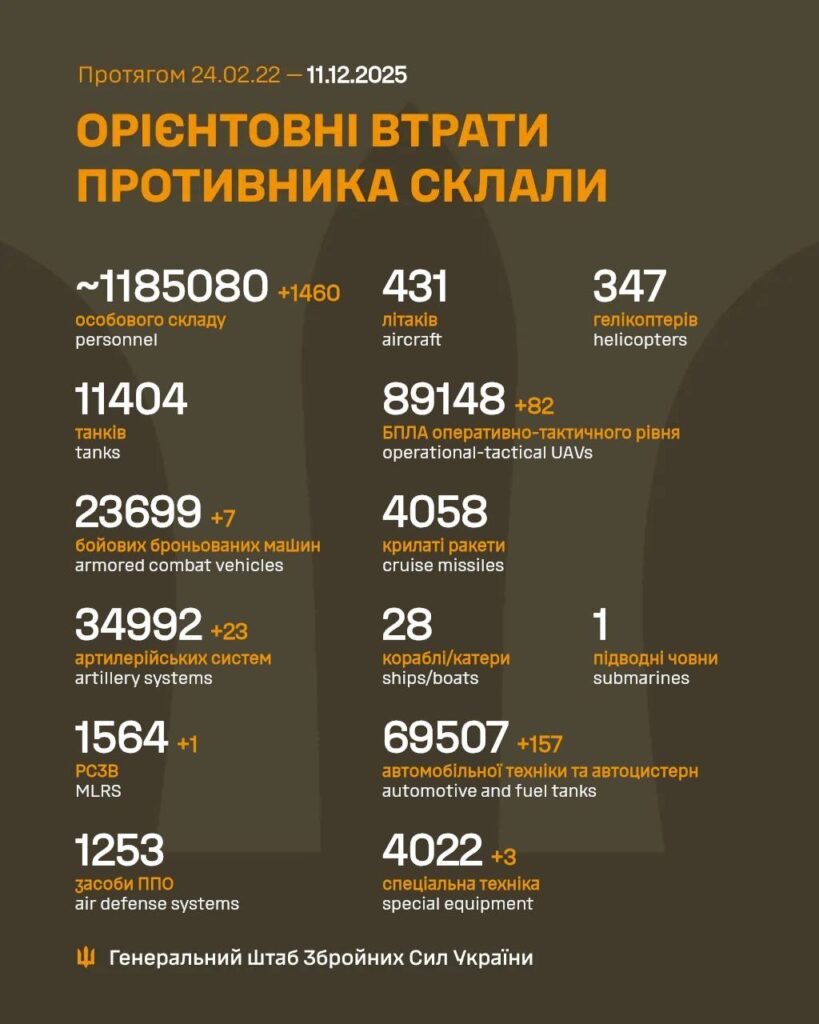
Russian losses
Unusually high number of dead and wounded Russian soldiers, the highest since April 18 when it reached 1530. The average since June 1 is 1017.
- 1460 KIA
- 7 AFVs
- 23 Artillery systems
- 1 MLRS
- 82 UAVs
- 157 Vehicles & fuel tanks
- 3 Special equipment
SLAVA UKRAINI


Don't forget to donate, Ukraine's cause is ours! Support Ukraine!


234 combat clashes
“USA wants to allow domestic and other companies to access the frozen Russian assets in Europe. The money, around 200 billion dollars, is intended for various investment projects in Ukraine, according to information provided to the Wall Street Journal.
The plan is described in various appendices to the peace plan that the USA is pushing Ukraine to agree to. One of the proposals is to build a gigantic data center in Ukraine that would be powered by electricity from the Zaporizhzhia nuclear power plant, which, according to the USA’s proposal, is controlled by Russia. The newspaper points to the idea as a typical example of Trump’s philosophy of “business-for-peace.”
According to reports, USA’s negotiators Steve Witkoff and Jared Kushner have sought the help of top executives on Wall Street to get ideas on how to revive Ukraine’s economy. They are planning, among other things, to attract Ukrainian soldiers to lay down their weapons and instead operate USA-controlled data centers in the country, earning “Silicon Valley”-level salaries.”
Germany is making a major investment in defense with the goal of acquiring Europe’s largest conventional army, writes TT. The country is about to spend 52 billion euros, equivalent to 560 billion Swedish kronor, on 29 new major procurements.
22 billion euros will be spent on basic equipment and clothing, 4.2 billion on the armored infantry vehicle Puma, three billion on Arrow 3 anti-aircraft missiles, and 1.6 billion on surveillance satellites, according to a source for Bloomberg.
In addition, mandatory conscription for all 18-year-old men is being reintroduced. The goal is for the military to grow from today’s 182,000 active soldiers and around 49,000 reservists to a total of 460,000 personnel, of which 260,000 are active.
I actually didn’t think so, although it’s only an increase of 8 billion USD.
400 million USD to Ukraine is a drop in the ocean compared to the 50 billion that was approved during Biden’s time. Better than nothing anyway and shows that they dare to go against Trump.
Then it has to go through the Senate as well so it is far from clear.
“The US House of Representatives goes against Trump – invests heavily in security in Europe
The US House of Representatives has passed a comprehensive defense and security package that includes investments in strengthened security in Europe, writes The Guardian. The package seems to clearly distance itself from Donald Trump’s policy of reducing US engagement in Europe.
The package means that eight billion dollars more than what Trump requested will be invested in Europe. It also means that the US will always keep at least 76,000 soldiers on European soil and that it will be more difficult for the president to call back soldiers or withdraw more advanced military equipment.
Security is particularly strengthened in the Baltics and along NATO’s eastern flank. 400 million dollars are also allocated to support Ukraine.
The proposal now moves on to the Senate.”
https://omni.se/usa-s-representanthus-gar-emot-trump-satsar-stort-pa-sakerheten-i-europa/a/xrRX9Q
Sweden is following Denmark’s lead and beginning to consider the implications of the USA’s changed attitude towards Europe.
“There are discussions within the Swedish intelligence service about how to view the USA, sources tell Svenska Dagbladet. Yesterday, Denmark became the first Nordic country to describe the USA as a security threat.
A source familiar with the military intelligence service Must says that the CIA and FBI have become politicized during Donald Trump’s administration. The source finds it “difficult to see” that Sweden’s cooperation with the USA will be as trustworthy.
Within the Swedish Armed Forces, a “nightmare scenario” has been discussed, according to another source.
– If Russia were to test NATO’s Article 5 by attacking a country in our vicinity? Would we then receive a warning from the USA today?”
https://omni.se/kallor-forsvaret-tar-fram-nytt-mardromsscenario/a/pB6Xdo
🥺The European Parliament’s translator burst into tears during the story of 11-year-old Roman, who survived the Russian attack on Vinnytsia.
At the European Parliament, during the screening of documentaries about Ukrainian children on December 10, the translator of the speech by 11-year-old Roman Oleksiy from Lviv burst into tears.
The boy survived a Russian missile strike on Vinnytsia on July 14, 2022, which resulted in the death of his mother. Roman said that it was the last time he saw her alive.
After the tragedy, the child underwent 36 surgeries and lengthy rehabilitation due to severe burns and injuries. Despite everything, the boy returned to studying, dancing, and music, and even received an award from Zelensky. Video: Radio Liberty”
❗️This night, kamikaze drones attacked the 🇷🇺Dorogobuzh TPP, located in the Dorogobuzh District of the Smolensk Region. This is a thermal power plant with an electrical capacity of about 90 MW and a thermal capacity of over 240 Gcal/h, which provides energy supply to industrial facilities and residential infrastructure in the region. The chemical enterprise PJSC “Dorogobuzh” was also a target of the attack.”
https://bsky.app/profile/militarynewsua.bsky.social/post/3m7ozqqwoic2x
“Ryska Tg-kanaler rapporterar om en massiv drönarattack mot Ryssland förra natten. Ryska försvarsdepartementet hävdar att man sköt ner 287 drönare. 40 av dem sköts ner över Moskva, flygplatser stängdes i området. Över 200 flygningar ställdes in eller omdirigerades, inklusive en flygning med Armeniens premiärminister Pashinyan.”
https://bsky.app/profile/antongerashchenko.bsky.social/post/3m7ozx7lks22s
See below, regarding the meeting of the flight with the Prime Minister of Armenia 🇦🇲, could Ukrainian drones have been over Armenia on their way to the Caspian Sea?
Not impossible.
Yes, Ukraine/HUR has certainly known exactly which flight the Armenian president would take and allowed the planning of the attack in the Caspian Sea a bit mysteriously. 🧌
“Rysk propagandist Solovyev erkänner att Rysslands ekonomi inte är i gott skick: “Vi besöker Indien – deras tillväxt är högre, vi besöker Kina – deras tillväxt är högre. Har du någonsin hört ledarna för Kinas eller Indiens finansiella institutioner säga något i stil med, ‘Åh, du vet, vi behöver en balanserad tillväxtbana’? Eller, ‘Du vet, tillväxt är mycket skadlig’? Det är omöjligt per definition.”
https://x.com/Gerashchenko_en/status/1999018605896204701“
Off-Topic, Venezuela
“The Venezuelan regime strongly condemns the US for seizing a large oil tanker off the coast of Venezuela, writes TT. In a statement, Venezuela describes it as “obvious theft” and “international piracy.”
Venezuelan President Nicolas Maduro demanded on Wednesday evening that the US stop its actions against the country.
– From Venezuela, we demand an end to the illegal and brutal intervention by the US government against Venezuela and Latin America, he told supporters in the capital, as reported by AFP.
According to the US, the vessel was subject to American restrictions.”
https://omni.se/venezuela-fordomer-usa-stold-och-piratverksamhet/a/zOLXg4
The AFU morning report indicates a synchronized Russian offensive push in the north, Lyman/Kupyansk, and in the south. In Pokrovsk, the pressure of the attacks had not changed. The Ukrainian attacks (unlocalized) were of the same order of magnitude as yesterday’s, thus setting a record (top 5 since May 1 this year).
N Slobozhansky-Kursk 8↗️
S Slobozhansky 11💥↗️
Kupyansk 9💥↗️
Lyman 27💥💥↗️
Slovyansk 13💥
Kramatorsk 2
Kostjantynivka 23💥↗️
Pokrovsk 49💥💥💥
Oleksandrivskij 22💥↗️
Huliaypillia 22💥↗️
Orikhivsk 9💥↗️
Prydniprovskij/Dnipro 2
Sum sectors 197↗️
Unlocalized 37
Total 234↗️
👍
“❗️🇺🇦Ukraine has for the first time (!) halted the operation of a 🇷🇺Russian oil platform in the Caspian Sea, according to sources from RBC-Ukraine.
▪️ Long-range SBU drones struck the Filanovsky platform, owned by “Lukoil-Nizhnevolzhskneft”. At least 4 hits. Oil and gas production from more than 20 wells has been completely stopped;
▪️ The platform was operating at one of Russia’s largest fields in the Caspian (reserves – 129 million tons of oil and 30 billion cubic meters of gas). The products were intended for export.”
https://bsky.app/profile/militarynewsua.bsky.social/post/3m7p3dsau2s2x
“
💥⚡️So they must have traveled through one or several of the countries Azerbaijan, Russia, Georgia, Armenia, Iran, Iraq, Syria, and/or Turkey? Or has Ukraine bought a submarine in the Caspian Sea?
It sounds almost a bit far-fetched but not impossible.
Hope they have come across a submarine! 😄
I hope the EU forces Trump to make Elon sell X, as part of a deal where the EU keeps American treasury bills/bonds in exchange for Trump ceasing his attempts to divide the EU and focusing on other matters. Because it is a stable, good, and user-friendly app.
“The ability for US companies to conduct transactions at foreign “Lukoil” gas stations has been extended until April 29, 2026, stated OFAC – after instructions from Trump to loosen restrictions on Russia.
The Department of the Treasury’s Office of Foreign Assets Control (OFAC) is issuing Russia-related General License 128B, “Authorizing Certain Transactions Involving Lukoil Retail Service Stations Located Outside of Russia.”
These licenses usually cover day-to-day consumer transactions—fuel purchases, card payments, settlement through international payment systems.
It postpones restrictions that would otherwise make these routine payments impossible. In this case the lifting is possibly linked to Trump’s personal business interests or support of buying Putin time to earn revenue for the regime in Moscow.
Trump has already started setting up personal business deals with OFAC sanctioned oligarchs – expect these sanctions to be lifted too, in the near future”
https://bsky.app/profile/beefeaterfella.bsky.social/post/3m76uyyskls26
https://beefeaterresearch.substack.com/p/rotenberg-brothers-putins-oligarch?r=4r2ohh&utm_campaign=post&utm_medium=web&triedRedirect=true
165 days trapped on Ukraine’s front line
For two Ukrainian soldiers — Oleksandr Tishaiev and Oleksandr Aliksieienko — this modern battlefield reality turned what should have been a relatively routine month-long deployment, into a gruelling 165-day battle against not only Russian forces but also starvation, dehydration, and insanity.
https://kyivindependent.com/how-2-soldiers-survived-165-days-trapped-on-ukraines-front-line/
“The latest Trump peace plan draft doesn’t require Russia to withdraw troops from Donbas, only Ukraine must pull back, creating a “demilitarized buffer zone”. Zelensky sees this as freezing the war. The plan also pushes Ukraine to accept territorial swaps, which U.S. officials call inevitable.”
https://bsky.app/profile/noelreports.com/post/3m7p7fbmduk2m
https://www.facebook.com/share/p/14UUHUwHGvW/?mibextid=wwXIfr
The new war economy
By maintaining stability and innovating to resist Russia, Ukraine has shown that size doesn’t matter as much in conflicts as it did before. Europe can learn from this as the US withdraws, writes Elina Ribakova.
Russia was expected to defeat Ukraine within weeks. Nearly four years after the full-scale invasion, Ukraine still stands.
Despite Russian claims, territorial gains have been limited. Russia controls about 19 percent of Ukraine, including the territories occupied in 2014. By 2025, Russia has conquered about 3,000 square kilometers, but most gains are scattered, operationally insignificant, and achieved at a high human cost.
This is far from the picture of an inevitable advance that Moscow has put forward in connection with intense diplomatic activity in recent weeks. But it helps explain why Ukraine has resisted US pressure to agree to a peace plan that favors Russia.
Ukraine’s experiences since February 2022 have turned long-standing assumptions about the war economy upside down – from the belief that size and industrial capacity guarantee victory to misconceptions about mobilization, logistics, and adaptability.
Russia had advantages in key economic factors. Yet its autocratic regime has struggled to translate these strengths into military power. Western support – including capital, technology, and intelligence – tipped the balance in Ukraine’s favor, and Ukraine’s own macroeconomic resilience and innovative approaches reinforced that effect.
The lesson is clear. European financing and Ukrainian inventiveness together can create an effective deterrent against external threats, even as Americans withdraw.
Bigger is not stronger
Winning a war depends on the ability to finance, supply, and equip. In 2024, Moscow increased its military spending to an estimated $149 billion, equivalent to 7.1 percent of GDP and about 19 percent of total public spending, double the amount in 2015. In contrast, Ukraine’s military spending in 2024 amounted to $65 billion, at least 34 percent of the country’s GDP – the highest military burden of any country in the world.
But what the Kremlin planned as a “blitzkrieg” turned into a war of attrition. For a smaller country like Ukraine, the strategy of withdrawing slowly while causing maximum damage is a feasible strategy. The size of the conquered territory does not give a complete picture of the war’s dynamics.
For Russia, decades of state-sponsored monopolies in key parts of the economy, suppression of private initiatives, and failures to build modern value chains have made the country technologically dependent and vulnerable to sanctions. The country’s shift from Europe towards China goes against basic economic geography and has weakened rather than strengthened its strategic position.
Population decline, a shrinking pool of military-age men, and resistance to joining the army have forced the Kremlin to resort to costly mobilization tactics. The state drains vital sectors of labor, exhausts its police and industrial workforce, and relies on monstrous “human wave” tactics on the battlefield.
Instead of a swift conquest, Vladimir Putin has led Russia into a conflict the country never planned for, while the economy stagnates. In contrast, Ukraine has strengthened its integration with the West and embraced modernization. This has given the country access to global networks, innovation, and continued external support. While Ukraine’s GDP collapsed by 29 percent in 2022 due to the war, growth had returned by 2023, supported by public consumption and partial recovery during wartime.
Most importantly, Ukrainians are motivated to fight for a modern democratic future, while Russians lack such a unifying goal.
The key to Ukraine’s resilience
At the beginning of the 2022 invasion, both Ukraine and Russia faced risks of financial instability – Russia due to sanctions and Ukraine due to the direct effects of Putin’s war of aggression. Yet both countries managed to steer their economies away from the economic abyss. This was particularly remarkable for the much smaller Ukraine, considering that the war was unfolding on its territory and its capital, Kiev, was under direct military threat.
War is not just about a military attack, but also about the ability to withstand massive macroeconomic shocks, including infrastructure destruction, export collapse, revenue loss, population displacement, labor market disruptions, reduced foreign investment, and extreme uncertainty.
If Russia had attempted a full-scale invasion in 2014, Ukraine would almost certainly have lost – not only because the country lacked a trained army, but also because authorities would have had to simultaneously combat a financial crisis, which would have strained the already limited administrative capacity. The conditions in 2014 were extremely challenging: Ukraine faced an overvalued exchange rate, decreasing reserves, severe fiscal pressures, and a deep domestic political crisis.
Since then, Ukraine has made significant improvements in macroeconomic management and strengthened its integration with the West. The reforms implemented between 2014 and 2022, supported by the IMF and international donors, proved crucial in sustaining the war effort by supporting a resilient macroeconomy and innovation.
One of the most important of these was the transformation of Ukraine’s central bank (NBU). The bank underwent a complete restructuring, with extensive personnel changes and disposal of questionable assets. The NBU successfully implemented a full-fledged inflation targeting policy before the war. Since February 2022, it has kept the financial system stable, ensured that banks continue to operate, and kept inflation under control.
In addition, Ukraine implemented extensive fiscal reforms, where digitalization, expenditure constraints, and measures for increased transparency were combined with efforts to improve tax collection. Key measures included establishing an electronic platform for public procurement and the DIIA app, “the state in a smartphone.” Measures to support businesses, such as targeted tax breaks, eased the pressure on companies during the toughest months.
In addition, Ukraine initiated long-awaited energy reforms by restructuring the state energy company Naftogaz. Energy subsidies had long burdened the budget, while the sector was characterized by corruption.
Ukraine’s rapid transition to the European electricity system at the beginning of the full-scale invasion was another decisive factor. Despite Russia’s invasion in 2014, Ukraine’s power grid had remained synchronized with Russia’s, a legacy from the Soviet era. The country originally planned to disconnect from Russia and join Europe in 2023, but the war accelerated the process, and a forced synchronization – made possible by several years of planning – was carried out in March 2022.
The reforms are far from complete. This essay is published at the same time as a major corruption scandal shakes Ukraine. While Russia’s corruption often dominates the headlines, Ukraine has also struggled to strengthen its domestic anti-corruption institutions. Ambitious reforms have often been implemented in an incomplete manner. However, the fact that Ukraine’s National Anti-Corruption Bureau (NABU) and the specialized Anti-Corruption Prosecutor’s Office (SAPO) can now address the highest levels of power is a sign of progress.
These reforms would not have been possible without a strong culture of civil society participation, investigative journalism, and the public’s demand for accountability, as evidenced by the large protests against attempts to limit the independence of NABU and SAPO.
Macroeconomic governance, structural reforms, and military performance are all interconnected. Ukraine has also
succeeded in leveraging innovation in a way that Russia has struggled to emulate. While Russia’s larger size and deeper resources give the country greater scalability, Ukraine has had to adapt quickly and creatively. The country’s strategy emphasizes leadership competence and flexible brigades, with a destruction-oriented strategy aimed at inflicting greater losses on the enemy – both in terms of personnel and materiel – than they themselves suffer, thereby reducing Russia’s ability to fight effectively. However, it is difficult to assess the success of this strategy, as neither side is transparent about personnel losses and estimates vary widely.
Not all allies are equal
For Ukraine, alliances with the West have been crucial. The USA, EU, and other partners provide advanced weapons, intelligence, economic support, and deep political and economic integration. Cooperation with the West has strengthened Ukraine’s modernization and institutional reforms.
Russia, on the other hand, relies on a much narrower group of economies – primarily China, Iran, and North Korea – which provide drones, ammunition, personnel, vehicles, and consumer goods, but at a high political and economic cost. These relationships are transactional, often asymmetric, and make Moscow increasingly dependent, while offering few of the technical, economic, or institutional advantages that Ukraine receives from its Western allies.
According to the Kiel Institute, Ukraine has received over 300 billion euros in aid from more than 40 countries. The EU and its member states have committed to providing support of around 187.3 billion euros.
The EU’s early decision to activate the temporary protection directive proved crucial. By granting protection to Ukrainian refugees on a large scale, they avoided what could have become a serious humanitarian and social crisis across Europe – they welcomed displaced Ukrainians and relieved pressure on Ukraine.
From a broader perspective, Europe still spends much less on defense than what an actual war in Europe could require. In 2024, EU member states’ defense expenditures amounted to around 343 billion euros, or about 1.9 percent of GDP – but they are increasing, and according to estimates for 2025, they could reach around 2.1 percent of GDP.
For the EU as a whole, it has proven to be much more cost-effective to moderately increase defense spending while simultaneously supporting Ukraine than to proactively build up large standing military structures.
From this perspective, Ukraine’s aid needs – although significant in relation to the country’s own economy – are modest compared to Europe’s financial capacity and constitute a relatively inexpensive insurance premium against a serious security threat. A “reparations loan” of up to 210 billion euros, currently under discussion, would greatly contribute to financing Ukraine’s defense and Europe’s collective security in the coming years.
Defending Europe: Lessons from Ukraine
Rebuilding Europe’s defense – especially in light of the US withdrawal – is a huge challenge. It has been underfunded for decades, with a depleted defense industrial base and a military capacity that is severely inadequate in critical areas. Most importantly, Europe must now develop intelligence capabilities that can replace those currently provided by the US and reduce Europe’s dependence on both American and Chinese equipment.
Nevertheless, Europe has a strategic asset: Ukraine itself. With the help of its partners, the country has resisted a nuclear-armed adversary with superior manpower and financial resources for almost four years.
Ukraine shows that modern warfare is as much about maintaining industrial production and financing as it is about assets on the battlefield. Deterrence requires economic strength, industrial depth, and long-term financial planning. Europe needs financial space for a prolonged conflict, mechanisms to rapidly increase the production of ammunition, explosives, electronics, and repair capacity, and long-term tools – such as contracts, guarantees, and advance purchases – to stabilize supply chains and increase critical supplies.
Innovation and decentralization are strategic advantages that Ukraine has leveraged – and that Europe can emulate. Ukraine’s defense ecosystem shows that speed, experimentation, and distributed decision-making can outperform traditional, slow procurement systems.
The most important lesson from this for Europe is that innovation wins wars when bureaucratic frictions are minimized. While centralized standards are maintained, Europe should adjust budgets and procurement powers closer to military units, so that commanders can acquire what works instead of waiting for multi-year tenders or getting stuck in disputes between member states.
Europe’s path to security
In the modern war economy, size matters – but much less than conventional wisdom suggests. Ukraine has shown that a smaller nation with preparations and allied support can withstand a much larger aggressor. Allied support has been crucial in promoting reforms and innovation, financing military support, and limiting Russia through sanctions, which have raised the costs for its military-industrial complex.
The USA has already reduced much of its practical engagement. Previously, they have decreased the information exchange with Ukraine, despite this resulting in minimal costs for Washington – the USA has the necessary capacity, still collects this information, and Ukraine, in return, provides valuable information about Russian systems.
In this context, a realistic goal for the EU is to create a “rebalanced NATO.” When Europe and Ukraine can independently deter a weakened Russia, the security guarantee included in NATO’s Article 5 would no longer be the alliance’s primary basis. Instead, NATO would rely on interoperability, coordinated planning, and shared resources among its European members and Ukraine.
Ukraine’s resilience depends primarily on its macroeconomic stability and inventiveness. For Europe, this shows that defense does not require excessive spending. How you spend is as important as how much. By learning from Ukraine and increasing productivity, Europe can build a credible deterrent force.
🇵🇱 Nowa ekonomia wojny
Utrzymując stabilność i wprowadzając innowacje, aby przeciwstawić się Rosji, Ukraina pokazała, że w konflikcie rozmiar ma mniejsze znaczenie niż kiedyś. Europa może wyciągnąć z tego wnioski w obliczu wycofywania się Stanów Zjednoczonych, pisze Elina Ribakova.
Oczekiwano, że Rosja pokona Ukrainę w ciągu kilku tygodni. Prawie cztery lata po rozpoczęciu pełnej inwazji Ukraina nadal broni swojej pozycji.
Wbrew rosyjskim twierdzeniom, zdobycze terytorialne są ograniczone. Rosja kontroluje około 19% terytorium Ukrainy, w tym terytoria zajęte w 2014 r. W 2025 r. Rosja zajęła około 3000 km², ale większość zdobyczy jest rozproszona, nie ma znaczenia operacyjnego i została osiągnięta wysokim kosztem ludzkim.
Jest to oczywiście dalekie od narracji o nieubłaganym postępie, którą Moskwa propagowała w ostatnich tygodniach w ramach intensywnych działań dyplomatycznych. Pomaga to jednak wyjaśnić, dlaczego Ukraina opiera się presji Stanów Zjednoczonych, aby zgodzić się na plan pokojowy korzystny dla Rosji.
Doświadczenia Ukrainy od lutego 2022 r. podważyły długo utrzymywane założenia dotyczące ekonomii wojny – od przekonania, że wielkość i potencjał przemysłowy są gwarancją zwycięstwa, po nieporozumienia dotyczące mobilizacji, logistyki i zdolności adaptacyjnych.
Rosja miała przewagę w kluczowych czynnikach ekonomicznych. Jednak jej autokratyczny reżim miał trudności z przekształceniem tych atutów w siłę militarną. Wsparcie Zachodu – w tym kapitał, technologia i wywiad – przechyliło szalę na korzyść Ukrainy, a odporność makroekonomiczna Ukrainy i jej innowacyjne podejście spotęgowały ten efekt.
Wniosek jest jasny. Połączenie europejskiego finansowania i ukraińskiej pomysłowości może stworzyć skuteczny środek odstraszający przed zagrożeniami zewnętrznymi, nawet jeśli Amerykanie się wycofają.
Większy nie znaczy silniejszy
Zwycięstwo w wojnie zależy od zdolności do finansowania, zaopatrzenia i wyposażenia. W 2024 r. Moskwa zwiększyła wydatki na wojsko do około 149 mld dolarów, co stanowi 7,1% jej PKB i około 19% całkowitych wydatków rządowych, czyli dwukrotnie więcej niż w 2015 r. Dla porównania, w 2024 r. wydatki wojskowe Ukrainy osiągnęły 65 mld dolarów, co stanowi co najmniej 34% jej PKB – jest to najwyższe obciążenie wojskowe spośród wszystkich krajów na świecie.
Jednak to, co Kreml planował jako „blitzkrieg”, zamieniło się w wojnę na wyniszczenie. Dla mniejszego kraju, takiego jak Ukraina, strategia powolnego wycofywania się przy jednoczesnym zadawaniu maksymalnych strat jest realna. Wielkość zdobytych terytoriów nie oddaje w pełni dynamiki wojny.
W przypadku Rosji dziesięciolecia monopoli sponsorowanych przez rząd w kluczowych obszarach gospodarki, represjonowanie prywatnej inicjatywy i niepowodzenie w budowaniu nowoczesnych łańcuchów wartości sprawiły, że kraj ten stał się zależny technologicznie i podatny na sankcje. Odejście od Europy w kierunku Chin jest sprzeczne z podstawowymi zasadami geografii gospodarczej i osłabiło, a nie wzmocniło pozycję strategiczną kraju.
Spadek demograficzny, kurcząca się pula mężczyzn w wieku poborowym i opór przed wstąpieniem do armii zmusiły Kreml do stosowania kosztownych taktyk mobilizacyjnych. Państwo pozbawia kluczowe sektory siły roboczej, wyczerpując zasoby policji i przemysłu, i polegając na potwornych taktykach „fali ludzkiej” na polu bitwy.
Zamiast szybkiego podboju, Władimir Putin doprowadził Rosję do konfliktu, którego nigdy nie planowała, a jej gospodarka znalazła się w impasie. Ukraina natomiast wzmocniła swoją integrację z Zachodem i przyjęła modernizację. Dało jej to dostęp do globalnych sieci, innowacji i trwałego wsparcia zewnętrznego. Podczas gdy PKB Ukrainy spadł o 29% w 2022 r. z powodu wojny, w 2023 r. nastąpił powrót wzrostu gospodarczego, wspierany przez konsumpcję publiczną i częściowe ożywienie gospodarcze w czasie wojny.
Nie wszyscy sojusznicy są sobie równi
Dla Ukrainy sojusze z Zachodem miały decydujące znaczenie. Stany Zjednoczone, Unia Europejska i inni partnerzy zapewniają zaawansowaną broń, wywiad, wsparcie finansowe oraz głęboką integrację polityczną i gospodarczą. Współpraca z Zachodem wzmocniła modernizację Ukrainy i reformy instytucjonalne.
Rosja natomiast opiera się na znacznie węższym gronie gospodarek – głównie Chinach, Iranie i Korei Północnej – które dostarczają drony, amunicję, ludzi, samochody i towary konsumpcyjne, ale robią to przy wysokich kosztach politycznych i finansowych. Relacje te mają charakter transakcyjny, często asymetryczny i powodują coraz większą zależność Moskwy, oferując jednocześnie niewiele korzyści technologicznych, finansowych lub instytucjonalnych, jakie Ukraina uzyskuje od swoich zachodnich sojuszników.
Według Instytutu w Kilonii Ukraina otrzymała ponad 300 mld euro pomocy od ponad 40 krajów. UE i jej państwa członkowskie przeznaczyły na wsparcie około 187,3 mld euro.
Kluczowe znaczenie miała wczesna decyzja UE o uruchomieniu dyrektywy w sprawie tymczasowej ochrony. Przyznając ochronę masowo napływającym uchodźcom z Ukrainy, uniknęła ona poważnego kryzysu humanitarnego i społecznego w całej Europie, przyjmując wysiedlonych Ukraińców i łagodząc presję na Ukrainę.
Z szerszej perspektywy Europa nadal wydaje znacznie mniej na obronność, niż mogłaby wymagać rzeczywista wojna w Europie. W 2024 r. wydatki na obronność państw członkowskich UE wyniosły około 343 mld euro, czyli około 1,9% PKB – choć kwota ta rośnie, a szacunki na 2025 r. sugerują, że może ona osiągnąć około 2,1% PKB.
Dla całej UE niewielkie zwiększenie wydatków na obronność przy jednoczesnym wsparciu Ukrainy okazało się znacznie bardziej opłacalne niż prewencyjne budowanie dużych stałych struktur wojskowych.
Z tego punktu widzenia potrzeby Ukrainy w zakresie pomocy – choć duże w stosunku do jej własnej gospodarki – są niewielkie w stosunku do możliwości finansowych Europy i stanowią stosunkowo tanią składkę ubezpieczeniową od poważnego zagrożenia bezpieczeństwa. Obecnie omawiana „pożyczka reparacyjna” o wartości do 210 mld euro znacznie przyczyniłaby się do sfinansowania obrony Ukrainy i zbiorowego bezpieczeństwa Europy w nadchodzących latach.
Co najważniejsze, Ukraińcy są zmotywowani do walki o nowoczesną, demokratyczną przyszłość, podczas gdy Rosjanom brakuje takiego jednoczącego celu.
Klucz do odporności Ukrainy
W pierwszych dniach inwazji w 2022 r. zarówno Ukraina, jak i Rosja stanęły w obliczu ryzyka niestabilności finansowej – Rosja z powodu sankcji, a Ukraina z powodu bezpośrednich skutków agresywnej wojny Putina. Jednak obydwu krajom udało się uchronić swoje gospodarki przed upadkiem. Było to szczególnie niezwykłe w przypadku znacznie mniejszej Ukrainy, biorąc pod uwagę, że wojna toczyła się na jej terytorium, a stolica Kijów była bezpośrednio zagrożona militarnie.
Wojna to nie tylko atak zbrojny, ale także zdolność do przetrwania ogromnych wstrząsów makroekonomicznych, związanych z zniszczeniem infrastruktury, załamaniem eksportu, utratą dochodów, wysiedleniem ludności, zakłóceniami na rynku pracy, spadkiem inwestycji zagranicznych i skrajną niepewnością.
Gdyby Rosja podjęła próbę pełnej inwazji w 2014 r., Ukraina prawie na pewno przegrałaby – nie tylko dlatego, że nie miała wyszkolonej armii, ale także dlatego, że władze musiałyby jednocześnie walczyć z kryzysem finansowym, co nadwyrężyłoby i tak już ograniczone możliwości zarządzania. Warunki w 2014 r. były niezwykle trudne: Ukraina borykała się z zawyżonym kursem walutowym, wyczerpującymi się rezerwami, poważnymi presjami fiskalnymi i głębokim kryzysem politycznym w kraju.
Od tego czasu Ukraina dokonała znacznej poprawy w zakresie zarządzania makroekonomicznego i wzmocniła swoją integrację z Zachodem. Reformy przeprowadzone w latach 2014–2022, wspierane przez MFW i międzynarodowych darczyńców, okazały się kluczowe dla utrzymania wysiłków wojennych, ponieważ stanowiły podstawę odpornej makroekonomii i innowacji.
Jedną z najważniejszych z nich była transformacja Narodowego Banku Ukrainy (NBU). Bank został całkowicie zrestrukturyzowany, co wiązało się ze znacznymi zmianami kadrowymi i zbyciem wątpliwych aktywów. Przed wojną NBU z powodzeniem wdrożył pełnoprawny system celów inflacyjnych. Od lutego 2022 r. utrzymuje stabilność systemu finansowego, zapewnia ciągłość działania banków i kontroluje inflację.
Ponadto Ukraina przeprowadziła szeroko zakrojone reformy fiskalne, łącząc cyfryzację, ograniczenie wydatków i środki zapewniające przejrzystość z działaniami mającymi na celu poprawę ściągalności podatków. Kluczowe działania obejmowały utworzenie elektronicznej platformy zamówień publicznych oraz aplikacji DIIA „państwo w smartfonie”. Środki wsparcia dla przedsiębiorstw, takie jak ukierunkowane ulgi podatkowe, złagodziły presję na firmy w najtrudniejszych miesiącach.
Ponadto Ukraina rozpoczęła długo oczekiwane reformy energetyczne, restrukturyzując państwową spółkę energetyczną Naftogaz. Dotacje energetyczne od dawna obciążały budżet, a sektor ten był pełen korupcji.
Kolejnym kluczowym czynnikiem było szybkie przejście Ukrainy na europejski system elektroenergetyczny na początku pełnej inwazji. Pomimo inwazji Rosji w 2014 r. sieć energetyczna Ukrainy pozostawała zsynchronizowana z Rosją, co było dziedzictwem czasów radzieckich. Kraj pierwotnie planował odłączyć się od Rosji i dołączyć do Europy w 2023 r., jednak wojna przyspieszyła ten proces i w marcu 2022 r. udało się osiągnąć awaryjną synchronizację, która była możliwa dzięki wieloletnim planom.
Reformy są dalekie od zakończenia. Niniejszy esej ukazuje się w momencie, gdy Ukrainę wstrząsa ogromny skandal korupcyjny. Chociaż korupcja w Rosji często dominuje w nagłówkach gazet, Ukraina również boryka się z problemami związanymi z umacnianiem krajowych instytucji antykorupcyjnych. Ambitne reformy często były realizowane w sposób niedoskonały. Jednak fakt, że Krajowe Biuro Antykorupcyjne Ukrainy (NABU) i Specjalistyczna Prokuratura Antykorupcyjna (SAPO) są obecnie w stanie zająć się najwyższymi szczeblami władzy, jest oznaką postępu.
Reformy te nie byłyby możliwe bez silnej kultury uczestnictwa społeczeństwa obywatelskiego, dziennikarstwa śledczego i publicznego domagania się odpowiedzialności, czego dowodem są duże protesty w odpowiedzi na próby ograniczenia niezależności NABU i SAPO.
Zarządzanie makroekonomiczne, reformy strukturalne i wyniki wojskowe są ze sobą powiązane. Ukrainie udało się również
wykorzystać innowacje w sposób, który Rosja ma trudności z powieleniem. Podczas gdy większy rozmiar i bogatsze zasoby Rosji zapewniają jej większą skalowalność, Ukraina musiała szybko i kreatywnie dostosować się do sytuacji. Jej podejście kładzie nacisk na umiejętności zarządzania i zwinne brygady, wykorzystując strategię nastawioną na zniszczenie, mającą na celu zadanie wrogowi większych strat – zarówno w ludziach, jak i sprzęcie – niż sama ponosi, zmniejszając w ten sposób zdolność Rosji do skutecznego walczenia. Ocena sukcesu tej strategii jest jednak trudna, ponieważ żadna ze stron nie podaje informacji o stratach osobowych, a szacunki są bardzo zróżnicowane.
Obrona Europy: wnioski płynące z Ukrainy
Odbudowa europejskiej obronności – zwłaszcza w kontekście wycofywania się Stanów Zjednoczonych – stanowi ogromne wyzwanie. Od dziesięcioleci obszar ten był niedofinansowany, co doprowadziło do osłabienia bazy przemysłowo-obronnej i poważnych braków w zakresie zdolności wojskowych w kluczowych obszarach. Co najważniejsze, Europa będzie teraz musiała rozwinąć zdolności wywiadowcze, które zastąpią te obecnie zapewniane przez Stany Zjednoczone, oraz zmniejszyć swoją zależność od sprzętu zarówno amerykańskiego, jak i chińskiego.
Europa ma jednak strategiczny atut: samą Ukrainę. Dzięki pomocy swoich partnerów kraj ten od prawie czterech lat opiera się przeciwnikowi dysponującemu bronią jądrową oraz przewagą pod względem siły roboczej i zasobów finansowych.
Ukraina pokazuje, że współczesna wojna polega w równym stopniu na utrzymaniu produkcji przemysłowej i finansowaniu, jak i na zasobach bojowych. Odstraszanie wymaga siły gospodarczej, potencjału przemysłowego i długoterminowego planowania fiskalnego. Europa potrzebuje przestrzeni fiskalnej na wypadek przedłużającego się konfliktu, mechanizmów umożliwiających szybkie zwiększenie produkcji amunicji, materiałów wybuchowych, elektroniki i zdolności naprawczych, a także długoterminowych narzędzi – takich jak umowy, gwarancje i zakupy z wyprzedzeniem – w celu stabilizacji łańcuchów dostaw i zwiększenia skali kluczowych nakładów.
Innowacyjność i decentralizacja to strategiczne atuty, które wykorzystała Ukraina i które Europa może powielić. Ukraiński ekosystem obronny pokazuje, że szybkość, eksperymenty i rozproszone podejmowanie decyzji mogą przewyższać tradycyjne, powolne systemy zamówień publicznych.
Głównym wnioskiem dla Europy jest to, że innowacje wygrywają wojny, gdy minimalizuje się biurokratyczne tarcia. Zachowując scentralizowane standardy, Europa powinna dostosować budżety i uprawnienia zakupowe do potrzeb jednostek wojskowych, umożliwiając dowódcom nabywanie tego, co się sprawdza, zamiast czekać na wieloletnie przetargi lub grzęznąć w sporach między państwami członkowskimi.
Droga Europy do bezpieczeństwa
W nowoczesnej ekonomii wojny rozmiar ma znaczenie – ale znacznie mniejsze niż sugeruje konwencjonalna mądrość. Ukraina pokazała, że dzięki przygotowaniom i wsparciu sojuszników mniejsze państwo może powstrzymać znacznie większego agresora. Pomoc sojuszników miała kluczowe znaczenie dla wspierania reform i innowacji, finansowania pomocy wojskowej oraz ograniczania Rosji poprzez sankcje, które podniosły koszty jej kompleksu militarno-przemysłowego.
Stany Zjednoczone już znacznie ograniczyły swoje praktyczne zaangażowanie. W przeszłości ograniczyły wymianę informacji wywiadowczych z Ukrainą, mimo że wiązało się to z minimalnymi kosztami dla Waszyngtonu – Stany Zjednoczone dysponują niezbędnymi zdolnościami, zbierają te informacje niezależnie, a Ukraina w zamian dostarcza cennych informacji na temat rosyjskich systemów.
W tym kontekście realistycznym celem dla UE jest powstanie „zrównoważonego NATO”. Gdy Europa i Ukraina będą w stanie samodzielnie powstrzymać osłabioną Rosję, gwarancja bezpieczeństwa USA zawarta w art. 5 NATO nie będzie już stanowić podstawy sojuszu. Zamiast tego NATO będzie opierać się na interoperacyjności, skoordynowanym planowaniu i wspólnych zdolnościach swoich europejskich członków i Ukrainy.
Odporność Ukrainy wynika przede wszystkim z jej stabilności makroekonomicznej i pomysłowości. Dla Europy oznacza to, że obrona nie wymaga nadmiernych wydatków. Sposób wydawania środków jest równie ważny jak ich wysokość. Czerpiąc wnioski z doświadczeń Ukrainy i zwiększając produktywność, Europa może zbudować wiarygodny środek odstraszający.
👍the site translates Polish! (Inte konstigt det här är dyrt)
Ah, interesting.
My instruction (if writing on the Swedish side) for translations to the English side is something like this:
Translate the text from Swedish to English, if parts of the text are already in English leave them unchanged (to preserve the original).
Then the same thing but in reverse if writing on the English side.
I don’t mention other languages, so it tries to translate to the correct target language even if it’s not in English.
Also, I’ve noticed that it can be a bit capricious and do as it pleases at times. Wouldn’t surprise me if it sometimes translates other languages and sometimes not.
No ceasefire then, what do you think?
Now we are starting the journey towards a violent war.
It looks like Trump’s cheating peace deal has faded away.
I still believe that there will be some form of ceasefire in 2026.
Regarding the latest news from Zelensky about elections and territorial concessions, he throws the ball back to Trump & Putin. I don’t think Putin will back down as long as he has Trump on the hook, so there probably won’t be a ceasefire yet.
The oil platform is exciting – new target
Great post MXT 👍
Thank you, thank you!
Sounds boring if they have to give up land areas, but I guess (or hope) that maybe it’s planned so that they have given in a little, but not so much that Russia will agree to it, just to show that they can compromise after all.
“A proposal for territorial concessions from Ukraine’s side has been sent to Donald Trump, according to Germany’s Chancellor Friedrich Merz, reports AFP. The proposal was sent on Wednesday. – It mainly concerns the question of which territorial concessions Ukraine is willing to make, says Merz. It is unclear what territorial concessions are involved. The first peace proposal of 28 points included demands for the Donbas region and the Crimean Peninsula to be abandoned. The first peace proposal has since been revised, but according to reports to Politico, the USA is determined that Ukraine must hand over full control of Donbas.”
https://omni.se/a/M7gJ3K
We’ll see, I hope Europe isn’t just playing to the galleries here because then I’ll be upset
Yes, one is a bit nervous that this will end up completely crazy, with Ukraine giving up way too much while Russia pretty much gets what they want.
It’s all up to Europe now, and if we chicken out and aren’t prepared to do what’s necessary, Ukraine will be forced into a humiliating defeat.
But of course, it’s fundamentally all the fault of the USA for siding with Russia.
If the USA had continued to send 30-60 billion USD/year in military aid, the situation would probably look completely different. Now it’s not just a matter of missing weapon deliveries but also the pressure that the USA puts on Ukraine (and Europe).
Zelensky is testing both Trump and Putin. Presidential election okay, if the election can be monitored by allied forces. Land concession okay, but Ukraine chooses what, not Russia.
I don’t think either of them will bite.
Offra Krim, keep the rest.
No 🙅! The Russians are conducting drone safaris in Kherson, over the Dnieper River. At least one Kherts strait without a bridge to Russia is needed.
Clarification to the above 16.34. This is what I believe EU leaders have as a countermove to Trump’s proposals regarding territorial concessions. However, I hope that Ukraine will make a move against Crimea when (if) they can.
But even if the EU leaders are selfish, it is not strategically wise to sacrifice Crimea from a European defense perspective, right? Wouldn’t it be better with the most eastern land areas of Ukraine instead?
👍 oh, yes, I answered without reading the original post and missed the context.
I was also thinking that they could sacrifice Crimea earlier, but when I started looking around, I saw that there are large deposits of natural gas in the Black Sea outside of Crimea, so it is probably important for Ukraine to retain it.
It is probably important that they can get Krym back. Partly for the natural resources in the surrounding waters, but also to avoid the potential threat to maritime traffic.
We need to go to war with Russia, not reward them.
If we reward them, we will surely end up in war.
Above text 205 – quite a lot lies with the Ukrainian soldier.
and the big question is whether the rest of Europe’s soldiers would accept the same
The article shines with its absence of this aspect, the human, Ukrainian people’s will to defend themselves, captured much better by Peter Kadhammar in AB the other day.
Regarding the development of who has drone superiority. I know it has shifted. During the fall, there has been some talk about the Russians regaining the upper hand through better training and good Chinese technology. The other day, Greggen wrote that Ukraine had a clear advantage on the drone side.
I realize it’s more complicated than one side having the upper hand; there are many types of drones and many types of drone warfare and different fronts. But it would be interesting to hear if anyone has more informed thoughts.
UA has learned to fight in a drone-targeted environment – it is darn world-leading and the reason is that China’s digital battlefield is best against fixed targets – when it comes to small moving targets, not so good.
then the wheel keeps turning all the time and the small AI interceptors are on the move and have probably arrived a bit
Thank you for your response.
I think I have only seen you write about China’s digital battlefield. Is it a strong guess based on the fact that much of the hardware comes from there, or are there any clear data points supporting direct Chinese involvement?
More about Kupiansk.
“Hey Mr.P, Ukrainian forces are mopping-up in Kupiansk!”
https://bsky.app/profile/freefran.bsky.social/post/3m7ony26i6c2w
“The Armed Forces of Ukraine have encircled the Russians in Kupiansk, — insiders Meanwhile, DeepState reports Russian advances in Sloviansk and Pokrovsk. ZSU Insider Tg”
https://bsky.app/profile/sanmarcos.bsky.social/post/3m7ns3a4kxk2d
Very nice by UA up there 👍👍👍👍👍💥💥
So incredibly silly! Calibri is considered woke?
Furthermore, they complain that switching to Calibri cost money, and yet they want to spend even more money to switch back?
There must be something seriously wrong with them.
“The USA’s diplomatic correspondence is to be conducted in the font Times New Roman. This is stated by Foreign Minister Marco Rubio in a directive to American embassies and consulates.
In 2023, the Biden administration decided to switch from Times New Roman to Calibri. The switch was made to facilitate reading for people who have difficulty, such as dyslexics. Calibri is considered easier to read because it lacks serifs and has larger spaces between letters.
Rubio writes that the switch has not made reading easier for anyone but has only cost money. He believes it is an example of the Biden administration’s DEI agenda. DEI stands for ‘diversity, equity, inclusion’.”
Suddenly, everyone started using Calibri 11 so I switched to it as well.
No more Arial or Times Roman 12
Arial in some contexts, Calibri in most. Times Roman has no reasonable use anymore.
Otherwise, it’s a fantastic political invention to be able to justify anything by saying that the status quo is woke and caused by DEI. Polaris is woke, we need more coal in the atmosphere. The moon is woke, it needs to be taken down. And so on.
I think it’s probably just because it was during the Biden administration that the font was changed, I don’t think that decision came from Rubio but from Trump/Vance. I wonder if Rubio is lying awake at night feeling guilty, he is the only one who has sometimes shown examples of independent thinking in Trump’s administration.
Times New Roman is maybe nice, but a bit old-fashioned, that’s what we used in the reports we did in school in the early 90s
Sure, it’s because Biden switched.
Surprised that Trump hasn’t demanded them to create a special “Trump Emperor” font.
Nothing wrong with Times really but it might have become a bit cliché and feels old.
It was probably standard in web browsers too back in the days when you couldn’t influence the design much. It was quite difficult to read back then on those small screens and the low resolution that was used.
Stenhård äldre Ukrainare!
“Bastards, get out!” — a resident of Kupiansk drives Russian occupiers out of the entrance of his apartment building.”
https://bsky.app/profile/wartranslated.bsky.social/post/3m7naasdnt227
✊✊💥💥
“❗️🇺🇦Ukrainian military personnel from the 45th Artillery Brigade destroyed a 🇰🇵North Korean 107-mm MLRS “TYPE 75″ in the Eastern direction.”
https://bsky.app/profile/militarynewsua.bsky.social/post/3m7plxea3v226
Staffed by NK right?
I didn’t see any soldiers in the movie, but North Koreans are quite short so maybe they weren’t visible?
“Perpetually sun-kissed Dmitry Medvedev announced that in 2025, Russia recruited more than 400,000 men into the Ukrainian meat grinder on contract – slightly fewer than last year, but enough to illustrate the scale of the ongoing mass disposal. Across several regions, enhanced incentives remain in place for those willing to sign the death contract. In some areas, a fighter’s annual pay now exceeds 6 million rubles (about $75,000) – essentially six to ten years of an ordinary civilian salary handed out in a single year.”
“Trump team weighs forming 5-nation group with Russia to replace G7 — Politico
En tjänsteman som arbetade i Vita huset under Trumps första regering noterade att idén att skapa en Core 5, eller C5, allians som involverar USA, Kina, Indien, Japan och Ryssland inte längre anses särskilt chockerande.”
https://newsukraine.rbc.ua/news/trump-team-weighs-forming-5-nation-group-1765448733.html
A club for losers 🤣🤣
They are really stupid. How do they think it would work? India and China are not exactly happy with each other, Japan is not a fan of China either, and Russia doesn’t do business unless they can exploit those they do business with. The initial meeting would end in bloodshed.
Japan is probably wondering how the hell did we end up on that list?
“❗️The crew of a Leopard 2A4 tank from the 🇺🇦155th Mechanized Brigade is operating in the Pokrovsk direction.”
https://bsky.app/profile/militarynewsua.bsky.social/post/3m7pkzr5fgk2r
“❗️Russians claim that 🇺🇦Ukrainian forces have started installing small IR (infrared) spotlights on ground and aerial drones in order to blind 🇷🇺Russian FPV drones.”
https://bsky.app/profile/militarynewsua.bsky.social/post/3m7pnedz5rk26
Is it not just as good to go all out with sanctions package 20-100 at once?
“EU’s 20th package of sanctions to target Russian nuclear power, oil, and steel — EU Observer”
https://newsukraine.rbc.ua/news/eu-s-20th-package-of-sanctions-to-target-1765456729.html
“Russian agents are active in Moldova’s Transnistria, training for sabotage and launching drone production. Ukrainian intel says the goal is to destabilize the region and threaten Odesa — just 80 km from Tiraspol.”
https://bsky.app/profile/euromaidanpress.bsky.social/post/3m7pu3ileoq2x
https://euromaidanpress.com/2025/12/11/russia-eyes-moldovas-transnistria-as-new-threat-axis-toward-odesa-says-ukrainian-intelligence/
https://www.facebook.com/share/p/1Bgn9D3sx4/?mibextid=wwXIfr
11.12.2025 update that today focuses on Trump’s possible attack on Venezuela. So what have the US armed forces learned from the war in Ukraine and the Gaza conflict? One might also ask how much the experience they have gained in Ukraine can be converted into USD? As it now appears, the Trump administration is boasting about how they have helped a Ukraine that is extremely ungrateful, but they are forgetting the experiences they have gained through enormous amounts of Ukrainian blood. So let’s look at Trump’s Venezuela problem in the form of Gregg’s Ukraine Brief.
Gregg’s Ukraine Brief
How the wars in Ukraine and Israel are changing US strategy in Venezuela
— Why future conflicts will be won by those who master unmanned systems, not massive invasion armies
Over the past two years, we have seen warfare change more than in any other decade since World War II. The front lines in Ukraine, as well as Israel’s technological response to asymmetric threats, have demonstrated one thing with brutal clarity:
Unconventional, unmanned systems have changed the balance of modern warfare.
Ukraine’s ability to use cheap, fast-moving drones to knock out Russian air bases hundreds of kilometers away — often from civilian-equipped vehicles — has shattered traditional doctrines of air defense and military dominance.
Israel’s precision strikes with manipulated pager systems show that modern warfare is no longer about large, heavy weapon systems – but about penetration, data, and psychological effect.
It is against this backdrop that we should interpret the US’s increasingly visible military preparations off the coast of Venezuela.
There are many indications that Washington is preparing military leverage to influence Venezuela’s political development. But the question is what kind of war the US is preparing for – and what kind of war is possible in the new era of unmanned dominance.
The US dilemma: regime change without invasion
There are strong indications that the US goal is to create the political conditions for a change of government in Caracas, but without carrying out a full-scale invasion. There are rational reasons for this:
• Venezuela’s forces have probably adapted their defenses based on Russian experiences in Ukraine.
• The country has access to cheap drones and Russian advice.
• The US risks higher losses than American public opinion can tolerate.
• A ground war would tie up resources that are currently needed in the Indo-Pacific and Europe.
Just like on the Pokrovsk front, we see here how smaller, smarter forces can achieve effects that previously required divisions.
The Ukrainian model: intelligence, disruption, and precision
Much of what Ukraine does on a daily basis can be directly translated into a possible US strategy in Venezuela:
1. Information dominance
The US can build a Ukrainian-inspired surveillance network of HALE drones, small UAS, and ground-based UGVs to map Caracas and the oil regions in detail.
2. Multi-layered electronic warfare
Just as Ukraine blinds Russian air defenses with EW systems, the US can neutralize Venezuela’s S-300VM and Buk-M2E systems without having to physically destroy them.
3. Cascade attacks with cheap drones
Ukraine has shown how 300–500 simultaneous drones can overwhelm an entire air defense system. The same strategy can be used to cut off Venezuela’s command centers.
4. UGV as a long-term pressure tool
In Ukraine, ground robots have become increasingly important. In Venezuela, UGVs would carry small UAS deep into the country, striking targets such as power stations, mobile phone masts, and propaganda centers—without harming civilians.
5. Precise tactical escalation – and de-escalation
Ukraine has developed the ability to increase pressure on Russian targets and then quickly back off to control the psychological narrative. The US can use the same logic to pressure Maduro without crossing the threshold into full-scale war.
Why this matters for Ukraine’s future
What is interesting – and what concerns us directly – is that Ukraine now serves as the global test bed for the military doctrines of the 2020s.
Everything from:
• drone swarms
• electronic warfare
• long-range attacks at 1000+ km
• frontline interconnected sensor networks
• UGV systems at stabilization points
• real-time artillery correction…
has been created, improved, and documented in Ukraine.
As the US now considers its strategy towards Venezuela, it is not inspired by Iraq in 2003 or Panama in 1989 – but by:
Pokrovsk, Myrnohrad, Kupjansk, and Avdijivka in 2023–2025.
Israeli cyber and signal operations in 2023–2024.
This means that Ukraine’s capacity for innovation – often forced by a lack of resources – is now shaping US global security policy.
It is a recognition of Ukraine’s military innovation leadership.
Conclusion: Drone warfare is now the central military doctrine in the world
The US has two choices in Venezuela:
1. Conventional invasion – expensive, risky, politically explosive.
2. Unmanned dominance – cheaper, faster, almost no risk of own losses.
Everything indicates that the latter is the path on the table in Washington, and that path has its birthplace on the battlefields of Ukraine.
For Ukraine, this means:
• that our innovations now shape global strategy,
• that the drone and EW ecosystem should be seen as an export industry after the war,
• that our military capability is also central to future NATO doctrines,
• and that the war in Ukraine is driving a global shift in how superpowers handle conflicts.
There is something deeply symbolic about this:
A country that has been forced to defend itself with creativity and technical ingenuity has become the world’s teacher in modern warfare!!!!!!!
👍
Hmm, Surely the American military has learned a lot from Ukraine, but if they get to use their experiences in Venezuela I’m not sure. Yes, and now I’m going to complain a bit about Trump again. Trump likes to threaten and project power. At the same time, he believes that Ukraine is losing, doesn’t have the cards, and he doesn’t like Zelensky. Trump also has difficulty taking good advice. They have now also made it clear to the army that loyalty to the president is of the highest priority.
On the other hand, Trump may have taken in some of Putin’s strategy, they are winners, he has said. Maybe they won’t go as far as meat wagons, but I think it will be something similar to the Gulf War, bombs and possibly ground troops supported by shadow-like drones.
And now the US has also become pirates, Trump is bragging about how big a tanker he has hijacked.
And besides, Russia has been involved in Venezuela, I wonder if Putin has promised to let go of Venezuela if Trump pressures Ukraine into an unfavorable peace.
@CB500four Last paragraph: Russia has not had much to oppose where they have been “involved”: Syria, Iran most recently. So the question is whether Venezuela is a “card” Putin is holding, one Mediterranean and one Atlantic away?
Otherwise, one could have imagined a Cuban Missile Crisis 2.0. The difference is that (once again) the Soviet Union was so much stronger (more comparable to the US militarily compared to Russia, and economically the USSR’s GDP global share) than today’s Russia.
Sounds like the Belgians are starting to soften!
“Sooner or later, the frozen Russian assets in Europe will need to be used to support Ukraine,” says Belgium’s Deputy Prime Minister Vincent Van Peteghem according to Reuters. Next week, the EU will vote on the proposal to use the money to support Ukraine, something Belgium has been hesitant about. A large portion of the money is in Belgium, which has led several Belgian politicians to oppose the proposal. Van Peteghem says that there is still concern in the country, but agrees that the money must be used. “Russia must pay for the war,” he says.
Lite kognitiv dissonans sett till Trump tystande av Japans utrikesministerium i samband med Japans verbala konflikt med Kina.
🇯🇵🇺🇸❌🇷🇺🇨🇳 BREAKING – U.S. B-52 strategic bombers conducted joint flights with Japanese F-35s and F-15s over the Sea of Japan, a show of force in response to recent Chinese and Russian incursions.
➡️ Japan’s defense ministry stated that the drill underscored both nations’ commitment to resisting any attempts to alter the regional status quo by force.
See the latest updates with us: @visionergeo
Maybe some general will get fired after that? 😃
“Two villains, one goal. How Trump and Putin are attacking Europe.”
https://bsky.app/profile/maks23.bsky.social/post/3m7pr7rxpok2w
“❗️The United States does not want to see us in NATO. What separate agreements the US has with Russia — neither you nor I know. In time, all secrets are revealed, — Zelenskyy.”
https://bsky.app/profile/militarynewsua.bsky.social/post/3m7pxy2mlq22d
Hackers have breached “Micord,” a key developer of Russia’s unified military registry system. The group responsible says it accessed internal documents, emails, and damaged parts of the infrastructure. The rights group “Idite Lesom” shared the data, promising to publish the files soon.
🇺🇦Lyman direction: On the approaches to the settlement of Dibrova, the enemy is again advancing in small groups, trying to find weak spots. They managed to reach a cottage house, but as soon as these scumbags got too close, our soldiers immediately opened fire on them.
The house was burned down, and the pigs who broke in were forced to retreat and regroup. Some of them didn’t get lucky — several were killed on the spot.🇷🇺 🇺🇦In the north, the grey zone continues to spread, the enemy is probing the flanks, and small sabotage and reconnaissance groups are wandering a bit to the east and trying to lurk in the forests.
Here, maximum vigilance is important, because such groups can quietly cut off the edge and try to push forward if we give them even the slightest opening. 🇺🇦When it becomes clearer where exactly the scumbags plan to press and how they are building their steps towards Sloviansk — we’ll discuss it later. However, it’s already clear that serious problems are brewing on one of their flanks, and they don’t even realize it yet. The main thing is for us not to screw up! ☠️We’re working! 🇺🇦Muchnoy Jugend
https://bsky.app/profile/babayagafella.bsky.social/post/3m7pxzps4x22l
I wonder why they have omitted Poland? Stupid.
“Despite Poland being one of the EU countries that has been most active in supporting Ukraine, the country has not been allowed to participate in the peace talks, reports Politico.
Poland did not attend either when E3 leaders Friedrich Merz, Emmanuel Macron, and Keir Starmer met in London for discussions on the US peace proposal or at the peace talks in Geneva at the end of November. This is despite Poland per capita spending the most money on defense, being the main hub for military support to Ukraine, and also being home to a million Ukrainian refugees, the site writes.
– Not everyone in Washington – and especially no one in Moscow – wants Poland to be present everywhere, Prime Minister Donald Tusk said last week.
At home, the opposition party Law and Justice, PiS, has used the absence of Polish presence to criticize the Prime Minister.”
https://omni.se/sura-miner-nar-polen-inte-far-vara-med-i-samtalen/a/3pjeqP
Yes, Poland is the country in Europe that, along with Finland and next to Ukraine, has taken the security threat from Russia most seriously.
It’s actually a bit strange, it’s not a small country either. One understands the Russians, and Washington has surely received directives on who they are not allowed to include in the discussions, but the Europeans should include them, maybe they in turn have received directives from Washington.
Surely could be like Putin -> Trump -> EU but in that case EU should stand its ground.
På sätt och vis bra att detta exponerar vilka krafter som Trump indirekt stödjer i sin säkerhetspolitik gentemot Ryssland. Krafter som utgör ett direkt hot mot Trumps prestigefyllda fredsprojekt i Mellanöstern. Liknande hot kanske dyke upp i konflikten mellan USA och Venezuela?
🇰🇵❌🇮🇱 North Korea has issued an explicit threat toward Israel, saying the “Zionist entity will be wiped out when the moment arrives.” The statement marks one of Pyongyang’s most direct and hostile declarations against Israel to date.
https://x.com/bananpolo/status/1999142520781975616?s=46
“Ukraine and the United States will sign agreements on reconstruction as well as on security guarantees. There may even be a Marshall Plan–type initiative for Ukraine, Zelensky said.”
https://bsky.app/profile/kyivpost.com/post/3m7pyep2dhs27
I don’t believe it until I see it. I guess that if so, it is arranged so that it is Europe that has to buy help for Ukraine from the USA at double the price.
Is also hesitant.
https://x.com/Mylovanov/status/1998815062874792265?s=20
Perfect!
“Russian channels report that at Kacha airfield in occupied Crimea there has been an UAV strike on an AN‑26 military transport aircraft. There are reportedly casualties and fatalities among personnel.” source
🫶🏼
76th GAAD in Pokrovsk
is in reserve but not in the strategic
gets beaten
Is there no peace reasonably?
The peace negotiations are currently ongoing in Pokrovsk, Kupyansk