
Ukraine has attacked both an oil refinery in Novoshakhtinsk and a pumping station in Tatarstan. According to eyewitnesses, both were ablaze after the attack. The governor of Rostov has confirmed that they have been subjected to massive attacks, and there are also reports of several explosions being heard.
Novoshakhtinsk has been attacked several times before, including on September 25 and August 25. According to the Ukrainian General Staff, the refinery in Novoshakhtinsk can process about 7.5 million tons of oil per year. The facility is considered one of the most important suppliers of petroleum products in southern Russia, supplying the Russian armed forces. 1,533 km northwest of Novoshakhtinsk, Ukrainian forces also attacked an oil pumping facility in Almetyevsk, Republic of Tatarstan. Read more here.
Updated:
It is also reported on social media that an oil refinery in Perm owned by Lukoil has also been attacked. Link here.
Apparently, it has been confirmed by the governor who says an industrial facility has been damaged.
Today’s Russian losses
Once again high losses, today’s dead and wounded Russian soldiers enter sixth place on the top ten list, and today’s soft vehicles take fifth place. 70 artillery pieces are also high but do not reach a top ranking.
- 2471 KIA
- 5 Tanks
- 18 AFVs
- 70 Artillery systems
- 3 MLRS
- 1 Air defense system
- 1459 UAVs
- 4 UGVs
- 651 Vehicles and Fuel tanks
- 7 Special equipment
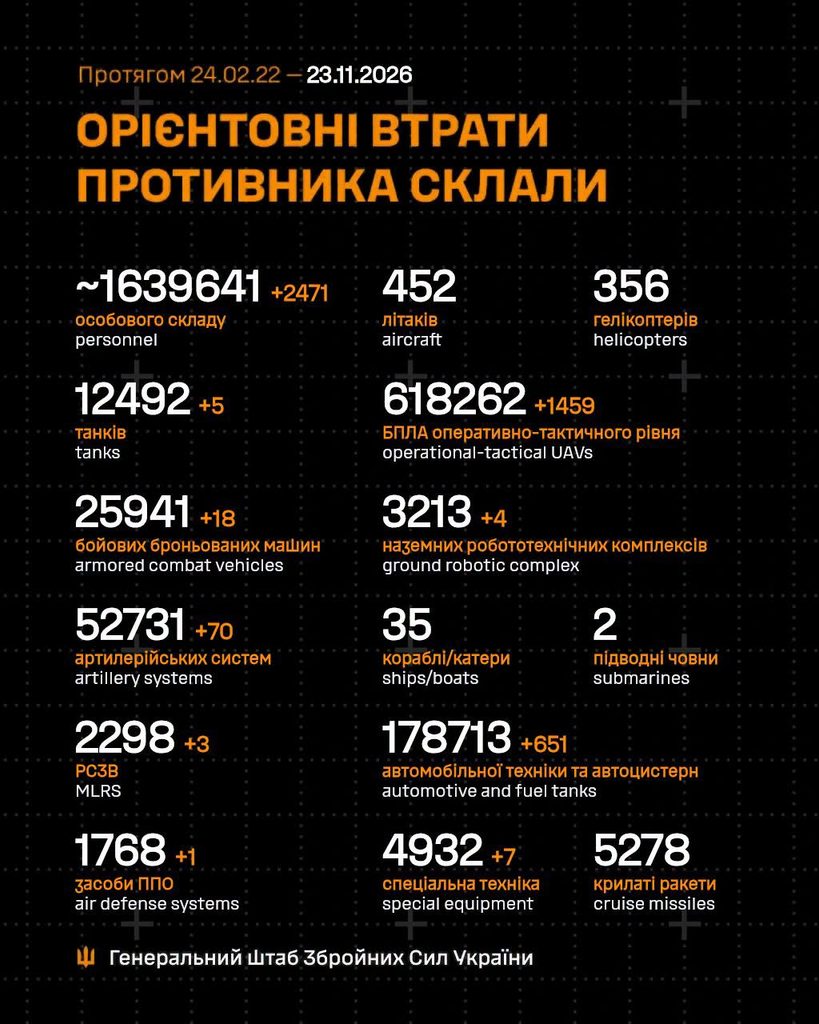
Ukrainian General Staff morning report
Comment:
57 localized attacks out of a total of 149 gives 92 unlocalized, and thus the ratio is 92 / 57 ≈ 1.61.
Operational information as of 08:00 on November 23, 2026, regarding the Russian invasion
Glory to Ukraine!
The 1734th day of the Russian Federation’s full-scale armed aggression against Ukraine has begun.
Total Russian attacker losses during the past day amounted to 2,471 personnel. Additionally, five tanks, 18 armored fighting vehicles, 70 artillery systems, three rocket artillery systems, one air defense system, four ground-based missile systems, 1,459 unmanned aerial vehicles, 651 vehicles, and seven units of special equipment were neutralized.
During the past day, a total of 149 combat engagements.
Yesterday, the enemy conducted 72 airstrikes, during which 254 guided aerial bombs were dropped. Additionally, the attackers used 7,964 kamikaze drones and carried out 2,250 shellings against communities and our troops’ positions, of which 25 were with rocket artillery.
Enemy shelling affected, among others, the communities of Korenok, Tovstodubove, Ulanove, Bachivsk, Iskryskivshchyna, Volfyne, Neskuchne, Yastrubshchyna, Bezsalivka, Luzhky, Topolia, Vilna Sloboda, Sopych, Fotovyzh, Hirky, Shalyhyne, Vovkivka, Malushyne, Brusky, and Studenok in the Sumy region, as well as Khrinivka and Leonivka in the Chernihiv region. Luzhky was subjected to an airstrike.
During the past day, the defense forces’ aviation, missile units, and artillery hit two areas with concentrations of enemy personnel and equipment, two command posts for unmanned aerial vehicles, and two artillery systems.
In the northern Slobozhansky and Kursk sectors, the attacker conducted three airstrikes with six guided aerial bombs and 52 shellings against our troops’ positions and communities.
In the southern Slobozhansky sector, Ukrainian units repelled three enemy attacks in the direction of Rubizhne, Bochkove, and Ivashchyne.
In the Kupyansk sector, the enemy conducted no assault operations.
Attempts to break into our defense were repelled in the Lyman sector, where the occupiers carried out seven attacks towards Zarichne and Lyman.
In the Slovyansk sector, the enemy carried out six attacks in the areas around Yampil and Ozerne.
In the Kramatorsk sector, the enemy carried out no attacks.
In the Kostyantynivka sector, 17 attacks were recorded. The attackers conducted offensive operations in the area around Kostyantynivka as well as towards Novoselivka, Dovha Balka, Rusyn Yar, Hruzke, and Vilne.
In the Pokrovsk sector, the enemy carried out 15 attacks. The occupiers attempted to advance towards Chernihivka, Dobropillia, Bilytske, Krasnopodillia, Shylivka, Myrne, Serhiivka, and Molodetske.
In the Oleksandrivka sector, the enemy carried out no assault operations.
In the Huljajpole sector, the occupiers attacked our defenders’ positions seven times. According to updated information, the enemy tried to advance towards Dolynka, Uspishne, Rybne, and Rizdvianka.
In the Orikhiv sector, two attacks were recorded towards Zarichne and Pavlivka.
In the Prydniprovsk sector, the enemy carried out no assault operations.
In the Volyn and Polissya sectors, no signs have been detected that the enemy is forming offensive force groupings.
We continue to stop the Russian armed aggression.
Join the defense forces! Glory to Ukraine!
SLAVA UKRAINI


Don't forget to donate, Ukraine's cause is ours! Support Ukraine!


** ❗️🚢BREAKING: Ukraine has released footage of the attack on the Russian corvette Merkury off the coast of Libya. The corvette was sunk, along with a Ka-27 military helicopter. Seven Ukrainian-made naval drones were used. The second vessel hit is said to be Russian military cargo ship MV ANGARA. ** Video:
https://bsky.app/profile/specialkhersoncat.bsky.social/post/3n2xlwrnvdk2u
Lukoil oil refinery in Perm
** Perm. One of Russia’s largest oil refineries is on fire. LUKOIL-Permnefteorgsintez has a processing capacity of around 13 million tonnes of oil per year. It produces gasoline, diesel, jet fuel, and other petroleum products that support Russia’s economy and military logistics. **
https://bsky.app/profile/antongerashchenko.bsky.social/post/3n2xlygdxgs2b
** Back to Ukraine attacks now, and as I said the attack on the Lukoil refinery in Perm’ is ongoing and here’s another new video just in. Clear evidence of big fires burning at the plant now, as one Ukraine drone manages to avoid all Russian air defence and fly serenely beyond it. ** Video:
https://bsky.app/profile/twmcltd.bsky.social/post/3n2xjx3csqc2v
** Lukoil refinery in Perm, Russia, this morning after the overnight Ukrainian drone attack. **
https://bsky.app/profile/specialkhersoncat.bsky.social/post/3n2xizjdwrc26
** 🔥🛢️Ukrainian drones attacked the Lukoil oil refinery in Perm, Russia. It is one of Russia’s largest refineries, with a processing capacity of 13.1 million tonnes of oil per year ** Video:
https://bsky.app/profile/specialkhersoncat.bsky.social/post/3n2xiigxygs23
Novoshakhtinsk oil refinery in Rostov
** ‼️Multiple Ukrainian drones struck the Novoshakhtinsk oil refinery in Russia’s Rostov Oblast overnight on November 23, triggering several large fires. Flames are visible from for away. The refinery, which has a maximum annual processing capacity of 7.5 million tonnes, produces various products. ** Video:
https://bsky.app/profile/noelreports.com/post/3n2xlyb5o5k25
**🔥🛢️The Lukoil refinery in Perm wasn’t the only Russian refinery attacked overnight. The Novoshakhtinsk refinery in Rostov Oblast was also targeted. Novoshakhtinsk can process 5.6 million tonnes.**
https://bsky.app/profile/specialkhersoncat.bsky.social/post/3n2xkcupyhk2m
** Even now in the morning the fire in the Novoshakhtinsk refinery in Russia is still raging. ** Video:
https://bsky.app/profile/tendar.bsky.social/post/3n2xgcxnc422b
** ❗️The Novoshakhtinsk oil refinery continues to burn after an overnight attack by Ukrainian drones. ** Smoking video:
https://bsky.app/profile/militarynewsua.bsky.social/post/3n2xqvvlm452r
** Russia launched 153 long range drones and no missiles overnight. Of these, 134 were stopped – a minimum of 87.6% but actually over 90% with many still flying. For jet drones 42 of 60 were intercepted. There were hits at 11 locations. **
https://bsky.app/profile/twmcltd.bsky.social/post/3n2xjdapnn22v
There is now a newly translated film:
Day 1733 of the war. Volodymyr Zelenskyy’s speech to the Ukrainians
Volodymyr Zelenskyy reports on Russian attacks in the Kyiv region as well as efforts to restore electricity supply. He also emphasizes the importance of defense cooperation and Ukraine’s integration into the EU.
Category: Zelenskyy’s speeches, interviews, and meetings
Date: 2026-11-22
In the video above, you can see that Zelensky is starting to look worn out after 1733 days.. 🫂
** Interestingly, the footage shows that the naval drone used to attack the Russian military cargo ship was also equipped with missile armament, most likely unguided rockets. ** Video:
https://bsky.app/profile/specialkhersoncat.bsky.social/post/3n2xm5n3loc2u
There is now a newly translated film:
Chaos on Crimea: Thousands fill the streets after an attack on the bridge has left them trapped
Ukrainian attacks on the Crimea bridge and other supply routes have caused fuel shortages and logistical problems, leading to widespread discontent among the civilian population.
Category: RFU News
Date: 2026-11-22
👍
In the bigger picture, the attack ratio seems to correlate somewhat with KWIA, but looking at variations over shorter periods, it appears completely random.
The lower chart shows that it is the unlocalized ones that mostly affect the total number of attacks.
No definitive conclusions can be drawn about the correlation.
KWIA can be high despite a low total and low ratio and vice versa, but sometimes they also match quite well.
Then you almost get a feeling that there is a delay in the reporting of the battles by 3-4 days. The charts would match a little better if KWIA was moved forward..
“The charts would match a bit better if KWIA was moved forward” –
I am trying to neutralize the lag with a three-day average (as in both charts above). Otherwise, it looks even more random in the upper chart. You can try a seven-day average.
1. Two dominant hubs in Donetsk: Pokrovsk & Kostjantynivka
Pokrovsk is consistently the single heaviest Russian assault sector with 586 recorded ground attacks over the entire period (31.6% of all localized assaults) and 136 during the latest eight-day period from the 16th–23rd of November (average 17.0/day, with a peak of 26 on November 21).
Kostjantynivka steadily ranks second with 439 assaults in total (23.7%) and 106 during the 16th–23rd of November (average 13.3/day, with peaks around 18 on November 16 and 20 and 17 on November 23).
Together these two adjacent sectors account for 55.3% of all Russian ground attacks over the entire time series (and 54.0% during the 16th–23rd of November).
2. Northern flank (Lyman & Slovyansk) gains more ground during 16–23 November
While Huliaipole in the south was clearly larger than Lyman and Slovyansk at the end of October (104 assaults from Oct 26–Nov 3 versus 72 in Lyman and 21 in Slovyansk), Lyman (57 assaults, average 7.1/day) and Slovyansk (40 assaults, average 5.0/day) have overtaken Huliaipole (43 assaults, average 5.4/day) during the period 16–23 November.
Especially Slovyansk has climbed from 2.7% of assaults in the early phase to 8.9% during 16–23 November (with a local peak of 12 attacks on November 19).
3. N. Slobozhansky & Kursk: Brief ground spike in an otherwise fire support-dominated sector
N. Slobozhansky & Kursk mainly functions as a sector for air (KAB), artillery, and MLRS fire with sparse ground assaults (63 assaults in total).
During 16–23 November however, a clear local deviation is visible: after 0 ground attacks from 16–18 November and 3 on November 19, ground assaults spike to 10 on November 20 (and 2 on November 21), before returning to only air and fire bombardment on November 22–23.
4. Almost completely quiet or inactive zones
Prydniprovsky has 0 recorded ground assaults in the entire data series (Oct 26–Nov 23).
Kramatorsk (20 total, only 2 during 16–23 November), Oleksandrivsk (13 total, 3 during 16–23 November) and Kupiansk (22 total, 3 during 16–23 November) are at very low or sometimes zero assault levels.
👍
Kaleikino oil pumping station
“🔥 In the city of Almetyevsk, Republic of Tatarstan, the Defense Forces attacked one of Russia’s key oil transportation infrastructure facilities, Kaleikino oil pumping station.” Video:
https://bsky.app/profile/maks23.bsky.social/post/3n2xn2rsr2c2c
** 🇺🇦 Ukrainian strike reportedly hits major Druzhba oil pipeline infrastructure in Russia’s Tatarstan. Ukrainian forces reportedly struck the Kaleikino oil pumping station in Tatarstan, approximately 1,000 kilometres from the front line **
https://bsky.app/profile/osintradar.bsky.social/post/3n2rdocknps2k
** Russia 🇷🇺 Tatarstan 🎥 A pleasing sight! A pumping station, “Kaleikino,” in the Russian region of Tatarstan was attacked by drones, OSINT channels report. This is one of the key nodes in the Russian oil transportation system. The pumping station is located ~ 1300 km from Ukraine 📭:@skyoverukraine 🇺🇦 ** Video:
https://bsky.app/profile/blue24world.bsky.social/post/3n2wfbe4rec22
Now waiting for atmospheric films with Russians waiting for soup in mile-long queues. It should be the season for that now.
** ❗️Work on destroying 🇷🇺Russian logistics on logistics routes in the occupied territories continues. ** Videos:
https://bsky.app/profile/militarynewsua.bsky.social/post/3n2xqruesmv2r
** How did Russian forces in Ukraine replace Starlink after it was blocked from using the system? A rare video of Russian communications troops repairing fibre optic cables illustrates how Russia has adapted.
The footage, published by ‘Military Chronicle’, shows Russian Armed Forces communications brigade in action. As the channel notes, “the primary task of this unit (and others like it) is the repair and maintenance of fibre optic cables.”
“Russia was forced to use them en masse after banning “grey” Starlink terminals in Ukraine and adding them to a “whitelist” with mandatory user verification. However, fibre optics had been used before, for example, for laying communications between occupied areas.
“Once the Rassvet satellite constellation reaches its full network capacity and density, the need for fibre optics will remain, but will be significantly reduced.” ** Video:
https://bsky.app/profile/chriso-wiki.bsky.social/post/3n2xqgsd3ux2j