
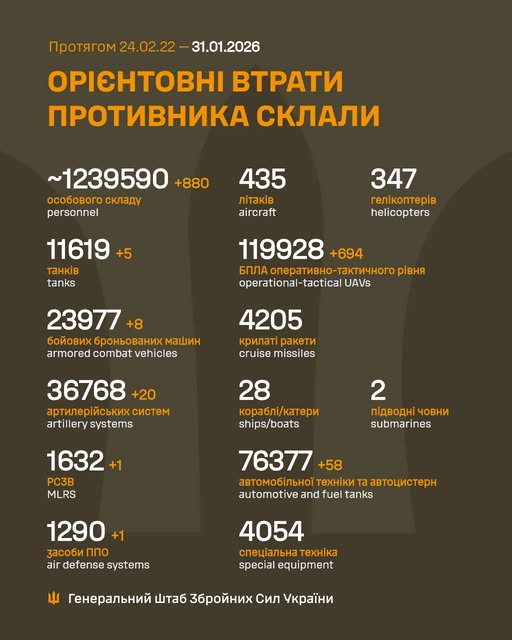
- 880 KWIA
- 5 Tanks
- 8 AFVs
- 20 Artillery systems
- 1 MLRS
- 1 Air defense systems
- 694 UAVs
- 58 Vehicles & fuel tanks
SLAVA UKRAINI


Don't forget to donate, Ukraine's cause is ours! Support Ukraine!
SLAVA UKRAINI
Don't forget to donate, Ukraine's cause is ours! Support Ukraine!
You must be logged in to post a comment.


For every two Russian attacks (localized in the AFU report) one unlocalized (possibly Ukrainian*) attack. *If Ukrainian, it may indicate a significant counteroffensive from the Ukrainian side after yesterday’s record-breaking Russian offensive.
N Slobozhansky-Kursk 0
S Slobozhansky 25💥💥↗️
Kupyansk 6↘️
Lyman 9💥↘️
Slovyansk 7
Kramatorsk 0
Kostjantynivka 14💥↘️
Pokrovsk 46💥💥💥↘️
Oleksandrivskij 9💥↘️
Huliaipole 19💥↘️
Orikhivsk 3
Prydniprovskij/Dnipro 1
Sum sectors 139↘️↘️
Unlocalized 65↗️
Total 204↘️
S Slobozhansky 25💥💥↗️
Localized (Russian) attacks per section, accumulated total
Total (localized + unlocalized)
👍
AFU 🇺🇦:
“⚡️⚡️Tor-M1 air defense system, UAV control points, and other military facilities belonging to the enemy have been hit.
As part of the measures to reduce the offensive capacity of the Russian aggressor, units from Ukraine’s defense forces struck a number of facilities yesterday and overnight on January 31 in the temporarily occupied areas of Ukraine and on the aggressor state’s territory.
⚡️In the temporarily occupied part of the Luhansk region, in the area around Kamianka, the enemy’s Tor-M1 air defense missile system has been hit. Results are being specified.
⚡️In the temporarily occupied territory in the Zaporizhia region, the enemy’s UAV control point (Rivnopillia) has been hit, as well as a storage of material and technical resources belonging to a separate motorized infantry brigade (Voskresenka) and a concentration of enemy forces in the areas of Rivnopillia, Pryvillia, and Uspenivka.
⚡️In the temporarily occupied part of the Donetsk region, in the area around the village of Poltavka, a control center belonging to an enemy motorized infantry regiment has been hit.
⚡️Additionally, units from Ukraine’s defense forces struck a hostile unmanned aerial vehicle control point in the area around Sluchovsk in the Bryansk region of Russia yesterday.
⚡️Furthermore, an attack has been carried out on a concentration of enemy forces in the area around the town of Chasiv Yar in the occupied part of Donetsk oblast.
🔥🧐Enemy losses and the results of the attack are being specified.
💪Ukraine’s defense forces will continue to systematically carry out measures aimed at weakening the Russian aggressor’s offensive capacity and reducing its combat potential.
To be continued.💥
Glory to Ukraine!🇺🇦🇺🇦🇺🇦”
AFU reports:
204 stridssammanstötningar
69 flyganfall
174 KAB
6,731 kamikaze-dronar
4,098 granater (114 från MLRS)
Russia is the number one enemy of the USA, contrary to what we are brainwashed with every day here on the blog. This is according to Cuban-American and Ukrainian politicians, who are still considered to have their feet on the ground (in Ukraine and the USA & Cuba), below.
Can Sweden send a robot with a longer range (200-200 miles, Sweden – to develop a robot to deter Russia, Oct 23, 2024) to Cuba to deter them and Russia? Don’t we (did we?) have an island in the Caribbean where we can base the robot? Johan, maybe you are nearby and can scout? Or send Den Gamle. Although he has probably had some shady dealings with a certain Che Guevara.. 🤨..
”
Tonight, the United States effectively formalized a casus belli regarding Cuba. My forecast: either there will be military intervention, or the regime will collapse on its own.
An executive order by Trump has appeared on the White House website. The essence of the document is simple. It states directly that the Cuban regime cooperates with and supports forces that the United States considers hostile. Russia 🇷🇺 is first on that list. Next come China, Iran, Hamas, and Hezbollah. In other words, Cuba is described not merely as a communist dictatorship, but as a platform where America’s adversaries operate freely.
— @m_zablotskyy
”
Thank you for your solidarity.
The regime in #Cuba is directly responsible for aiding Russia in its illegal, horrific invasion against #Ukraine.
Know that we Cuban-Americans support the brave Ukrainian people as you continue to defend your homeland from Putin’s aggression!
— @repcarlos
In their own geopolitical interest sphere, it is certainly true that they prefer to avoid Russia and China in order to have full control themselves, but when it comes to Ukraine, they don’t seem to care very much. There, they just want to achieve peace.
Why is it so important for them to achieve peace? To the extent that they believe Ukraine should give up territories, etc. The USA does not contribute much, so they do not have any major costs directly, rather they get to sell weapons that the EU and others pay for.
What is your theory about this?
My hypothesis is that the USA (the administration, the Senate) is well aware that Putin must continue the war to keep Russia together domestically. And it is certain that Russia will never agree to a peace agreement, even if offered exclusive control over the entire Donbass. For the existence of Ukraine is an existential threat to the Kremlin, just as an end to the war itself would be for the Kremlin. Putin needs to continue the war for the sake of war itself, and ultimately to wipe out Ukraine. The leadership of the USA knows this at least as well as naive (in several recurring cases, e.g. TY, Fr, SE) counterparts in Europe. The peace process aims to clarify this relationship publicly. Then it becomes domestically in the USA (it is already internationally) fully legitimate to do to Russia what has just been done to Venezuela, and planned against Iran. North Korea. Then China has no friends left.
I really hope that you are right, even though I myself am not at all so sure.
Joni Askola (@joni_askola) January 23, 2026:
Putin is trapped. He cannot stop the war because he hasn’t reached his strategic goals.
Stopping now means admitting he destroyed his country for nothing.
The only way to peace is to hit them so hard that they are the ones begging to stop
”For [Putin], it is not crucial whether Russia wins quickly, loses slowly or gets stuck in a protracted war of attrition. The crucial thing is that the system survives – and in that sense, the war is a tool rather than a problem.”
— K.Gregg 18 Jan 2025 upd
Development:
https://www.facebook.com/share/p/17omhKGVhp/?mibextid=wwXIfr
“
Putin’s grip on power explains why the war in Ukraine does not end
There is still a persistent belief in the West that the war in Ukraine will somehow end “on its own” – through economic collapse in Russia, popular discontent, or an internal power struggle in the Kremlin. This image is more based on wishful thinking than on analysis. In reality, the connection between Vladimir Putin’s power position and the character of the war in Ukraine is both clear and uncomfortably consistent.
Vladimir Putin still holds power firmly. Not because he is popular, successful, or efficient – but because the entire Russian state system is built on control, fear, and institutional deadlock. The security apparatus is loyal, the opposition crushed, and all formal powers concentrated around the president. There is no visible alternative power center and no mechanism for a quick change of power.
This is exactly why the war in Ukraine looks the way it does.
As long as Putin is not threatened from within, there is no real incentive to end the war. For him, it is not crucial whether Russia wins quickly, loses slowly, or gets stuck in a prolonged war of attrition. The crucial thing is that the system survives – and in that sense, the war is more of a tool than a problem. A ongoing war legitimizes repression, silences opposition, explains economic failures, and binds society and power through fear and a siege mentality.
This is clearly reflected on the battlefield. Russia avoids actions that could create domestic shock, such as full mobilization or high-risk offensives. Instead, the war is conducted with limited ground operations, high tolerance for losses, and a growing focus on low-intensity air strikes. Small groups of drones are sent night after night towards Ukrainian cities – not to knock out energy systems in a decisive battle, but to wear down society over time.
Militarily, this is inefficient. Politically, it is rational.
Targeting electricity, heating, water, and housing creates an insecure daily life, stress, and economic burden – both for Ukraine and its allies. It is the same logic that keeps the Russian power system alive: endurance through suffering. For Putin, the war is not a failure as long as it does not threaten his grip on power.
That is why waiting for a Russian collapse is dangerous. As long as the security apparatus functions, repression increases, and no rivals are allowed to emerge, the war will not end from within Russia.
Ukraine’s future is therefore not determined by Putin’s fall, but by Ukraine’s and the West’s ability for long-term endurance.
The consequence is clear: the war enters a phase that is less spectacular but more demanding. Fewer sensational headlines, more nightly alarms. Less breakthroughs, more everyday wear and tear. Energy supply, repairs, healthcare, and societal resilience become as crucial as artillery and drones.
Putin is not strong because he wins the war. He can continue the war because he controls his system. And that is why this war will be long, brutal – and decided by who can endure the longest.
The signs are becoming increasingly clear: Russia is losing influence – step by step
Russia is not experiencing a sudden collapse. But the country is gradually losing what practically determines great power status: the ability to influence other states’ decisions, shape international rules of the game, and transform military and economic strength into political influence. This weakening is happening slowly, but the pattern is now clear.
One of the most revealing signs is that Russia’s influence today more and more often needs to be bought, rather than chosen. In Africa, the Middle East, and parts of Asia, relationships are built not on long-term alliances but on transactions: security services in exchange for natural resources, military support for base rights, political support for discounts, debt relief, or weapon deliveries. It is influence that works as long as the ability to pay exists – and that quickly disappears when the costs become too high.
At the same time, perhaps Russia’s most important tool of power has been eroded: the energy weapon. For decades, the Kremlin could use gas and oil to influence political decisions, especially in Europe. That time is practically over. Europe has broken its dependence on Russian gas, oil exports are made at significant discounts, and the transports depend on an expensive and vulnerable shadow fleet. Russia can still sell energy, but can no longer control markets or use deliveries as an effective political leverage.
Militarily, influence is also decreasing. Despite enormous efforts, Russia has failed to translate military violence into political results in Ukraine. No decisive breakthroughs have been achieved, no political concessions have been forced, and Western support for Kyiv has rather been strengthened than weakened. Globally, the war has damaged Russia’s military prestige: weapon systems are being questioned, export customers hesitate, and the image of Russia as an efficient military power has deep cracks.
Relations with the remaining partners also show how isolated the country has become. Cooperation with China, Iran, and North Korea is not equal alliances but asymmetric dependencies. China buys Russian energy cheaply but offers no security guarantees. Iran cooperates tactically but pursues its own regional interests. North Korea is more of a last resort than a strategic partner. It’s not about bloc formation, but about Russia being forced to accept subordinate relationships to keep the system running.
Another clear sign of loss of influence is that Russia is increasingly less setting the international agenda. Today, Moscow reacts more often than it acts: to sanctions, oil price movements, logistical constraints, and Ukrainian attacks on military and energy infrastructure. The ability to force other actors to adapt to Russian decisions has decreased significantly.
When external influence decreases, control inward often strengthens. In Russia, this happens through increasing repression, tougher legislation, more propaganda, and an increasingly strong security state. For Vladimir Putin, this helps secure power in the short term. But the price is high: international attractiveness diminishes, and the country becomes increasingly isolated.
In summary, Russia is still capable of disrupting, threatening, and sabotaging. But that is not the same as having influence. Shaping alliances, influencing markets, and controlling political outcomes require resources, credibility, and options – and these are now shrinking.
Russia is not losing influence through a dramatic collapse:
– They are losing influence through erosion.
– Slightly less energy power.
– A few less real partners.
– Slightly lower military credibility.
– Slightly greater dependence on repression.
In geopolitics, this is often how great powers lose their position – not overnight, but relentlessly, step by step.
It is also a war of attrition against Russia. Where active warfare against Syria, Iran, Venezuela, Cuba, economic warfare against Indian imports of Russian oil, American diplomatic offensives in Belarus, Azerbaijan, step by step effectively undermine Russia and undermine Russia’s war against Ukraine, making the war an increasingly existential issue, where everything in Russian society is put to the test. Add to that reports from before Christmas that the USA provided Ukraine with information to help combat oil refineries. They also continue to maintain American war-winning weapon systems in Ukraine (HIMARS, Patriot, F16, Starlink, intelligence). There is NOTHING that the USA does or has done that helps, or has helped Russia win the war against Ukraine. Disprove me!
An annual reduction in support of between 30-50 billion USD must surely be seen as a huge advantage for Russia, right?
That is almost equivalent to nearly a third of what Russia spends on its military budget each year.
Sanctions have been lifted against Belarus regarding aircraft spare parts, something that Russia can surely benefit from.
In terms of prestige, Putin and Russia have been elevated simply by meeting and discussing collaborations, etc. Instead, the opposite should be done, undermining Putin to create space in Russia for dissatisfaction and doubt.
Instead, Zelenskyy is diminished.
When the most effective way to hit hard against Russia would be to instead strengthen Ukraine and help them defeat them.
I rather think that Trump wants Russia and China to stay on their own side so the USA can take control on its side. Undermining Russia’s economy is in the USA’s self-interest, but of course, it benefits Ukraine, although there is nothing indicating that they do it for Ukraine’s sake.
Zelensky was already short, he hasn’t gotten any shorter, – joking aside, what I mean is that talk is talk, it’s not the same as facts – that something actually happens.
“Prestige” is also just talk, not facts. Prestige doesn’t cover a fire in one of Russia’s largest oil refineries.
Regarding weapons, the fact is that Europe has long been dragging its feet and relying heavily on American action, and the USA has, with some factual basis, shifted the responsibility for Europe onto Europe. As we can see, the war is part of a larger web of conflicts far outside Europe, with known actors where Russia is a key player. But Europe has not taken on the larger conflict. Where was/is Europe in the overthrow of illegitimate dictatorships like Syria, Iran, Venezuela, Cuba? Which have contributed significantly to the Russian war machine. Perhaps more than what weapons worth tens of billions of dollars contribute? Hasn’t Iran stopped supplying drones and missiles to Russia’s war in Ukraine since the American-Israeli attack last summer? (What did this attack cost in billions of dollars? What did Europe contribute?) What happened to using frozen funds in Europe to buy weapons from the USA? Why aren’t Taurus and Storm Shadow in Ukraine?
Belarus -. (But sanctions regarding re-exports also apply to Belarus)
Grok:As I am informed USA and Israel hit Iran last year targeting nuclear processing capability. What I am curious about is the cost of such an operation, and specifically how much money did USA and Israel spend in pursuing their attack against Iran?
Extract:
In June 2025, Israel launched a series of strikes against Iranian military and nuclear targets in a 12-day conflict dubbed Operation Rising Lion, which began on June 13 and ended with a ceasefire around June 24. The United States directly participated on June 22 with Operation Midnight Hammer, targeting three key nuclear sites: Fordow, Natanz, and Isfahan. This joint effort aimed to degrade Iran’s nuclear processing capabilities, though assessments vary on the long-term impact, with some U.S. intelligence estimates suggesting a setback of only months to two years.
Estimates for the costs incurred by the U.S. and Israel focus on direct military expenditures for munitions, aircraft operations, missile defense, and related activities during this specific operation. These figures do not include broader economic impacts, long-term rebuilding, or prior investments in military hardware development.
### U.S. Costs
The U.S. portion, centered on the single-night Midnight Hammer strikes, is estimated at $2.04 billion to $2.25 billion in total direct expenditures.
### Israeli Costs
Israel’s expenditures for the full 12-day operation are estimated at $8.7 billion to $12.2 billion, with daily costs averaging $725 million ($593 million for offensive operations like airstrikes and $132 million for defense and mobilization).
Some reports differentiate between direct military spending ($8.7-12.2 billion) and total economic losses ($6-17.8 billion, or 1-3.3% of Israel’s ~$540 billion GDP), but the former aligns with operational outlays for the attacks.
Actual figures may vary due to classified details and differing accounting methods.
Everything the USA does in South America is probably about removing competing countries from its hemisphere. The USA’s tough stance on Cuba is nothing new; they have refrained from military operations since the Bay of Pigs, but otherwise, the goal has always been to remove the regime and Russia from there.
And as you write, the USA is probably pulling the rug out from under Russia here and there.
The USA sometimes achieves positive results, positive in the sense that it is negative for Russia. However, I believe that much of the positive outcome is a side effect. The USA sees that Russia has weakened and simply takes the opportunity to fill the void before China does.
Under Trump, the USA does not have any ideological goal of spreading democracy in the world and helping people overthrow dictatorships. Maybe it wasn’t always like that in the past either, but now it’s about business and natural resources. Old alliances are broken if they do not allow the USA to exploit the other party, just as Russia enters into alliances.
For us, the war in Ukraine is closest to our hearts, and we want Ukraine to win and Russia to disappear (preferably). The USA does not have the same goal; otherwise, the support would look completely different. Their goal is to end the war so they can do business with Russia and access the natural resources in eastern Ukraine, whether they belong to Russia or Ukraine doesn’t matter, as long as the USA has the right to them. Trump pressures those he considers to be in a weaker position; it’s in his nature. So initially, he was tough on Zelensky because he took the information he received from Putin as facts, but lately, he has begun to realize that Ukraine, together with Europe, may not be so weak after all. Now he has started to put more pressure on Russia, both in words and actions (sanctions against Lukoil).
However, I am skeptical about peace negotiations in the form of a business deal.
I believe that security takes precedence over business value even in the current Trump regime. And there, Russia is a threat and not an opportunity. An explicit example of this is the executive order regarding Cuba above. If the Cuban Missile Crisis had unfolded differently, it would probably have affected the outcome of the Cold War. I think many countries in Europe breathed a sigh of relief when the Russian fleet turned back.
I continue riding on my hobbyhorse: there are competing interests in the American administration, and Trump probably doesn’t have many fixed principles. There is no honor among thieves, so he is definitely not a reliable friend of Putin, although I personally believe that Trump himself has admired/envied Putin to some extent, but this could very well turn into contempt when Putin shows weakness. John Bolton has previously said that Trump places great importance on personal relationships when it comes to foreign policy.
Cuba is probably pushing Marco Rubio around, by the way.
Kremlinology… that one would need to apply such things to the White House.
The Government of Cuba has taken extraordinary actions that harm and threaten the United States.
”Cuba🇨🇺 aligns itself with — and provides support for — numerous hostile countries, transnational terrorist groups, and malign actors adverse to the United States 🇺🇸 , including Russia 🇷🇺 , China 🇨🇳, Iran 🇮🇷, Hamas, and Hezbollah. ”.
For example, Cuba blatantly hosts dangerous adversaries of the United States, inviting them to base sophisticated military and intelligence capabilities in Cuba that directly threaten the national security of the United States. Cuba hosts Russia’s largest overseas signals intelligence facility, which tries to steal sensitive national security information of the United States. Cuba continues to build deep intelligence and defense cooperation with the PRC. Cuba welcomes transnational terrorist groups, such as Hezbollah and Hamas, creating a safe environment for these malign groups so that these transnational terrorist groups can build economic, cultural, and security ties throughout the region and attempt to destabilize the Western Hemisphere, including the United States. Cuba has long provided defense, intelligence, and security assistance to adversaries in the Western Hemisphere, attempting to thwart United States and international sanctions designed to enforce the stability of the region, uphold the rule of law, and safeguard the national security and foreign policy of the United States. Cuba continues to try to thwart United States efforts to address threats to the United States posed by hostile countries, transnational terrorist groups, and malign actors, including in the Western Hemisphere.
https://www.whitehouse.gov/presidential-actions/2026/01/addressing-threats-to-the-united-states-by-the-government-of-cuba/
Joni Askola, @joni_askola:
“If spheres of influence return, Russia falls into Europe’s orbit, not the other way around.
Their economy is smaller than Italy’s.
You cannot dictate terms to a continent when you are that weak.
Russia is not a superpower”
The USA could have ensured that Ukraine won the war as early as 2022.
Europe could have too.
The USA does what is good for the USA, which MXT does not agree with 😀
Yesterday’s economic atomic bomb was also good for US financial institutions.
In the Ukraine war, our interests did not align with those of the USA.
For Iran, it does.
The Kurds were a betrayal that I still find hard to digest.
Yes, Europe too as you say. If the USA/Europe had done it, Russia would have had its war-financing infrastructure completely intact, Putin probably still in power with a huge arsenal of artillery, grenades, missiles. Continued construction in Iran. An intact Wagner wreaking havoc in different countries. And Europe would have just turned over the pillow and fallen back asleep, cranked up for the gas taps via North Stream II, without any hint of European defense industry. Russia’s military force today is well post-Cherson and post-Kupyansk offensive? That is, renewed, minus the above equipment?
I BELIEVE that the agreement that we will eventually be forced to see Ukraine sign has a lot of provisions on how Russia should be treated, probably more than Ukraine.
The moment the agreement is in effect, the USA will force Europe to normalize the situation.
Then it will be quiet.
And in that silence, Russia will rebuild its defense forces.
That’s what I believe because Ukraine probably can’t hold out any longer now that Europe has allowed itself to be talked around.
Then Europe will be busy with a 2008-style financial crisis in about six months.
🇪🇺 The European Union is considering replacing the price cap on Russian oil with a full ban on maritime transport of Russian oil. The proposal could be included in the EU’s 20th sanctions package against Russia over its war against Ukraine.
Yes, that would be something, and put a stop to the shadow fleet. Orban and Fico can go in step as they please.
OT, Venezuela
A positive effect of Trump’s and the US’s efforts.
“Venezuela’s acting president Delcy Rodríguez has presented a proposal for a “general amnesty law” in the country, which would mean that hundreds of political prisoners could be released. This is reported by AP. – May this law serve to redirect justice in our country, Rodríguez said in a speech in the country’s highest court. If passed, the amnesty law would apply retroactively from 1999 to the present day, according to Rodríguez. Therefore, opposition politicians, journalists, and human rights activists who have been imprisoned since then could be released. Rodríguez clarified that individuals convicted of murder, drug trafficking, corruption, and human rights violations will not be pardoned. Rodríguez also announced that the Helicoide prison will be closed. Several organizations, including the UN, have found evidence of human rights violations and torture rooms in the prison.”
https://omni.se/a/XM6Jrg
“The Swiss company s2a observed the Russian recon satellite „Luch“ when it suddenly got destroyed. It is currently not confirmed what destroyed the Russian satellite. Suspicion falls on „debris“.”
https://bsky.app/profile/tendar.bsky.social/post/3mdpvr4yiyk2e
This sounds promising, very promising
Chinese scrap likely.
I hope it didn’t break into small pieces, but stayed in one piece that can fall down and burn up in the atmosphere
“😳 Vampire tears off the occupier’s HEAD Kostiantynivka direction. Vampire strike drone of the Predator brigade continues the targeted destruction of the enemy. The main tool is 8.5 kg FABs. One arrival – and the enemy shelters collapse, the equipment burns…”
https://bsky.app/profile/maks23.bsky.social/post/3mdpv6qy3yk22
Can one watch without risk of PTSD, or warning?
Kiev is in darkness – shouldn’t the Trump impeachment hearing be on now?
A ‘d’ sneaked into the artillery fire. D as in Donald.
🤣🤣🤣
Malmö company develops new close-range defense against drones
The Malmö-based startup company Valkyr Defense Systems has presented a new system for defense against drones at short distances. The system, named HILDR, is intended to complement existing air defense and protection solutions by addressing threats in the so-called last line of defense, where other systems often have limited effectiveness.
https://www.aktuellsakerhet.se/malmobolag-utvecklar-nytt-narforsvar-mot-dronare/
Interesting. This is not the first time a person from Malmö/Lund has come up with military solutions. I’m thinking of Gunnar Lundholm who developed the Sterling engine to work in Kockums submarines. The idea is old but no one fully developed it. He started United Sterling and I believe the business was located in Arlöv. He collaborated with McDonnell Douglas, the German automotive industry, and Saab (cars). But for various reasons, they dropped out. However, United Sterling continued and succeeded. Kockums, which was threatened with closure, began an intensive collaboration. The rest can be considered industrial history. This makes the submarines extremely quiet and Saab’s major selling point to potential customers. “Näcken” was the first to receive the Sterling engine in the 80s. This achievement even made headlines, I remember, which is considered unique as celebrities and sports figures competed for space on the front pages at that time.
👍interesting!
The gold rush was towards China
where they have New Year and everyone sells before that.
now they struck before and a couple are insolvent over there
wait and you’ll see 😀
Hmm, could it be so, exciting, it will show next week. China probably has some American bonds to sell.
It’s so exciting – guaranteed
Rackarns vad smart det var 😳
It might be a bullseye if the USA manages to steer the economic crisis towards the Far East instead of here. A bit like during Corona?
We are collateral because they probably didn’t trust us but China’s big uncontrolled crash is looming 🤩🤩🤩
All is not forgiven but I’m in a good mood.
MXT has a lot of Bitcoin and is feeling down
This was almost like a beautiful painting or an Ocean’s 12 heist.
I’m on cloud nine.
Now crypto is also plummeting by the way.
I wonder how much fun they think it is in El Salvador, where they use BitCoin as the official currency.
Herregud 😳
Now Iran is in on it too
Read tomorrow about the gold heist
Are you shorting Alibaba now?
I used to have China funds, they performed really well, but I switched most of them to something European on the 22nd, I think it was a good move.
“❗️The moment a 🇺🇦Ukrainian MiG-29 fighter jet drops 🇺🇸American GBU-62 guided glide bombs on 🇷🇺Russian targets on the front line”
🥌💥~🍊🦭
Kind of like when Trump does the seal. It must feel for the Russian.
Cuba declares state of emergency due to US actions
“The partial payment under the PURL initiative was not carried out. The robots did not arrive,” says Zelensky.
— Expressen