
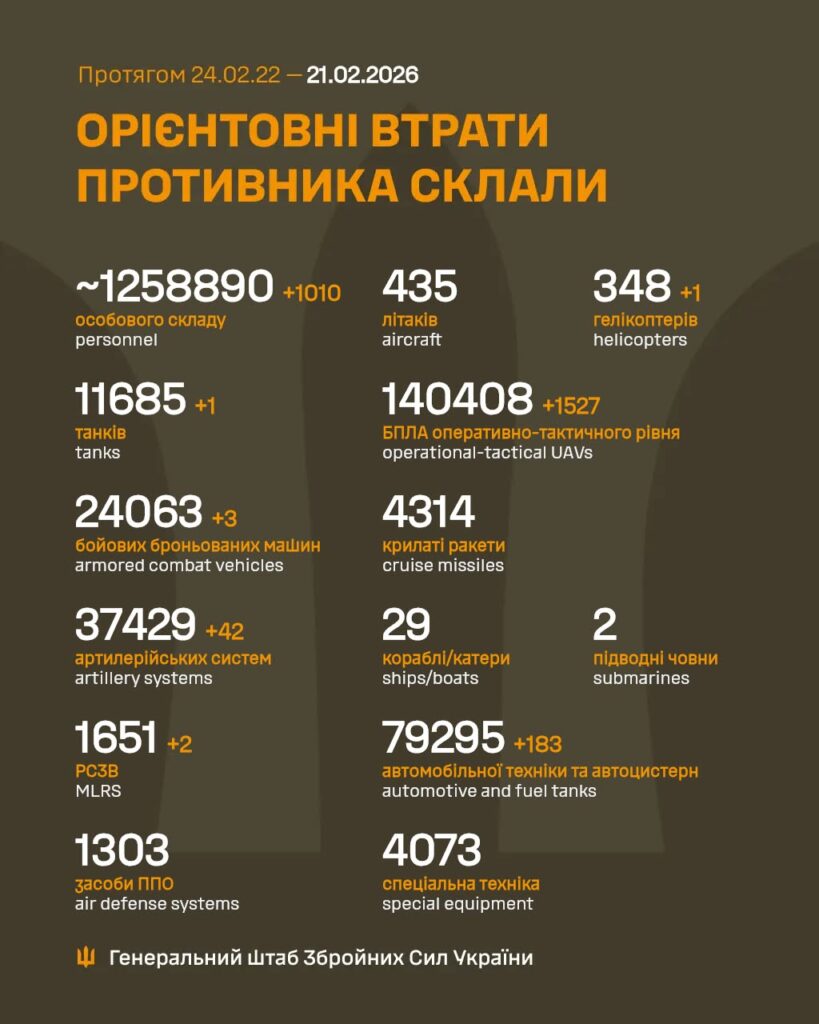
- 1010 KWIA
- 1 Tank
- 3 AFVs
- 42 Artillery systems
- 2 MLRS
- 1 Helicopter
- 1527 UAVs
- 183 Vehicles & fuel tanks
Russian activities
- 175 Clashes
- 89 Airstrikes
- 229 KAB
- 7,846 Suicide drones
- 2,967 Artillery attacks (69 from MLRS)
Russia’s nightly terror attack consisted of 120 Shahed drones and an Iskander-M. Ukraine downed 106 drones

SLAVA UKRAINI
OT: In addition, it was great to see that the Supreme Court in the US dared to go against Trump even though the majority of the judges were Republicans. There is still hope for the USA!


Don't forget to donate, Ukraine's cause is ours! Support Ukraine!


⚡️Update: 11 people have reportedly been injured as a result of a Ukrainian strike on a Russian ballistic missile factory. The attack was carried out with Flamingo missiles, and it targeted the Votkinsk plant in Russia’s Udmurtia region, where Iskander-M missiles are produced.”
https://bsky.app/profile/kyivindependent.com/post/3mfdze6srgk2d
https://kyivindependent.com/drone-strikes-russian-ballistic-missile-factory-over-1-300-km-from-ukraines-border/
Finally, the Iskander factory was painted pink!! I have been waiting for this!
Thank you!
Yes, it was hopeful with the Supreme Court’s decision.
I wonder how much substance there is in the leaked communication below regarding conspiracy with fake electors at the outcome of the 2020 election…?
https://open.substack.com/pub/deanblundell/p/live-w-congressman-denver-riggleman
Interesting! Of course, it’s impossible to know if the conspiracy is more than just that.
“❗️Strike drones attacked the 🇷🇺Neftegorsky gas processing plant in the Samara region overnight, causing a massive fire.”
https://bsky.app/profile/militarynewsua.bsky.social/post/3mfe54ot7zk2d
An increase in one sector only, Kostyantynivka 26💥💥↗️, while otherwise the pressure of the attacks decreased or was barely maintained. The proportion of unlocalized or Ukrainian attacks also decreased as a share of the Russian localized attacks (from 1 in two to 2 in five).
N Slobozhansky-Kursk 0↘️
S Slobozhansky 4↘️
Kupyansk 8↗️
Lyman 10💥
Slovyansk 10💥
Kramatorsk 0↘️
Kostyantynivka 26💥💥↗️
Pokrovsk 39💥💥
Oleksandrivskij 3↘️
Huliaipole 18💥↘️
Orikhivsk 3
Prydniprovskij/Dnipro 3
Sum sectors 124↘️
Unlocalized 51↘️
Total 175↘️
“❗️Drone operators of the “🇺🇦Gart” brigade destroyed a 🇷🇺Russian ammunition depot in the Southern Slobozhanskyi direction.”
https://bsky.app/profile/militarynewsua.bsky.social/post/3mfe5fy3brc2d
“❗️An attack on a Russian missile plant in Votkinsk, Udmurtia, Russia. 1,400 km from the border with Ukraine. The plant produces Iskander-M missiles, as well as Yars, Topol and Oreshnik missiles. It is under US, EU, Japan, Switzerland, Ukraine sanctions.”
https://bsky.app/profile/antongerashchenko.bsky.social/post/3mfe4ib6h4c24
Is sanctions another word for “import via another country”? Or does it actually work? Not only does it make it more difficult, but does it make importing impossible?
It’s probably a bit of both. It might be possible to stop more unique products/techniques, but unfortunately, it mostly complicates/expensive or forces them to use products of slightly lower quality (from China, for example).
I myself am not so convinced that the decision of the Supreme Court showed anything other than that the US Constitution is a robust construction. I am not convinced in itself whether the decision is positive or negative for the USA or the world, and in the world, us or certain antagonists to the West. China, for example, I do not cheer if they get a lot of money back due to the decision of the American Supreme Court. It is money that more or less directly goes to undermine our own economy and security. Hard to swallow, in other words.
It is easy for anti-Trumpism to take expressions that reinforce instead of solving real problems. Which leads to even stronger Trumpism. Exactly the same mechanisms that have led to the Sweden Democrats growing into one of the stronger parties in Sweden. In their eagerness to criticize someone/something, they shoot themselves in the foot.
I think you have fallen into Trump’s trap, that the exporter pays the customs duty. That’s wrong, it’s the importer and ultimately the American consumer who pays. No money should be paid back to China.
Regardless, tariffs lead to domestic production. Which we often find is better than outsourcing production. But just not when it’s Trump behind it. Then we gladly shoot ourselves in the foot. When Biden pursued the same policy, it was quiet. The same can be said about Europe’s dependence on Russian energy, Europe’s defense spending, and dependence on the USA. Politics in its absolute worst form.
The USA may well have whatever tariffs they want if they believe it’s good for them, but it should in that case be done with congressional approval, so that there is at least some form of anchoring in what the citizens think.
Tariffs were somewhat what Trump campaigned on, so the population is interrogated on the issue. But if Trump needs to take unconstitutional measures to fulfill his promise, that’s of course another matter. A certain responsibility towards the constitution may still lead one to choose to bring the matter to the Supreme Court. It’s probably not disputed that the legislation on the issue can be questioned. But that’s a completely different process. But as I said, on the issue, Trump did what he promised and what the voters chose.
Grok is a bit slow, but then it’s an early version, but gives me essentially right:
No, the statement is **not quite** true – it is a significant simplification that goes too far in several respects, even though it captures some of an ongoing change.
Let’s break it down step by step:
1. **The law of comparative advantages does not cease to apply just because production is automated**
Comparative advantages are about **relative** (comparative) costs/opportunity costs – not absolute. Even if labor costs → 0 through automation/robots/AI in many processes, there are still differences in:
– Energy prices (electricity, hydrogen, etc.)
– Access to raw materials and transport costs for these
– Capital costs (interest + depreciation on robots/AI infrastructure)
– Access to data, talent to train/maintain AI systems
– Regulatory environments (permit times, reliability of the power grid, carbon taxes)
– Logistics/infrastructure (ports, roads, power grid)
→ So, there are **more** factors creating comparative advantages, not fewer.
2. **Energy and raw materials are important – but far from the only ones**
Many sources (WTO reports, economic analyses 2024-2025) indicate that AI/automation is driving enormous demand for:
– Electricity (data centers + robots)
– Critical minerals (copper, lithium, nickel, rare earth metals for batteries, chips, engines)
Countries/regions with cheap, stable, and green energy (e.g. hydroelectric power in Norway/Québec, geothermal in Iceland, solar + wind + storage in certain parts of the Middle East or the USA) gain a **very strong** comparative advantage for AI-intensive manufacturing and data processing.
But that’s not the whole picture.
3. **Knowledge + production are interconnected – but not always as strongly as the statement suggests**
It is true that there are often advantages to having R&D, design, and production close to each other (e.g. Apple’s ecosystem, TSMC + Taiwanese cluster, automotive industry Tier-1 suppliers).
But in a world with extremely good digital communication + AI that codes, simulates, and optimizes → the need for physical proximity decreases for many types of knowledge.
Example: Many software companies design chips in the USA/Sweden but have them manufactured in Taiwan/South Korea without losing the “ability to develop the product”.
4. **What does reality say 2025-2026?**
– Automation/AI **reduces** the role of labor as a source of comparative advantage → that holds true.
– But it is not only replaced by energy + raw materials. New/remaining sources include:
– Access to **clean & cheap energy** (top priority)
– Access to **critical minerals** and semiconductors
– Strong **digital infrastructure** (fiber, low latency, data center capacity)
– **Institutional quality** (regulations, IP protection, legal certainty)
– **Clusters of AI/ML talent** (even though AI codes code → someone must steer the direction)
– Scale in **capital acquisition** for massive investments (factories cost billions)
In summary:
The statement is **partly true** regarding the dramatic decrease in traditional low-wage countries’ advantage when things can be automated. But it is **wrong** to say that **the only thing** left is energy + raw materials. Comparative advantages simply shift to other dimensions – and energy is just one (important) of them.
In the foreseeable future (say 10-20 years), we are likely to see a world where **cheap, green, and stable electricity + access to critical minerals + good regulations** become the most crucial factors for many automatable goods – but not the only ones.
Tariffs work best when they are introduced while there is still production within the country of the products the tariffs are imposed on. This is something that both Europe and the USA should have done when China began flooding the market with cheap products.
Implementing tariffs now will eventually lead to production moving back home, but it takes time, and people will likely be worse off before they get better.
The one who directly benefits from this is the State, so in that sense, it functions as an extra tax. So when Trump boasts about the taxes he lowers, mostly for the wealthy, he collects that money and more through tariffs, while the less fortunate see their standard of living decrease.
No idea who these “we” are, but it certainly does not include most of the world’s economists. It is of course poor from a preparedness perspective to unilaterally depend on dictatorships for essential goods like oil, but it is largely free trade that has made us and the world rich, trying to stop it through tariffs is truly throwing out the baby with the bathwater.
The only thing that is a competitive advantage where the law of comparative costs comes into effect, is access to and the price of energy and raw materials, as everything can now be automated and intellectualized (ai). At least within the foreseeable future. Of course, this does not apply to highly artisanal (/personal) products and services. But anything that can be automated, there is no reason to outsource. On the contrary, knowledge and the ability to develop products are intertwined with the ability to produce them.
Grok is a bit slow, but then it’s an early version, but gives me essentially correct:
No, the statement is **not entirely** true – it is a significant simplification that goes too far in several respects, even though it captures some of an ongoing change.
Let’s break it down step by step:
1. **The law of comparative advantages does not cease to apply just because production is automated**
Comparative advantages are about **relative** (comparative) costs/opportunity costs – not absolute. Even if labor cost → 0 through automation/robots/AI in many processes, there are still differences in:
– Energy prices (electricity, hydrogen, etc.)
– Access to raw materials and transport costs for these
– Capital cost (interest + depreciation on robots/AI infrastructure)
– Access to data, talent to train/maintain AI systems
– Regulatory environments (permit times, reliability of the power grid, carbon taxes)
– Logistics/infrastructure (ports, roads, power grid)
→ So, there are **more** factors creating comparative advantages, not fewer.
2. **Energy and raw materials are important – but far from the only ones**
Many sources (WTO reports, economic analyses 2024-2025) indicate that AI/automation is driving huge demand for:
– Electricity (data centers + robots)
– Critical minerals (copper, lithium, nickel, rare earth metals for batteries, chips, engines)
Countries/regions with cheap, stable, and green energy (e.g. hydroelectric power in Norway/Québec, geothermal in Iceland, solar + wind + storage in certain parts of the Middle East or the USA) gain a **very strong** comparative advantage for AI-intensive manufacturing and data processing.
But that’s not the whole picture.
3. **Knowledge + production are connected – but not always as strongly as the statement suggests**
It is true that there are often advantages to having R&D, design, and production close to each other (e.g. Apple’s ecosystem, TSMC + Taiwanese cluster, the automotive industry’s Tier-1 suppliers).
But in a world with extremely good digital communication + AI coding, simulating, and optimizing → the need for physical proximity decreases for many types of knowledge.
Example: Many software companies design chips in the USA/Sweden but have them manufactured in Taiwan/South Korea without losing the “ability to develop the product.”
4. **What does reality say 2025-2026?**
– Automation/AI **reduces** the role of labor as a source of comparative advantage → that holds true.
– But it is not only replaced by energy + raw materials. New/remaining sources include:
– Access to **clean & cheap energy** (top priority)
– Access to **critical minerals** and semiconductors
– Strong **digital infrastructure** (fiber, low latency, data center capacity)
– **Institutional quality** (regulations, IP protection, legal certainty)
– **Clusters of AI/ML talent** (even though AI codes AI → someone has to steer the direction)
– Scale in **capital acquisition** for massive investments (factories cost billions)
In summary:
The statement is **partly true** regarding the dramatic decrease in the traditional low-wage countries’ advantage when things can be automated. But it is **wrong** to say that **the only thing** remaining is energy + raw materials. Comparative advantages simply shift to other dimensions – and energy is just one (important) of them.
In the foreseeable future (say 10-20 years), we are likely to see a world where **cheap, green, and stable electricity + access to critical minerals + good regulations** become the most crucial factors for many automatable goods – but not the only ones.
Surely it is likely that things will change in this area, exactly how is unclear but introducing tariffs, which according to historical experience usually reduces aggregate wealth, requires a *very* good analysis according to the principle “extraordinary claims require extraordinary evidence,” that is, the opposite of what we have seen Trump proclaim and also not what an AI spits out. Link to a good study and I promise to read and comment.
Well, the plus side is that the Supreme Court interprets the law without succumbing to pressure.
As for the tariffs themselves, there are clearly other ways to continue with them. However, none of those ways would allow for the swift approach that Trump has used as pressure against individual countries. As I understand it, the current situation is that tariffs imposed by the president without support from Congress can only be used broadly (not against individual countries) and for a limited time, or only for certain specific sectors, or based on clearly researched and documented reasons that are strictly regulated. None of these options provide the lightweight leverage that Trump wants.
IEEPA can still be used, but not for tariffs, rather for more bazooka-like measures such as trade blockades, asset freezes, and capital flows.
So, it remains to be seen if Trump will now instead use the bazooka alternatives as leverage instead of tariffs. However, that would involve a game with much higher stakes. We’ll see if there will be any trial balloons on that theme in the future.
It will hardly be any countries, or rather companies, that have exported to the USA that will receive any money.
It is the American companies that have paid the tariffs that may get something back.
The problem here is not really the tariffs themselves (even though they are of course also largely idiotic), the problem is that Trump is making decisions that he is not entitled to make. If tariffs are to be imposed, it should go through Congress.
Do you want the USA to be a democracy with democratic processes or should the president, like a dictator, be allowed to do as he pleases?
What other decisions should he be allowed to make on his own?
It is reasonably mostly American consumers who pay the tariffs. Although one can imagine that non-American companies may also end up bearing some of the costs through reduced profit margins on sold goods.
But if we are very concrete. Who is it that actually pays money to the American state? It should be the one who imports, right!?
Thank you 205 for the link about the energy supply attack in Poland.
Well, they kept quiet this winter 😄
because it is NOT the only one.
Check here
https://www.dn.se/
https://www.dn.se/sverige/gangkopplad-man-slog-ut-vattenverk-i-vasteras/
It was almost comical – from both sides – !
UA opens up with the press they have now from Trump and Europe.
we have folded
but UA seems upset now
we’ll see
quite right that we are on our way to a ceasefire but UA refuse so far because ru wants the whole Donetsk
Jo Zelensky is starting to get tired of the United States’ double play and is preparing the people for a 3-year war, at least.
I don’t understand how he manages, and I fear that he won’t be able to handle it much longer. He’s not a psychopath like Putin or Trump, but he cares for his people and doesn’t shield himself from reality.
Russia’s new negotiator had apparently tried to wear down the other party with long monologues about a fabricated Russian history.
I think Europe has sharpened up quite well in terms of taking over some of the United States’ role, but from what I’ve read, now the U.S. is getting upset that we want to buy weapons from European manufacturers and not American ones. They, like Russia, have difficulty understanding the consequences of their own actions.
Ukraine is truly cast in its own mold.
completely incredible
Apparently customs duties today 👍
Trump can’t accept anyone disagreeing with him, so he tries again. It may take a few months before they are invalidated again. There is something wrong with the American political system, the founding fathers did not anticipate that the people would be so foolish as to vote in someone like Trump.
Offside: Customs
The move signaled that the president would press ahead with steep global tariffs despite the legal setback from the Supreme Court.
(nyt)
Time for Congress and the Supreme Court to start considering whether it might be time to declare the president legally incompetent.
Perhaps it is incomprehensible to declare the European politicians who resumed Northstream II after Trump stopped it and Biden came to power?
The same politicians who are behind Europe still financing the genocide in Ukraine by purchasing Russian fossil fuels. Who have not dared to lift a finger against India and China for their purchase of Russian fossil fuels, which Trump, on the other hand, has done with tariffs.
⚡️Update: 11 people are reported to have been injured as a result of a Ukrainian attack on a Russian factory producing ballistic missiles.
The attack was carried out with Flamingo missiles and targeted the factory in Votkinsk in the Russian region of Udmurtia*, where Iskander-M missiles are manufactured.
— Kyiv Independent
*Udmurts are the second largest ethnic group. Russian and Udmurt are official languages.
Udmurts or Votyaks are a Finno-🇫🇮Ugric people of about 637,000 individuals, mainly residing in the area between the rivers Kama and Vyatka, north of the Volga and up to the Ural Mountains, in Russia. They primarily speak Udmurt, but also Russian. In total, around 715,000 live in Russia, mainly in Udmurtia, where they constitute 32% of the population or approximately 497,000 inhabitants. In Tatarstan, between 205,000 and 235,000 Udmurts live, accounting for 5.9% of the population there; in Bashkortostan, there are up to 20,000. Smaller populations are found in regions such as Kirov Oblast, Perm Krai, and Mari El in Russia, as well as in Kazakhstan (16,000 according to data from 1989), Ukraine, and Uzbekistan. They are most closely related to the Komi.
*Few / no Udmurts in Finland
Slava Ukraini 💛💙 🦅 💫
“Why not do it now?” Former UK PM Boris Johnson urges Britain and allies to immediately deploy troops to safe areas of Ukraine — arguing that waiting for a ceasefire only hands Putin all the leverage
https://euromaidanpress.com/2026/02/21/former-uk-pm-says-west-should-deploy-troops-to-ukraine-before-a-ceasefire-not-after/
https://bsky.app/profile/euromaidanpress.bsky.social/post/3mffbfamsoo2v
Badaboom 🤣
МАДЯР🇺🇦
20.02.26
https://bsky.app/profile/insideukraine.bsky.social/post/3mffc3bsrsc2o
Only logged in.
DN:
[Nobel Peace Prize laureate 2022, lawyer Oleksandra Matviichuk, chair of the Ukrainian human rights organization Centre for Civil Liberties] believes that European leaders have failed to find their own line, and compares them to aquarium fish that startle when someone – like a capricious American president – taps on the glass.
– Europe has continued to be reactive. I interpret their actions as a tactic of non-escalation, but it has failed. As a long-term strategy, it is poor.
Her own recipe is simple: Russia must be weakened.
🇺🇦 Ukrainian FPV drone operator ingeniously blows up FAB-500, which went down and failed to explode right near the position of two Russian occupiers on the Kostiantynivka front line, Donetsk region.
https://bsky.app/profile/maks23.bsky.social/post/3mffckgbol22u
Update: 11 people are reported to have been injured as a result of a Ukrainian attack on a Russian factory producing ballistic missiles. The attack was carried out with Flamingo missiles and targeted the factory in Votkinsk in the Russian region of Udmurtia, where Iskander-M missiles are manufactured.
— Kyiv Independent
*Udmurts are the second largest ethnic group. Russian and Udmurt are official languages.
Udmurts or Votyaks are a Finno-Ugric people of about 637,000 individuals, mainly residing in the area between the Kama and Vyatka rivers, north of the Volga and up to the Ural Mountains, in Russia. They primarily speak Udmurt, but also Russian. In total, around 715,000 Udmurts live in Russia, mainly in Udmurtia, where they make up 32% of the population, or approximately 497,000 residents. In Tatarstan, between 205,000 and 235,000 Udmurts live, accounting for 5.9% of the population there; there are up to 20,000 in Bashkortostan. Smaller populations can also be found in regions such as Kirov Oblast, Perm Krai, and Mari El in Russia, as well as in Kazakhstan (16,000 according to data from 1989), Ukraine, and Uzbekistan. They are most closely related to the Komi people.
*Few / no Udmurts in Finland
Intressant. Thank you.👍
Free trade advocates! Hang up the suit and put away the shiny shoes in the closet and bring out the boots. We are at war! Few seem to have understood that Europe is at war, not even our European politicians. Neither Russia nor China are our friends. And they all need any tariffs we can muster. Or simply put, reduce their trade and fishing fleets. It is not the time for trade.
“We are probably so close to a war without already being at war that we will come during 2026 with the exception of a possible operation in the Baltics as well, and maybe Taiwan.”
https://johanno1.se/sv/ak-inte-pa-semester-till-iran-19-februari-2026/
Today,
entered her 2025 inaugural gown into the Smithsonian National Museum of American History’s First Ladies Collection today, a rare distinction held by only a few First Ladies in history.
Varning ⚠️ Twitter:
https://x.com/FirstLadyOffice/status/2024943425695400300
I wonder if Trump’s suit and tie will end up there too?
Or does Ullared have a suit museum?