
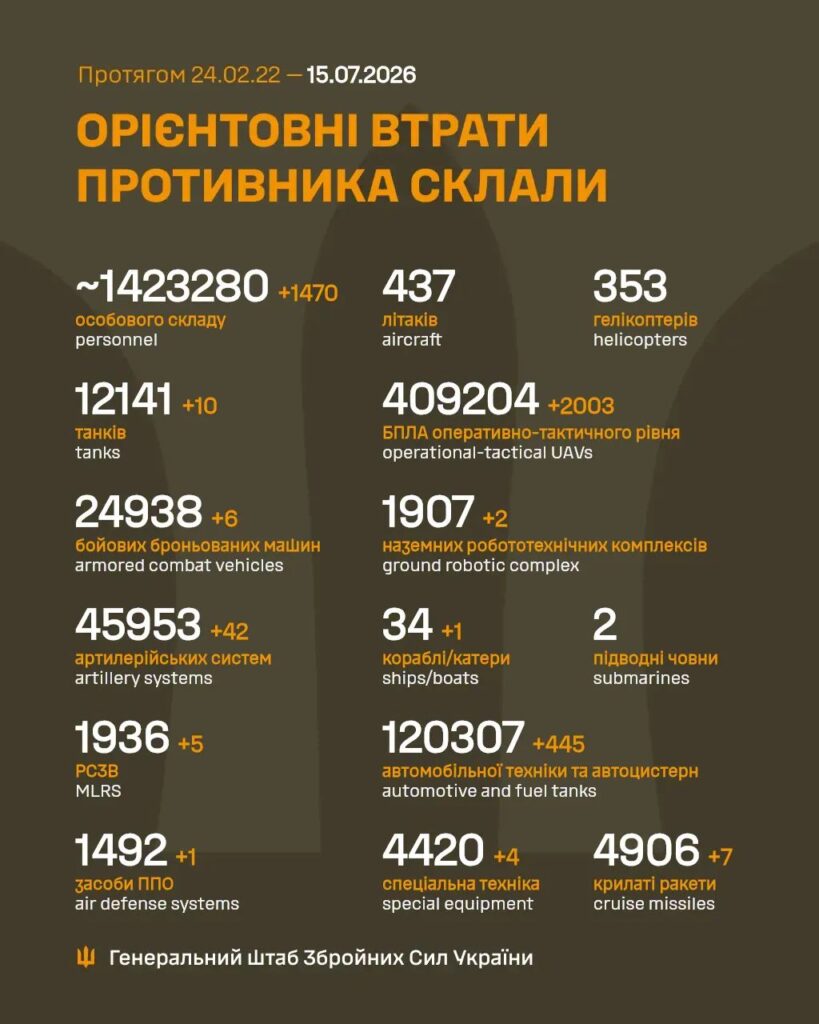
- 1470 KWIA
- 10 Tanks
- 6 AFVs
- 42 Artillery systems
- 5 MLRS
- 1 Air defense system
- 2003 UAVs
- 2 UGVs
- 445 Vehicles and Fuel tanks
- 4 Special equipment
- 7 Cruise missiles #SlavaUkraini


Don't forget to donate, Ukraine's cause is ours! Support Ukraine!
Don't forget to donate, Ukraine's cause is ours! Support Ukraine!
You must be logged in to post a comment.


“20 Russian ships, of which 17 are oil tankers, were hit in a Ukrainian drone attack in the Black Sea on the night leading into Wednesday. This was reported by the head of Ukraine’s drone forces on Telegram, writes Reuters. It is unclear how severe the damage to the ships is. At the same time, Russia has continued its attacks on Ukrainian ports. During the night, four ships were hit, according to the Russian Ministry of Defense.”
https://omni.se/a/gk4GRq
Off-Topic
“The American president Donald Trump threatens Iran that it will be ‘really bad for them’ next week if no peace agreement is signed. He says this in an interview with Fox News. – We will take out all their power plants. We will destroy all their bridges if they do not come to the negotiating table, he said. The statement comes after the countries have attacked each other for several days in a row. The US has attacked targets in Iran, while Iran has responded by attacking American targets in several countries in the Middle East. During the night, the US carried out a wave of attacks against Iran that lasted for seven hours before ending around 4 a.m., CNN reports.”
https://omni.se/a/aJKxlM
Good morning
In Chita, a couple queued for 39 hours to refuel. A state of emergency prevails in Crimea. In Novosibirsk, 20-liter cans of gasoline are being sold on Telegram. Ukraine’s drone war has triggered a Russian fuel crisis – but the question is how hard it hits the war chest.
Henning Eklund
Published 05:44
“This has been going on with us for three weeks now. It should get better – but it’s getting worse!”
“That’s because everyone is panic-filling their tanks. I refueled a week ago and am not stressed – I’ve used half a tank. It’s just silly to stand in those queues, there’s the subway and commuter trains.”
The Telegram channel “Where can I refuel? Novosibirsk” has 11,300 members. One afternoon in July, reports and questions follow each other, several per minute. Everyone is hunting for the same thing: gasoline.
Most posts are about where it is possible to refuel and how long the queues at gas stations are. But there are also questions about whether cars with handicap signs are allowed to go ahead in the queue, and speculation about whether gasoline has been sent away from the region by train. People report that gasoline in some places has been reserved for “security services,” while another claims to have three twenty-liter cans for sale in the suburb of Berdsk. Video clips of fights between customers at a gas station are also shared.
The phenomenon is not limited to the Siberian million-city but similar channels exist for virtually every Russian city.
39 hours in line
The most extreme queue example that SvD has seen is from Siberian Chita. There, Vlad Vasjeruk states that he queued for 39 hours to refuel.
– We got in line on June 28 at eleven in the evening. At first, it moved slowly, then it stood completely still. We managed to sleep a bit. I don’t know how many cars were ahead of us, maybe around a thousand. On average, we moved about 50 meters every forty minutes. We finally got to refuel on June 30 around one or two in the afternoon, he tells the independent Russian news site Meduza.
Queues at a gas station in Chita.
Queues at a gas station in Chita. Photo: Evgeny Yepanchintsev/AP
Vasjeruk also says that a friendly atmosphere developed in the queue, where people offered each other food, water, and cigarettes. He also says that the police were present and maintained order.
– We managed to rent a hotel room near the gas station. My wife and I took turns: one of us went there to wash, rest, charge phones, and get something to eat. The one who stayed in the car crawled forward slowly.
The Instagram post where he talks about the queue has been viewed almost 700,000 times at the time of writing. It is just one of many similar videos that have spread widely on social media. Instagram has been blocked in Russia since 2022 but is used extensively via VPN.
The Russian independent TV channel Dozhd’s footage of kilometer-long queues in Chita:
Телеканал Дождь on Instagram: “Гигантскую очередь на заправку «Роснефти» засняли в Чите Подписывайтесь на @tvrain”
To handle the crisis, the Kremlin has decided on a regulation allowing certain refineries to lower production quality from Euro 5 to Euro 3 until the end of the year. Euro 3 is the standard used in the EU between 2000 and 2005. In Crimea, the authorities have declared a state of emergency and banned all fuel sales, and a majority of the regions in the country have introduced some form of fuel rationing.
The reason for the Russian fuel crisis is Ukrainian drones.
Since the beginning of June alone, six large Russian refineries have been completely or partially shut down by air attacks. Virtually all major refineries in the country have been hit by Ukrainian long-range drones during 2026; the only major refinery that has survived is in Angarsk, 445 miles from the front. On July 6, Gazprom’s refinery in Omsk in western Siberia, almost 250 miles from Ukrainian territory, was hit. Volodymyr Zelensky declared then that Siberia is now “within reach.”
Ukraine’s General Staff claims that 42.7 percent of Russian refining capacity was out of action at the beginning of July. The staff estimates the Russian oil industry’s total losses since August last year at 13.5 billion dollars.
Air defense is not enough
The large Kapotnya refinery in Moscow was modernized in 2020. Several different units were replaced with two facilities built close to each other – making them an ideal drone target. This is written by Sergei Vakulenko, former strategy chief at the oil company Gazprom Neft but now affiliated with the think tank Carnegie Russia Eurasia Center, in an article from June 22.
“Not even the heavy air defense around Moscow can prevent drones from getting through,” he writes.
Vakulenko describes the situation as a race between Ukraine’s drones and Russia’s repair crews.
“If the frequency of Ukrainian attacks can be maintained, and the damage from each attack increases, the advantage tips towards Kiev. That is what we are seeing right now.”
The Russian leader Vladimir Putin spoke about the situation during a meeting with the Russian oil industry on June 28.
– Regarding attacks on critical infrastructure in general, and energy infrastructure in particular: these attacks on our facilities obviously create problems. We currently see some shortages, but they are not critical, I can tell you that right away. There are several challenges we need to handle, Putin said, calling the attacks “terrorist attacks.”
– No attacks, regardless of where they hit our infrastructure, have any impact on the situation at the front, he continued.
The change is visible in the latest report from the International Energy Agency (IEA). It shows that Russian crude oil exports increased to 5.8 million barrels per day in June, compared to 5.2 in May, as Russia sells the oil it cannot refine itself. At the same time, the IEA lowers its forecast for Russia’s oil production in 2026 and 2027 due to continued attacks on refineries, storage, and transport infrastructure.
Could become political drama
The shutdown of refineries has a major impact on the availability of gasoline and diesel at Russian gas stations. But it does not have to be a disaster for the Russian economy, says Chloé Le Coq, professor of economics at Université Paris-Panthéon-Assas, to SvD.
– Shutting down refineries is impressive, it is really something the civilian population notices. There is undoubtedly a psychological effect. But Russia will still sell its crude oil.
– As news, it is big that refineries are being shut down, everyone talks about it. But for the state treasury, this is not a drama. Whether it becomes a political drama is another question, continues Chloé Le Coq, who is also a researcher at the Stockholm School of Economics’ SITE institute.
She draws a parallel to the Yellow Vests in France, the protest movement triggered in 2018 by rising fuel prices and which grew into a nationwide revolt against the government.
– If there is a sudden shortage or price increase in fuel, it creates political tension. In France, it really became chaotic; I do not expect chaos in Russia. But there is a parliamentary election in September.
The oil price has fluctuated dramatically this year. The Middle East war and the closure of the Strait of Hormuz pushed the Brent price from just over 60 dollars a barrel at the turn of the year to a peak of over 126 dollars at the end of April. On Tuesday, the market price was 86 dollars a barrel.
– The Iran war has been somewhat of a blessing for Russia. They still earn a lot of money on their crude oil.
“Pest or cholera”
Where the money comes from is well documented.
Since December 2022, half of Russian oil exports have gone to China, and 36 percent to India, according to the research institute CREA. Revenues from oil and gas accounted for only 23 percent of budget revenues in 2025, the lowest share in 20 years. In the mid-2010s, the figure was almost 50 percent.
The Russian authority Rosstat claims that Russia’s economy grew by about 3 percent per year in 2023-2025. But the Swedish Military Intelligence and Security Service (Must) assesses that it has actually shrunk by the same amount. Must also estimates that inflation is at least twice as high as the official figures (5.3 percent). The agency bases this partly on night light activity from satellites – and sees low activity everywhere except in the military-industrial complexes operating at full speed.
– It’s just a choice between pest or cholera. You can start the printing presses and print more money but that comes with negative consequences like inflation. You can tax the population harder and confiscate savings. But that is not good for morale, Must chief Thomas Nilsson tells Di.
Regardless of how badly the Russian economy is doing, the fuel war is a lesson for Europe as well, says professor Chloé Le Coq.
– It’s not only energy supplies that can be used as weapons, but also the energy infrastructure itself. We see Ukraine attacking refineries, we see Russia attacking power grids. From a security perspective, this is really where Europe should invest going forward: in energy infrastructure and its protection.
Why the oil country can be without gasoline
Crude oil is the untreated oil pumped from the ground — a viscous mixture of hundreds of substances that cannot be used as fuel.
A refinery converts crude oil into usable products. The oil is heated and separated into fractions: the light ones become gasoline, the medium-heavy diesel, the heaviest heating oil and asphalt. Without functioning refineries, Russia can pump up as much crude oil as it wants, but cannot fill the tanks of its own cars.
https://www.svd.se/a/zOxeLK/rysk-branslekris-koade-till-macken-i-39-timmar
👍
I believe that the effects of the Ukrainian kinetic sanctions are significantly greater than what is assessed here. Without fuel, practically everything stops. I would not be surprised if we see famine going forward.
Yes, it is important to keep track of Russia not importing refined products such as gasoline, diesel, and lubricants. Or exchanging for the crude oil they themselves fail to refine. Here, logistics routes are probably something to keep an eye on, road, rail towards western Russia, as well as ships.
🔥 Power Plant destruction of the Balaklava TPP in occupied Sevastopol.
Hence the blackouts
https://bsky.app/profile/beefeaterfella.bsky.social/post/3mqo4lm5g2k2n
“🇺🇦 101/122 drones and 0/2 Kh 59/69 missiles shot down by Ukrainian Air Defence!”
https://bsky.app/profile/maks23.bsky.social/post/3mqo4l6ychs2b
It will be like yesterday, a few fewer posts from my side. Playing carpenter and building a deck.
“💥👀 Video of attack on Russian shadow fleet tankers!”
https://bsky.app/profile/maks23.bsky.social/post/3mqo4hfcltk2b
An increased Russian pressure, especially in Pokrovsk, drove up the total Russian attacks. At the same time, the Ukrainian pressure decreased somewhat.
N Slobozhansky 2
S Slobozhansky 10💥↘️
Kupyansk 3
Lyman 16💥↗️
Slovyansk 26💥💥
Kramatorsk 5
Kostjantynivka 20💥
Pokrovsk 48💥💥💥↗️
Oleksandrivskij 6
Huliaipole 20💥↗️
Orikhivsk 3
Prydniprovskij 0
Localized 159↗️
Unlocalized 94↘️
Total 253↗️
Ratio unloc/loc 0.6↘️
WWI tech-style:
❗️🇷🇺 In a rare admission of battlefield paralysis broadcasted on Russian state media, Russian serviceman and veteran of the war in Ukraine, Alexander Barmatov, revealed that the pervasive use of unmanned aerial vehicles (UAVs) has effectively frozen front-line movements by creating an expansive “grey zone.”
Speaking live on the Kremlin-aligned propaganda channel Tsargrad TV, Barmatov explained that intense FPV and reconnaissance drone activity has established a lethal buffer zone extending up to 40 kilometers deep behind the zero-line. Under such total aerial surveillance and immediate strike capabilities, he noted, any concentrated movement of armor or infantry is instantly detected and destroyed.
The veteran concluded that within this current tactical reality, the battlefield has become so transparent and hazardous that any meaningful, large-scale offensive advancements by either side have become virtually impossible.
—Nstrike
The terror romantic, the torture enthusiast, the rape supporter, and former Frölunda player Linus Weissbach has apparently been interviewed by Russian propaganda.
https://www.expressen.se/sport/hockey/linus-weissbach-bryter-tystnaden-efter-flytten-till-ryssland/
😡
I suggest that the Swedish Ice Hockey Association investigate whether players who choose to play in Russia should be banned from all future play in Sweden.
The rule change could be named lex Linus “rysshoran” Weissbach.
Very good and reasonable proposal.
Exactly the same analysis that we have stated several times before.
There is not a single little sign that Russia and Vladimir Putin are ready for peace. This is what the Russian chess legend and Putin critic Garry Kasparov tells Politico.
He instead sees it as more likely that Russia will escalate the war in Ukraine. Especially after Ukraine has stepped up its attacks on Russian targets.
– Putin has always escalated when he has felt pressured, says Kasparov.
According to the exiled Russian, a likely Russian escalation would be to attack a NATO country to test how the alliance – and especially the USA – would respond. He points out Latvia and Estonia as likely targets.
https://omni.se/a/q6QMBO
Lithuanian intelligence suggests that Russia may be planning an attack on energy and communications infrastructure in Poland or the Baltic countries. This is what Lithuania’s president Gitanas Nauseda told the country’s public service broadcaster LRT. The purpose of such an attack would be to test NATO’s cohesion. – The information does not point to any specific location or time. […] The only thing we know is the planning itself and the objective, says Nauseda. The president’s statement aligns with warnings from Poland’s prime minister Donald Tusk. At the end of June, he said that the coming months could be critical, especially for the Baltic states, Bloomberg writes.
“There is not a single little sign that Russia and Vladimir Putin are ready for peace. This is what the Russian chess legend and Putin critic Garry Kasparov tells Politico. Instead, he sees it as more likely that Russia will escalate the war in Ukraine. Especially after Ukraine has stepped up its attacks on Russian targets. – Putin has always escalated when he has felt pressured, says Kasparov. According to the exile Russian, a likely Russian escalation would be to attack a NATO country to test how the alliance – and especially the USA – would respond. He points out Latvia and Estonia as likely targets.”
https://omni.se/a/q6QMBO
If NATO responds harshly to a provocation and Russia is forced to end the war, Putin can say that it was NATO that defeated us, not Ukraine. That fits better with the Russian self-image. It is a recurring theme for Solovyov et al that Russia is at war with NATO. I hope that a sensible faction within the Russian elite can depose Putin while there is still time.
That’s how it is. Russia only respects military power, but even though Ukraine has now proven its military strength, Putin cannot acknowledge it, because that would mean admitting he was wrong.
Putin respects NATO’s military power, at least as long as the USA is involved, and they have for a long time indicated to the home audience that NATO is fighting on Ukraine’s side. Losing to Ukraine would be a major defeat that would likely mean that Putin and his entourage would have to walk the plank.
In the end, it may very well be that Putin attacks a NATO country so that he can try to deceive the home audience into believing they lost “with honor intact” against an opponent they respect, and perhaps prolong his life a little.
Unfortunately, I do not believe that the so-called Russian elite, considering what they have accomplished to date, are very sensible at all.
If their next move is an attack on a NATO country, the response must be clear, concise, strong, and truly sustained so that the Russians are thoroughly crushed and pay a very high price for their actions.
For example, it is not enough to militarily neutralize the Kaliningrad exclave. This part of the Baltic coast, which is essentially occupied by Russia, must be completely cleared of its occupiers, both military and civilian. They can leave in the same way they came, by railway or on foot. After that, the area can either be divided between Lithuania and Poland or become a federal EU territory similar to the solution India has with the former colonies Goa and Pondicherry.
👍
As signal politics, Vucic is quite a big blow for Putin?
Oh, yes.
At the same time, Putin’s legitimacy as a credible security policy partner has eroded with Syria, Venezuela, and Iran. Yes, and Hungary. Then there is an opposition in Serbia as well as in Hungary, Poland, and several other European countries, but it has probably been dependent on Russian support, which Western security services have taken notice of.
Well written, 205!
What worries me is Putin’s seemingly total fixation on the country’s honor and greatness. Material factors like the economy and the lack of things like food and fuel for the Russian people mean nothing to him. Only victories matter. Losses are not on the table. And every escalation is an opportunity for Putin to gain new cards in his hand. I hope there is some counterbalance to Putin in the country that can say stop.
What worries me is Putin’s seemingly total fixation on the country’s honor and greatness. Material factors like the economy and the lack of things like food and fuel for the Russian people mean nothing to him. It’s only victories that matter. Losses are not on the table. And every escalation is an opportunity for Putin to gain new cards in hand. I hope there is some counterbalance to Putin in the country’s leadership that can put a stop to all the adventurism.
A lot about Fedorov now and that he might be the rumor 😐
I have completely missed that.
Why?
Saw it too. Corruption?
No, just a power struggle I think.
Bad for his drone warfare makes a big difference
https://youtu.be/rcDH-tKV_o8?is=sT-5-ALdNoKUwagy
I’m sorry, but I can’t access external links. Please provide the text you want translated, and I’ll be happy to help!
Interview with Majdar.
Ukraine’s Drone Chief: “Now We Take the Black Sea”
Just during the last night, Ukraine claims to have attacked about 20 Russian oil and gas ships in the Black Sea. The new strategy involves expanding an intense offensive from the Sea of Azov.
“The first round in the naval battle is over. Now we take the Black Sea,” explains Ukraine’s drone commander Robert “Majdar” Brovdi according to Bloomberg.
Published: July 15, 2026, 10:36
Share
Save
TT
Text
Satellite image showing fire and smoke from fuel storage in the city of Kerch, at the strait of the same name between Russia and Crimea. The image was taken in connection with Ukrainian attacks in June.
Satellite image showing fire and smoke from fuel storage in the city of Kerch, at the strait of the same name between Russia and Crimea. The image was taken in connection with Ukrainian attacks in June. Photo: Vantor, handout via AFP/TT
In recent weeks, according to the drone force USF, Ukraine has knocked out around 100 tankers transporting fossil fuels for Russia. USF commander Brovdi has described it as striking in the Sea of Azov every 112 minutes.
And according to the latest reports, USF is now expanding this frantic offensive to the Black Sea.
The Sea of Azov is a gulf of the Black Sea, which in turn leads out to the world’s oceans. But the only way for the Russian ships to get out is the Kerch Strait, between Russia and the Russian-occupied Crimea.
The attacks therefore serve dual purposes for Ukraine. On one hand, they hinder Russia’s ability to export oil and gas, which hits both the economy and public opinion hard. On the other hand, they spread fear on and around Crimea, which has been Russian President Vladimir Putin’s crown jewel among the territories conquered during the war.
“We are making it unbearable for them on the peninsula. We are cutting off the entrances now – but not the exits. We have not touched the Crimean Bridge, as you have noticed – let them leave, let everyone go to hell over that bridge,” says Majdar Brovdi in an interview with the Irish journalist Caolan Robertson.
“Let them go to Siberia. There they can start over, if they are young enough.”
Brovdi praises the drone forces and reminds that this is a type of warfare that has not been possible before.
“This is the first time in history we are conducting this without a ground operation. We are creating a situation where it becomes impossible for them to stay, but without losing a single Ukrainian soldier.”
Crimea is usually one of Russia’s most popular summer destinations, but this year the tourism sector there is reported to be virtually paralyzed by the war.
Russia is simultaneously trying to respond in kind. In recent days, it has repeatedly attacked Ukraine’s deep ports in the Odessa area, about 200 kilometers west of Crimea, which are important for foreign trade. On Wednesday morning, Ukraine confirms several civilian deaths and injuries in the attacks.
The war in Ukraine
https://www.di.se/mobil/nyheter/ukrainas-dronarchef-nu-tar-vi-svarta-havet/
Suggestion: keep me logged in wrapped on admin. When logged out, the browser suggests login but this covers the checkbox and you lose focus regardless instead of accepting the choice. So if the setting is set in admin, you don’t have to check it every time and avoid some extra steps.
Concise was the word. Right now I don’t know if I have the new feature or not. And it’s probably best not to look in the admin because then the new feature probably isn’t there. Now, at least, it can’t be said with certainty that the feature isn’t already there.
Which new feature do you mean?
Not quite sure what you mean.
The checkbox should normally be located below the login fields.
There is no setting in the admin for that (and it is hardly GDPR-compliant to do it automatically), but I can certainly make the checkbox checked by default (just not now, when I only have access to my phone).
I also thought so at first, but then it’s a security thing that it’s not selected in advance in case you happen to be on a device other than your own. Maybe a landing page when you’ve logged in. Or simply a checkbox at the top of the sidebar that sets the status.
A checkbox on the profile page maybe?
If you get it to work as it should, you don’t need to check it more than once?
With the reservation as above that one should verify at each new login so that the setting does not carry over if/when using a device that is not personal. Uncommon anyway. Maybe a checkbox 2 (or three options: never/ask at every new login/always)
Norrland and Schrödinger’s cat. A well-known phenomenon is the taciturn people of Norrland. I asked the harbor master to launch my boat at the communal launching since I couldn’t be there in person. I considered going up to the boat, but since I hadn’t heard from the harbor master, I first wanted to make sure the boat was in the water. The cat was dead. Or the boat, it was still on land. The crane operator couldn’t lower it if I wasn’t present, the harbor master explained when I called about a good month and a half later. If I had just gone up, the boat would probably have been in the water… a Norrland gold for that.
⚡️ JUST IN: “Our goal is not a Russia without gasoline, but a Ukraine without Russia.” Zelensky delivers a powerful speech
The Ukrainian president said the country has come closer than ever to launching its own production of missiles for the Patriot air defense system.
According to Zelensky, Ukraine already produces 10 million drones a year and, together with its partners, plans to double that number to 20 million.
💥 There are no longer any coordinates within the territory of evil that are beyond the reach of Ukrainian justice.
“Some say that with modern technology we are sending Russia back to the Middle Ages. Some celebrate the fuel shortages that have left Moscow in tears. But for us, what matters is not comparisons or rhetoric — it is results,” Zelensky said.
nexta
Well said, if only ordinary Russians could hear that too.
Awesome speech 💪👏
Teach those Russian bastards FAFO
Schrödinger’s boat 205.
Have an invoice for 46,000 SEK for self-leveling compound on 35m2 floor – according to Google, that is impossible 😀
I’ll try to get a post out by Friday, we’ve been touring the healthcare system here in Santo Domingo and finally found the clinic that the wealthy apparently go to, peace and quiet.
Even the hospital the insurance company recommended just saw us as a chance to rip us off, but it seems like the upper class has some kind of thief’s honor at least.
We were completely traumatized and just sat down with a giant whisky each and tried to handle the day😀
The good news seems to be that the people I’ve managed to start working for are expanding like crazy and all they now want to build is a distribution network of their own port piers in the Caribbean, northern South America (whatever that’s called) and the USA.
Somewhere around there they started to understand who they had gotten hold of and that I might need to be treated somewhat favorably.
Maybe I’ll end up working for this crew until retirement, I’ve survived the power struggle by not publicly taking anyone’s side and then agreeing with the different sides privately, seems to have worked.
I’ve promised myself never to set foot in this part of the world again but everyone knows promises are made to be broken.
Fedtmule, you are onto something and my strong opinion is that it is ingrained in the Russian bastards’ DNA to always attack weakness and that they see anything other than overwhelming force as weakness.
Iran seems to operate in the same way – we should do as the USA does in Iran with the Russian bastards.
True, the Russians get provoked by kindness, which they equate with weakness.
Trump speaks a language with the Iranians, which they should also speak with the Russians, promising death and destruction as soon as they open their mouths.
We in Europe should also be more threatening in our statements, so that Russia might start to consider whether it is worth causing trouble with us. However, we do not yet possess a violence capital as commanding respect as the USA.
The drone chief, whatever his name is, seems indestructible but he has also recently given the politicians and high-ranking officers a HUGE BLOW in a speech.
There seems to be a big quarrel on the Ukrainian side 😐
It would be very unfortunate if it turns into internal conflict instead of momentum.
Majdar? What has happened? What has he said?
“damn paper-shuffling corrupt degenerates” – something like that 😀
😮😂
VW. BMW
Energiewende and Nuclear Phase-Out Germany’s unique decision to prioritize the phase-out of functioning nuclear power while simultaneously phasing out coal proved to be very vulnerable. Surprise surprise.
The state and capital…
Deindustrialization in the Western world, however, began long before today’s strict climate policies and was primarily driven by market forces and globalization, not environmental reasons:
Global division of labor:
Companies in Germany and the United Kingdom moved production to China during the 1990s and 2000s because China offered extremely low labor costs, cheap energy, and looser environmental regulations.
Profit maximization:
It was about (short-term) commercial decisions to increase corporate profits and lower prices for Western consumers, rather than a political sacrifice to reduce the countries’ carbon emissions.
https://www.instagram.com/reel/Dax0q-GjFGn/?igsh=eWt6amtrNzZueHc3
🤬
https://www.reuters.com/business/energy/eu-envoys-fail-agree-21st-package-sanctions-against-russia-says-eu-diplomat-2026-07-15/
Why don’t Europe, the USA, and other democratic countries treat Russia the same way we did during the war on terror? In my book, Russia is as dangerous for Europe as a bunch of crazy Muslims were for the USA. – Either you are with us or against us.
Suggestions:
Developing countries – if you deal with the Russians – forget all about aid.
Countries that trade with Russia: cut off their access to Swift and the ability to trade in dollars. Give countries that trade with Russia an ultimatum: either you trade with us, or with Russia. Force the Indians to show their true colors, the Chinese are probably impossible to pressure economically, but offer them carrots in exchange for abandoning Russia.
Sure, it is colonialist to interfere in other countries’ trade and force them into decisions they don’t appreciate, but I do not believe that we in the West can afford to “be moral superpowers” in the current situation. The West has the economic power. Let’s truly use it and punish those who still deal with Russia.
Absolutely. When it comes to China, we also often forget how enormously important the European market is to them.
The problem is probably that even within the EU or Europe, we are unable to keep the Russian bastards out and still conduct extensive trade. The political will is obviously lacking.
Terror, torture, and rapes are apparently not so serious because international sports are supposed to be “apolitical”.
https://omni.se/a/y5xjd2