
Already in 1984, the debate heated up regarding the navigation error track, especially between Ingvar Myhrberg (the submarine waltz 1985) who wrote for DN and on the other side stood Svenska Dagbladet and the officer corps.
Tommy Lindfors, who wrote below the surface 1996, also became involved in the debate.
SR has an opinion on the matter.
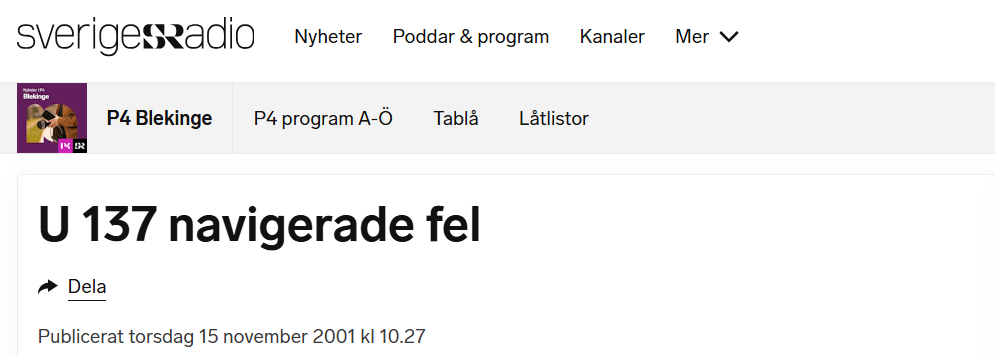
https://www.sverigesradio.se/artikel/23956
U137 was a major political scandal where both Defense Minister Gustafsson and Prime Minister Fälldin almost pulled a “Tsunami 2004” and were unreachable when they should have been available – Fälldin survived, but the Defense Minister struggled in the media.
But it also had consequences for the Russians, the ship commander Gustjin was rumored to have spent 2-3 years in the Gulag and then there was a lot of vodka in an apartment in a suburb of Moscow. Several in the staff were demoted along with Avrukevitj – not sure exactly what is true there, a lot of rumors.
It was a completely unprepared navy that had to quickly put together what they had available to be able to adequately man some ships, submarines, and artillery batteries when a Russian submarine ran aground in a military protected area not far from Karlskrona, and during ongoing submarine tests in the vicinity.
There is much discussion about our coastal batteries and fire control radar, but what the Soviets were probably most concerned about was our heavy attack, “The Supreme Commander’s Club”. If that swarm had flown in and fired its missiles, that relief force of about ten ships would have needed to be rescued.
The general debate shifted from Soviet violations to also include NATO influence operations, to the point where the Soviets were not really violating us – fluctuating between no Soviet violations at all or that it was mostly NATO.
Below, SVT promotes its own documentary from Uppdrag Granskning 2006 about Hårsfjärden with the words “offensive submarines were from NATO”. It is a truth with modification that is beyond the scope of this article series, but don’t worry, we will come to Hårsfjärden in the future and SVT is bending the truth.
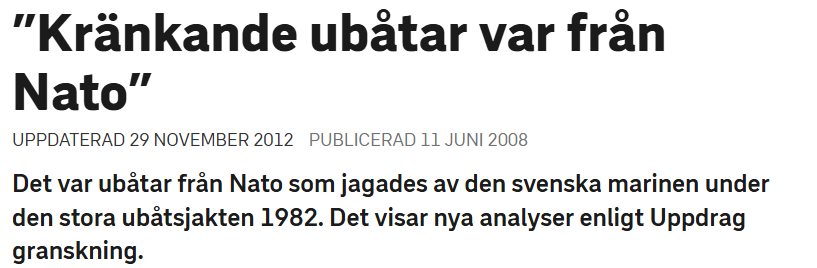
https://www.svt.se/nyheter/inrikes/krankande-ubatar-var-fran-nato
SVT dated 2014.

https://www.svt.se/nyheter/inrikes/u-batsjakter-vi-minns
Or that SVT keeps the question of whether U137 intentionally violated open as late as 2021.
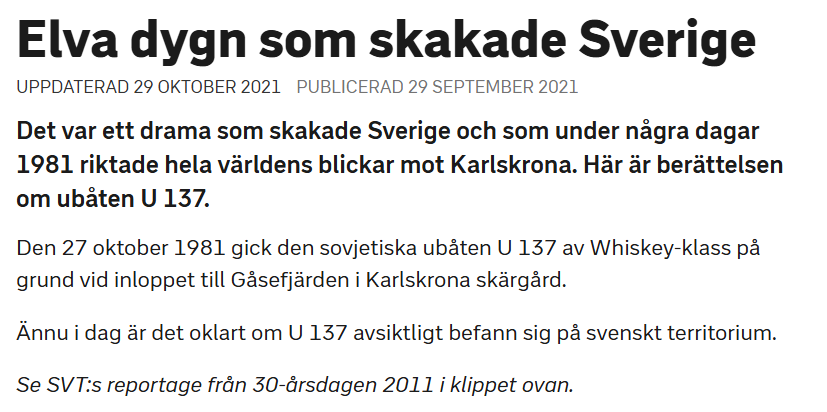
https://www.svt.se/nyheter/inrikes/11-dygn-som-skakade-sverige
SVT is after all our state television and they should as far as possible stick to the facts, but when it comes to the submarine issue, they have had some difficulties with that.
They still write this under most of their articles;

If you have stuck to honest analysis in the debate, like MANA member Nils-Ove Johansson concluded that NATO was the one violating us with our tacit approval, which they certainly stretched quite liberally, but that it was the Soviets who were preparing for war with us – and that it was the Soviets who were our enemies.
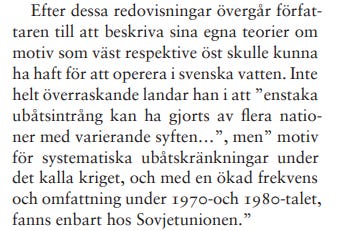
https://kkrva.se/hot/2015:1/rossander_ubatar_an_en_gang.pdf
If the Soviets had not prepared to attack us, the UK and USA would not have bothered to spend large sums spinning around in our archipelago in the small Baltic Sea.
As evidence of the above statement, we refer to what happened after the collapse of the Soviet Union when the calm settled and no submarines violated us for quite a few years – because the USA and UK had no intention of violating us but were just keeping an eye on the Soviets and wanted us to be vigilant.
Now in 2025, we have probably agreed that the USA is doing what is best for them – they are just like the bank, not your friend as we usually joke.
But the USA did not plan to invade us during the Cold War, it was the Soviets who planned it.
Some of the debaters who distinguished themselves in the overall debate focused on NATO’s violations and extrapolated over time to suggest that the Soviets never, or rarely, violated us.
Ola Tunander was influential and launched many of the theories that were picked up by others.
Swedish Radio
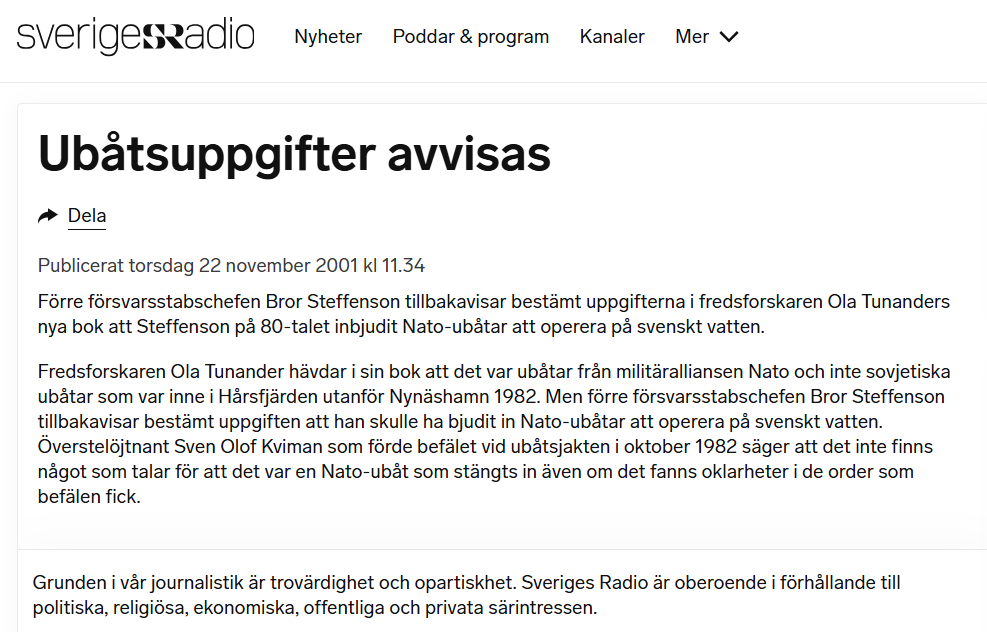
https://www.sverigesradio.se/artikel/25263
Ola was a bit of a Trojan horse as he was part of the expert group that was supposed to clarify the submarine violations and since then has enjoyed accusing other participants, the government, and the armed forces of covering up and lying, where the trust position he was honored to hold became a good springboard. There are countless discussions between older senior officers and Tunander where they spar with the pen.
If you haven’t heard the name before, it doesn’t mean he is marginal in the debate, just that you haven’t kept up – google his name and you will see a flood of opinion articles, books, and participation in all sorts of contexts, this is a person whose opinions have made a big impact in the overall debate and contributed to how the citizens of Sweden over time perceived who was actually behind the submarine violations in our inner archipelago.
Now after 2022, it’s easy to see how Ola Tunander has positioned himself in the Ukraine war – then we have a receipt for how he stands with regard to Russia, right?
On the question – “Has Russia violated international law” when they invaded Ukraine, he draws the following conclusion,
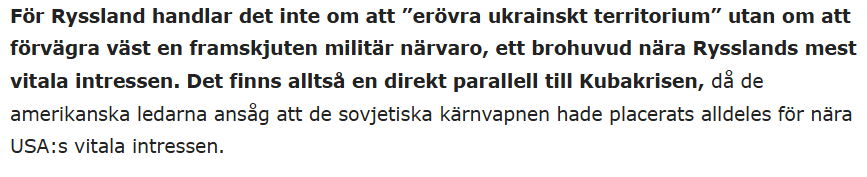
Some may think that Johan No.1 is extrapolating too far, but it is important to understand that since 2022 he has written remarkably much about the Ukraine war – for example, that it was not Russia that killed civilians in Bucha.
What Anders can definitely be held accountable for is that as an author, he has chosen to enhance Ola Tunander’s impact by often referring to him as a reliable source and giving credibility to his theories that the Soviet Union did not violate us.
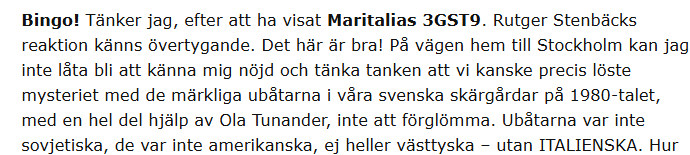
Anders is a supporter of Ukraine in the ongoing war – no discussion there even if he may not be very engaged in that particular debate.
All the quotes above are what these individuals themselves have written on their open platforms, and I adhere to the quoting right and provide references – so I believe I am doing the right thing and nothing is distorted to fit a narrative I am trying to build – honest as a Catholic priest in Boston.
Some may find it amusing to read about NATO’s reprehensible actions and double standards.
Others may feel that it was humiliating for our defense personnel who risked their lives to defend the country of Sweden when the Soviet Union violated us in our archipelago.
I believe we are on the right track to set the record straight that the Soviet Union did not directly violate us during the Cold War and I don’t like it. History should be described as honestly as possible for the historical record – not whitewashed with an agenda.
This is what a senior officer who was active in the Blekinge coastal artillery during those years wrote to me on one occasion, it was an opinion he had also expressed in other contexts but I omit the name for safety reasons;
“What I find difficult to live with is individuals who still, with misleading claims, try to excuse/minimize the Soviet Union’s aggressive behavior during this period. Without putting the event in its historical perspective. Without sustainable factual arguments. Like you just did.
Even more difficult is to live with the fact that some take the liberty to publicly ridicule the incredibly demanding efforts that primarily the Navy personnel were subjected to during the 80s and 90s. Asserting our territory cost many shattered dreams, economies, relationships, and, indirectly, several comrades’ lives”.
The references I have chosen above are by no means the only ones in the debate, but they cover the entire argumentation and are good examples of the arguments put forward.
Why is this important?
U137 is the only singular event where one cannot dismiss everything as mudslinging and conspiracy, and alternative explanations had to be found as to why the Soviet Union/Russia was not a threat to us.
Today, Russia is doing exactly what the Soviet Union did during the Cold War – violations, sabotage, influence operations, and subversive activities.
Most recently, 15 drones over a Belgian army base that they discovered by chance when they were testing an anti-drone weapon.
But what do you constantly hear from the Russian side?
- 23 drones flying into Poland was a mistake, or maybe they were Ukrainian.
- Drones over airports across Europe are definitely not Russian.
- Russia never intended to attack Ukraine.
- Everything is NATO’s fault.
“They’ve dusted off the Cold War manual,” you exclaim in surprise now, we’ve learned something new after three years of scouring johanno1.se where he just scams us on Swish.
With U137, the Soviet Union did the next best thing – navigation errors, faulty equipment, workplace accidents, or maybe drunkenness were suggested as reasons why the submarine ran aground. Choose whichever you like, they generously offered with a broad Russian grin.
Against the Soviet Union’s constant denials of all violations and the majority of creative explanations that journalists and debaters with large media platforms chose to promote, stood our defense personnel. They were just doing their jobs, didn’t have the same reach as the media, were hurt and insulted by unpleasant journalists – and in the end, they gave up in their attempts to seek redress.
The Armed Forces were completely abandoned, and the men who put in a tremendous amount of effort into debate articles against Ola Tunander are well beyond retirement age but feel that they must clear their names when they should be basking in Sweden’s appreciation for defending us against the Soviet Union.
Was it really wrong to try to make the Soviet Union look as bad as possible?
For almost four years now, we have been trying to talk down Russia in our discussion forums – the worse they look, the better.
Regarding U137, in my next post, I will show that the argument for navigation error is not reasonable – it is a matter of probability analysis and trying to show that the likelihood of that is too small, so the most likely scenario is that U137 accidentally ran aground on a covert mission.
It is also of interest to simultaneously demonstrate how much effort some choose to put into promoting a line that only benefited the Soviet Union, later Russia.
Already in the early 2000s, the line began to be strongly pushed that it was NATO submarines, but I only started to take a serious interest in this in 2015 – it was after I read Jallai’s website, of course, and had the same aha experience as everyone else.
My position at that time was that it was only NATO, and I found it sensational, I had been thoroughly deceived for the first and only time in my life.
When I found the Skalman thread (herring and mink), it took less than half a year before I understood that it was the Soviet Union that violated us – I changed my position because the evidence was overwhelming, you can actually follow in the thread how I slowly transitioned.
We also need to calibrate ourselves to the overall situation to better understand the motives.
In the early 1980s, the Soviet Union initiated Operation RYAN, which was a targeted information gathering effort to understand and receive warning of a nuclear attack from the USA.
It became somewhat of a self-reinforcing loop, and when the USA conducted the military exercise “Able Archer” in 1983, the Soviet Union thought, now hell will break loose – they were so paranoid and easily frightened after completely misinterpreting the situation.
You can google “Operation RYAN” yourselves, it is well described here actually, there are no guesses or speculations at all today.
https://en.wikipedia.org/wiki/Operation_RYAN
The Soviet Union carried out increasingly aggressive war preparations – as these are not part of U137, you will have to wait for later posts to be completed, I know it can be painful but Zen monks have a special breathing technique for when my posts take too long.
Well, no one really denies this bigger picture, but the interpretation of the perpetrator that follows becomes intriguing.
An honest debater will confirm that the USA/NATO/UK were in our waters partly with the Navy’s approval, sometimes to train us, conduct influence operations here and there – and sometimes they followed sharp Soviet missions where they were exposed to fire since our Navy did not always have good intelligence.
But the offending party preparing for war with us was the Soviet Union – everyone else was here to try to prevent the Soviet Union, nothing else, and our defense forces did their best to make the Soviet Union look bad.
This is where the cards are mixed up by finding the occasions when it was a Western submarine and extrapolating to the point that the Soviet Union never violated us.
The next post will present the arguments for the U137 navigation error against the actual information we have so that you can judge for yourselves what is most credible.
All counterarguments are from official reports or open sources and verifiable.
Johan No.1 has no “confirmation from an anonymous source in the defense forces” to rely on like everyone else likes because we simply cannot evaluate that. Here, only hard verifiable loose assumptions apply straight into the wall.
The next post will leave you almost newly converted with a burning hatred towards the Russians and feel that you really want to give those damn Russians a piece of your mind today for their outrageous audacity to violate us back in 1981.


Don't forget to donate, Ukraine's cause is ours! Support Ukraine!


Interesting reading! 👍
Had a busy day both at work and in the evening yesterday, have responded to some of the comments in yesterday’s thread.
(https://johanno1.se/sv/nar-kriget-kommer-15-oktober-2025/)
Good recording about the submarines 👍
Interesting, really looking forward to the continuation!
Good summary. We probably have the same understanding of what happened in Gåsefjärden in 1981.
Regarding Defense Minister Gustafsson, I got the impression that he acted clumsily and ended up on the sidelines. Fälldin probably took over his role there. Fälldin sometimes received criticism for being sluggish when he spoke, but during those days he was very clear and good. I remember he was praised by Palme, and that certainly wasn’t common.
I have never checked social media regarding U137, only talked to people who were either involved or on the sidelines and thus drawn my own conclusions.
U137 had a secret mission, what it was I do not know. What puzzles me is the speed U137 had in the fjord. It is claimed to be 8 knots. Maintaining that speed with a 75 m long submarine can only end in one way. And it did, evidently.
I will answer that in the next post
we guessed at about cruising speed
and there was still braking distance left
compared to the Finland ferry
That there were NATO submarines practicing in Swedish archipelagos is no surprise. Perfect to train a submarine crew in that environment. West Germans and Englishmen primarily, especially the latter (perhaps under orders from the USA). Then, blaming the Soviets made the whole exercise even more rewarding. I think the Danes, who had a few submarines at the time, refrained. This was because they had good cooperation with the Swedish navy in training their crews. The Danes had access to the diving tank at the naval base where they trained for free ascent. The Danish navy probably did not want to disturb that privilege. Speaking of the diving tank, several countries have received their training at FM DNC, which is considered high-quality in an international comparison. The diving center is located at the naval base.
Very interesting👍 your reasoning and conclusions seem reasonable and it is not at all surprising that SVT/SR is wrong🫣
I think all three posts, when the last one has arrived, will be difficult to question.
The first painted picture, now I wanted to show how the debate has progressed and then torpedo the whole erroneous narrative with the last post 😀
Well. Torpedo was the word. Appropriate in this context. Just don’t come dragging along with Italian mini submarines because we don’t believe in that.
We look forward to the next post 👊
What I find difficult to understand is why there is an interest today in “protecting” or “saving the face of” Russia, or the former Soviet Union. What is the single purpose, even if it can only be seen under a microscope?
I have understood that Jallai is “fixated” on Ola Tunander. I lose myself and don’t quite understand Jallai, at the same time (an article where he refers to Ola Tunander regarding an observation of what turns out to be an Italian mini-submarine) he claims that Palme was a man of the Soviets, but a few books later he is CIA and it was the KGB behind the attack. Does this mean that Jallai has also changed his mind regarding the submarine issue, that the Soviet Union did indeed intentionally violate Sweden? In his later books, Jallai does not seem to try to soften the image of Russia as a threat. At least not when he, in later books, writes about illegalists (network of Russian spy cells)..
We discussed Jallai quite a bit because far too many took him for the truth – the conclusion was that he wanted to sell books.
I was in an email exchange with him and it was like talking to a wall – when it was the NATO track selling books, that was it.
But yes, he is filthy rich and I am not 😀
We look forward to the next post 👊
OT
A rough ride. A file image of a Russian Navy Kilo Class submarine transiting between the Mediterranean and the Baltic on the surface. Photo: Royal Netherlands Navy.
Russia’s Submarine Problem Is Much Worse Than Many Imagine
https://www.navalnews.com/naval-news/2025/10/russias-submarine-problem-is-much-worse-than-many-imagine/
The Russian submarine Novorossiysk, an Improved Kilo-class vessel, has been forced to limp home to the Baltic after a mechanical failure in the Mediterranean.
While some reports exaggerated its plight, the incident exposes the Russian Navy’s declining presence in the region.
Since losing its Syrian base at Tartus in 2024 and facing restrictions on movement through the Bosporus, Russia’s Mediterranean task force has largely collapsed.
The Novorossiysk’s troubles highlight mounting maintenance issues and the broader erosion of Moscow’s naval reach in the Mediterranean.
The saga of the Russian Navy submarine Novorossiysk has captured headlines, and even mocking remarks from officials.
NATO chief Mark @SecGenNATO summed it up, commenting that the “broken Russian submarine” was “limping home from patrol“.
The submarine, a Pr.636.3 Improved Kilo class boat, has been transiting back from the Mediterranean to the Baltic since the start of the month.
The submarine reportedly suffered a mechanical failure in the Western Mediterranean in late September and has since been returning home on the surface.
That it is surfaced is not in itself unusual however.
Russian Kilos have been making this journey in this fashion for years. And it did not suddenly surface off France in any literal sense, despite clickable headlines.
Nautical puns aside, much that has been written about its is exaggeration and speculation. It’s another case of ‘wishful sinking’. Yet its woes do point to a much deeper submarine problem for the Russian Navy.
Russia’s Permanent Task Force In The Mediterranean
The Russian Navy established a ‘permanent task force’ in 2013.
Submarines, together with frigates and larger warships were based at Tartus in Syria.
The submarine component was often forward deployed from the nearby Black Sea Fleet.
This was despite the Montreux convention which restricts submarines from deploying between the Black Sea and the Mediterranean.
In practice Russia was able to bend the interpretation of maintenance voyages to get around these restrictions
The base at Tartus had enough facilities for submarines to rotate through there for up to a year at a time. An all-important repair ship, PM-82, was based there for extended periods to provide local maintenance support.
By 2022 there were regularly two or more submarines at Tartus, with two there at the beginning of the 2022 invasion of Ukraine.
Things were not to go smoothly however. The full-scale invasion of Ukraine resulted in Turkey closing the Bosporus to Russian Navy warships and submarines.
Together with a ban on Russian warships visiting Cyprus, which had previously supplied refueling and maintenance services, this was a major blow to the Russian presence in the Mediterranean.
Russian Foothold in Med Massively Weakened
Then in March 2024 the Ukrainian uncrewed surface vessel (USV) threat in the Black Sea forced the rerouting of supply ships from the shorter Black Sea route to the much longer Baltic one. But the biggest blow came when in December 2024 with the sudden fall of the Assad regime in Syria. This led to the Russian Navy being evicted from Tartus.
The submarine Novorossiysk was one of the first vessels to leave, passing through the Strait of Gibraltar on January 2nd 2025
Since losing Syria Russia has found it increasingly difficult to maintain a submarine presence in the Mediterranean. Deployments now have to sail from the Baltic, a 4,000 km voyage at the beginning and end of each deployment.
This has limited their time in the Mediterranean, and no doubt taxes crews and stretches maintenance schedules.
Submarine Patrols Continue, But Weaker“
Novorossiysk returned to the Mediterranean, accompanied by a support tug, in late June 2025.
Naval News has information that she called at ports in North Africa, and likely received specialist maintenance on at least one occassion.
But the vital support network of local basing is lacking.
Meanwhile Russia’s submarine fleet, particularly the diesel-electric Kilos, appear to be suffering from a maintenance backlog.
This affects the remaining boats in the Black Sea (one, Rostov-on-Don, was written off by repeated missile strikes), as well as those in the Baltic. So despite having a fleet of over 10 boats, there is no immediate replacement for illfated #Novorossiysk.
Russia can still deploy nuclear powered submarines there, which can sail submerged the whole way and arrive unannounced. It is known that Yasen (aka Severodvinsk) class cruise missile boats have occasionally ventured into the Mediterranean since 2022.
But these too are also stretched, and it almost certainly isn’t a permanent presence.
Will Russia Return To The Mediterranean?
The submarine deployments now appear more for show than a meaningful naval capability.
But Russia is likely to be intending to reestablish a base in there to allow a more potent force to be based there, tying up resources on NATO’s southern flank.
The base may be in Libya, with Tobruk being the obvious candidate
Any new base will take time to establish, with some degree of building work likely needed. Possibly the first sign will be Russian government cargo ships calling at the port, or repair ships sailing from the Baltic. – In the meantime it appears that Novorossiysk will take some time to replace on station in the Mediterranean, with no sign of another Kilo sailing south.
Russia’s submarine forces should not be underestimated, especially the latest nuclear powered boats.
But the Kilos are showing their limitations, and Russia has lost any sense of permanence in the Mediterranean. It’s not just the tale of one unfortunate submarine, it’s a growing hole in capacity and capability.
🧵✍️ Lew Anno Support https://x.com/anno1540/status/1978805632091214151?s=46
That was interesting 👍
Syria’s new leader was in Moscow yesterday so they will probably come back 😐