
Here follows a report on the Russian losses in the war in Ukraine. We go through the most important categories where we both look at how it has been for the entire war and also take a closer look at the past year to more easily see any trends in the near term. The statistics extend up to May 9.
Today’s loss report will be posted further down, as a comment to this post.
Many thanks to Ragnar Bjartur Gudmundsson who provides the statistics, feel free to follow him on Bluesky or on Twitter.
Summary
The war has continued with the same intensity over the past year. Russia carries out roughly the same number of attacks and suffers essentially the same losses in terms of personnel during the period. Regarding tanks and other armor, it has not changed much as it was already low before, but what we can see is that the increase in drones has been enormous, both at the front and in the nightly terror attacks. At the same time, we can sense that it seems to have leveled off somewhat towards the end, which may indicate that Russia is now having difficulty increasing production, but it is probably a bit too early to be certain.
Ukraine is knocking out more artillery than ever while Russian usage is decreasing, which is somewhat contradictory, but it is probably because different things are being reported. The increase in other vehicles is increasing but this is probably due to Russia using more, but smaller vehicles (e.g. motorcycles instead of infantry vehicles).
So far, no slowdown of the war can be seen looking back a year, however, the intensity was higher earlier in the war. Russia is likely at the level they can maintain and Ukraine matches it. Nothing in the statistics so far directly points to a turn in Ukraine’s favor, but nothing points to Russia gaining an increased advantage either.
Russia continues to take a few fields every day and still holds the initiative for now, but the speed of their advance has increasingly slowed and that is probably the main sign that they have soon reached their culmination point and that Ukraine will instead gain an advantage.
Killed and wounded Russian soldiers (KWIA)
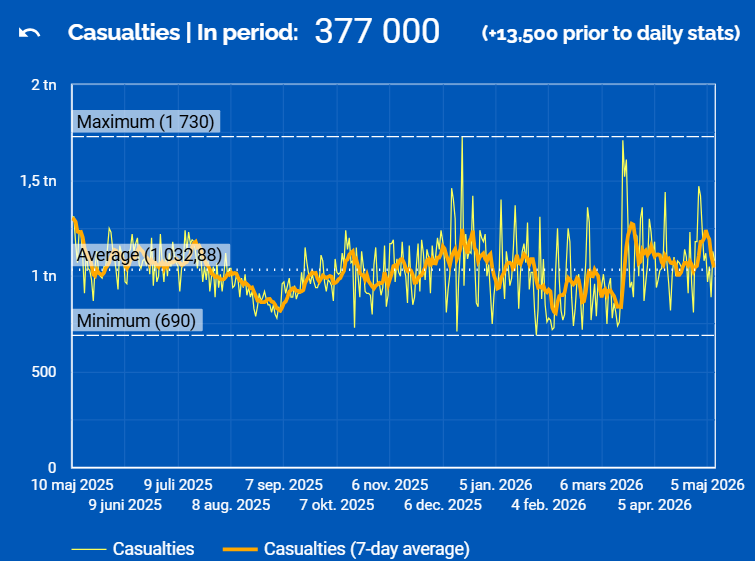
Regarding Russian personnel losses over the past year, there have been no major changes. It has fluctuated a bit around 1000 per day and the average is 1032. We have had a few isolated days with really high losses (1730) but also days with under 700.
So no special trends can be read during the past year except that towards the end it has been slightly above average.
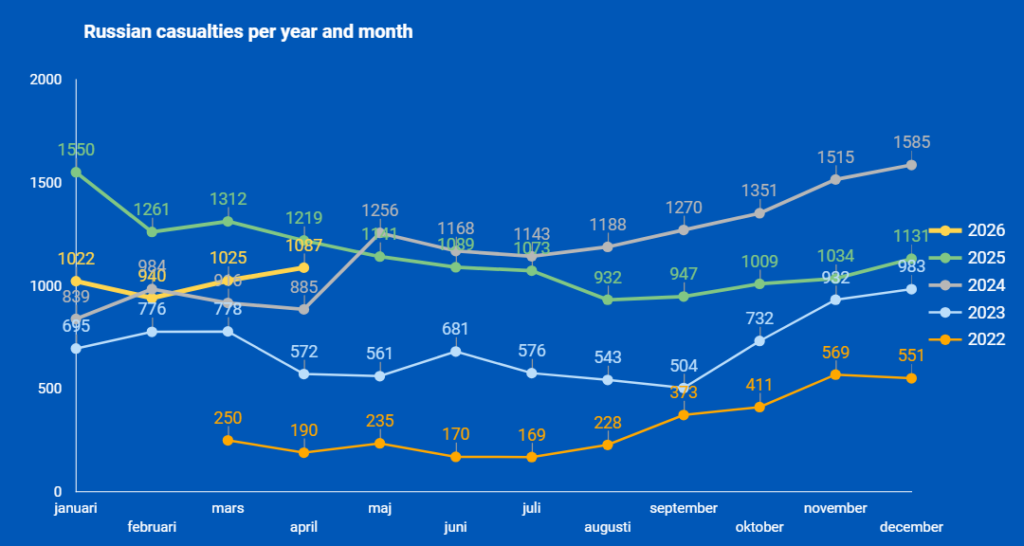
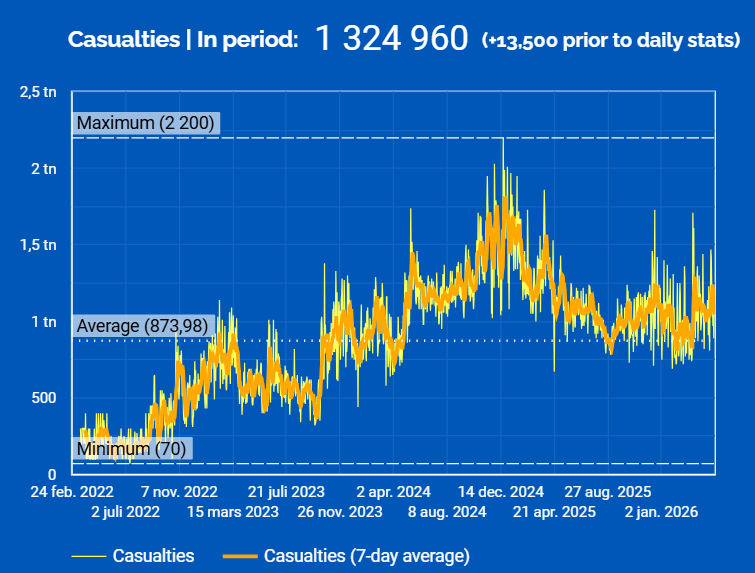
Looking at the war as a whole, one can see that the current losses are high. There has been a period with significantly higher losses but overall losses have been lower and the average for the entire war is 874/day compared to the 1032/day we have had during the past year.
The intensity of the war is still high. There are rumors that Russia can no longer produce enough personnel to replenish losses. That may be true but it is not visible in the loss reports.
Russian losses of soldiers in the war in Ukraine over the past year, killed and wounded:
Russian losses of soldiers in the war in Ukraine from the start of the war, killed and wounded, monthly
Russian losses of soldiers in the war in Ukraine from the start of the war, killed and wounded:
Russian tanks
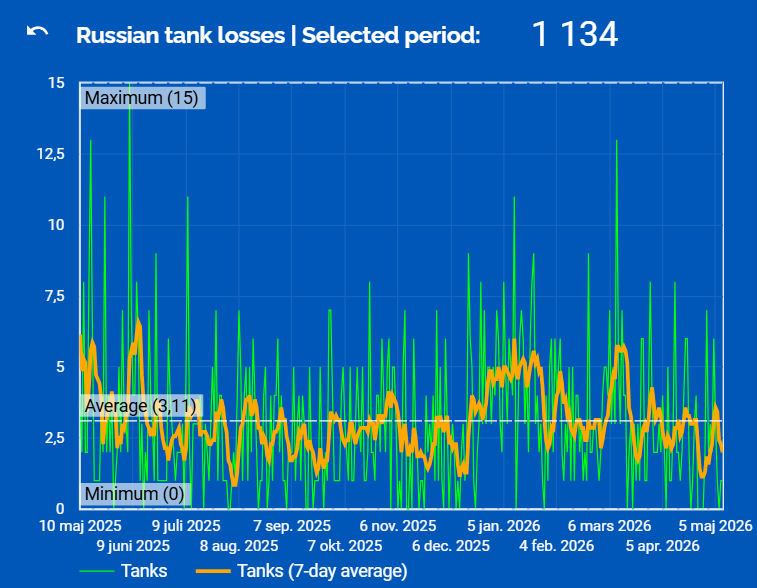
Regarding losses of Russian tanks in Ukraine over the past year, it looks roughly the same as for personnel losses. It has fluctuated a bit up and down but no clear trend can be read. Towards the end, it is actually the opposite of KWIA where losses are somewhat lower than for the entire period. Losses per day during the past 365 days are only 3.11/day.
There are rumors that Russia is not sending newly produced tanks forward but is building up reserves and that this is one reason why we do not see such high losses. That may be partly true, but at the same time I believe they simply have difficulty producing many more. The remaining tanks in stock are probably largely wrecks. Before the war, it was estimated that between 250-400 tanks were delivered per year but that would apply to the total, including refurbished and upgraded tanks. I have not been able to find any figures on how many were actually newly produced.
Personally, I believe Russia has mainly focused on quickly renovating older tanks rather than expanding the capacity for new production. Partly because it is faster and partly because they had large quantities of old tanks from the start. One reason we do not see many new tanks in Ukraine may simply be that there are not large quantities of them. The 1134 tanks knocked out over the past year may well be roughly the level they can produce in renovated tanks if the stock of old ones deteriorates more and more.
At the same time, I also believe it is very likely that they are saving the new ones to build up a reserve. They cannot use up all tanks and leave the rest of Russia unprotected, but I also think it is about tactical adaptation. Drones have made it much easier to knock out attacking tanks and the costs are probably seen as far too high, so they use them less and less.
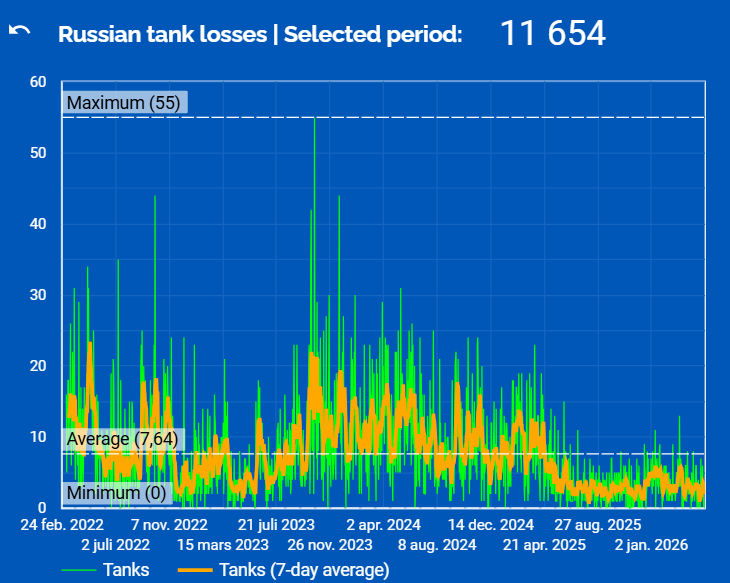
Looking at the whole war, the trend is clear. Tank losses are among the lowest during the entire war. There have been shorter periods with similarly low losses earlier but the low losses have now continued since August 2025. The average for the entire war is a little more than twice as high (7.64/day) as during the past year.
Russian losses of tanks in the war in Ukraine over the past year from today:
Russian losses of tanks in the war in Ukraine from the start of the war:
Russian armored vehicles (APVs / AFVs)
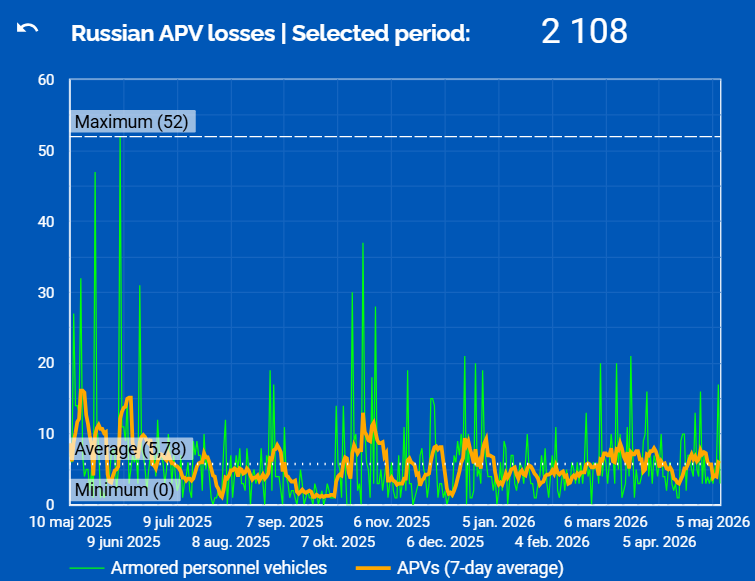
Regarding other armored vehicles, we see the same trend as for tanks. Not much has happened over the past year. There were some higher losses at the beginning but since then it has basically stayed at the same low level with an average of 5.8 per day.
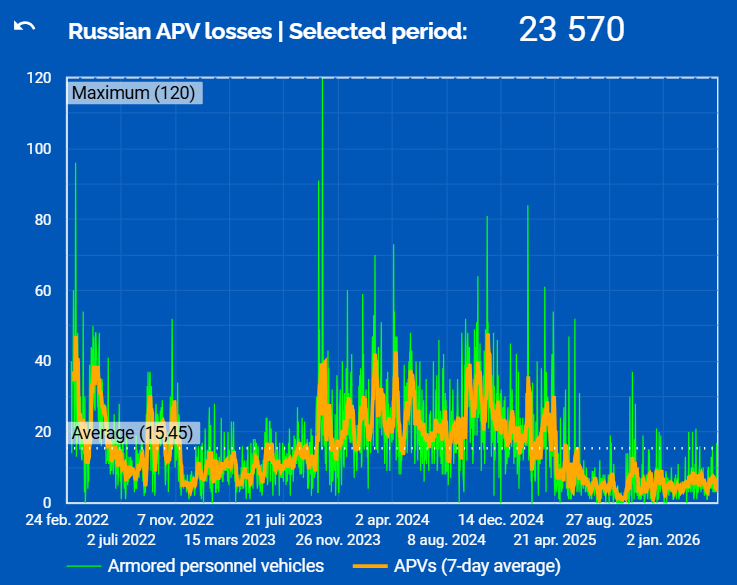
Just like with tanks, when we look at the whole war, losses of Russian armored vehicles are significantly lower now than before. The average for the entire war is 15.4/day, so in that respect, losses of armored vehicles have decreased even more and are now about 1/3 of the average, which is a bigger decrease than for tanks where it was closer to 1/2.
Also regarding armored vehicles, I believe the same reasoning I gave above applies. They do not have as many in stock, but probably also choose to use them less and surely save newly produced ones in a reserve.
Russian losses of armored vehicles in the war in Ukraine one year back from today:
Russian losses of armored vehicles in the war in Ukraine from the start of the war:
Russian artillery
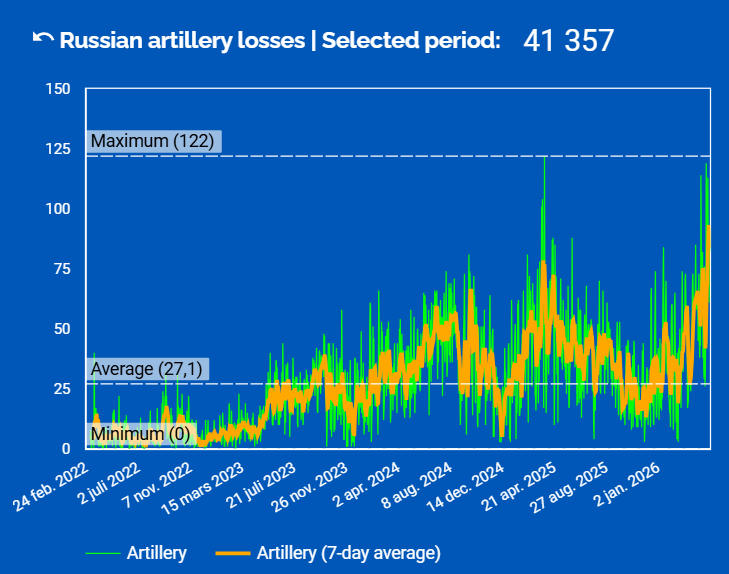
When it comes to losses of Russian artillery in the war in Ukraine, however, there has been a change even during the last 100 days. Losses have more than doubled at the end of the period compared to the beginning. The average for the entire period is 38.5/day while towards the end it is over 80/day.
Even when looking at losses over the entire war, we see that losses have never been higher than before.
Should one then conclude, contrary to the case with armor, that Russia can produce or refurbish significantly more than a year ago? I find that hard to believe, although it may possibly be that they receive help from, among others, North Korea with deliveries, but I am doubtful that this is decisive.
Looking at the statistics (see further down) on Russian artillery attacks, we instead see that they have decreased. The artillery attacks reported are likely from artillery pieces and not smaller mortars (otherwise the numbers would be significantly higher). However, mortars are probably included in the loss statistics.
My theory is that it is Ukraine’s drone capability that now allows them to easily identify and quickly take out even smaller, less mobile mortar groups (which also do not have a long range and must be close to the front) and that this accounts for most of the increase. Rather, the decline in Russian artillery attacks indicates that they are finding it increasingly difficult to deploy pieces and probably also ammunition.
One possibility is, of course, that they have also adapted their tactics here and do not use artillery as extensively but instead rely on drones. They may also be putting newly produced equipment in reserve.
Losses of Russian artillery in the war in Ukraineone year back from today:
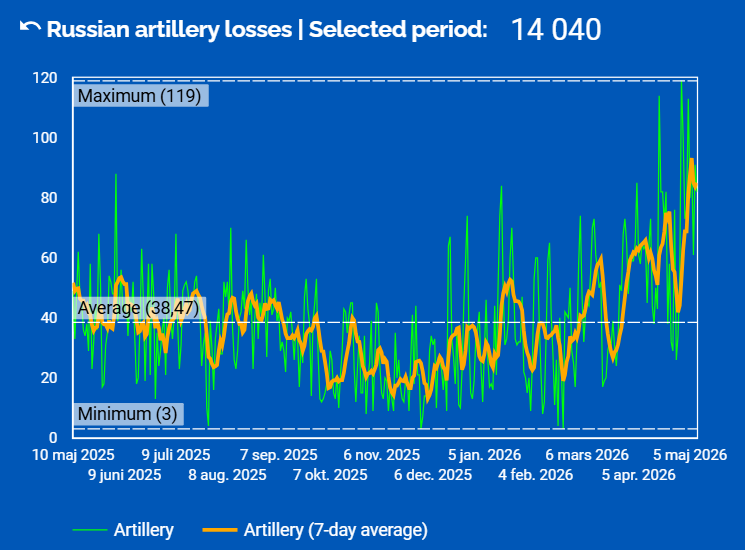
Losses of Russian artillery in the war in Ukraine from the start of the war:
Russian losses of rocket artillery (MLRS)
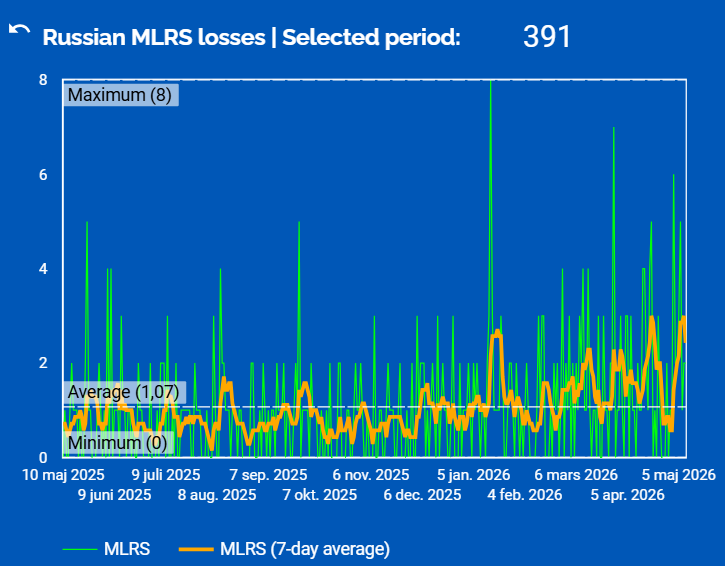
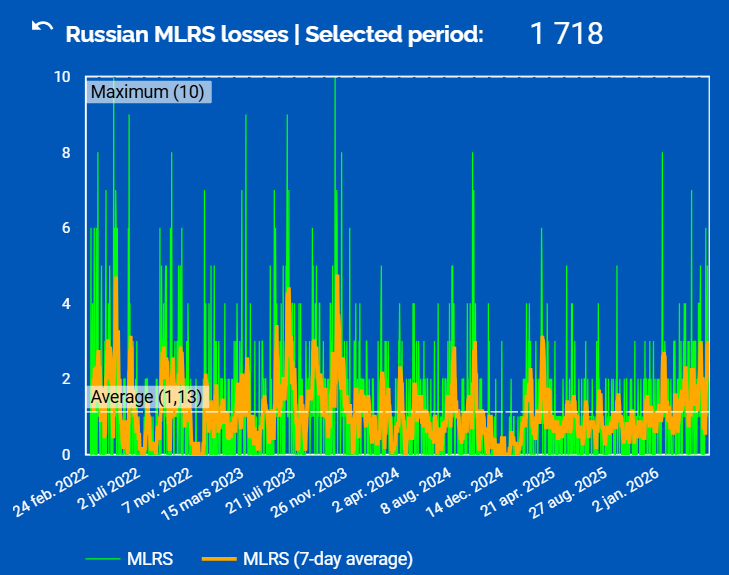
Here we see a similar trend as for regular artillery with an increase towards the end during the past year, however losses were significantly higher earlier in the war if we look at the whole. The conclusions regarding artillery above also apply here.
Losses of Russian MLRS (rocket artillery) in the war in Ukraine one year back:
Losses of Russian MLRS (rocket artillery) in the war in Ukraine from the start of the war:
Other unarmored vehicles (logistics)
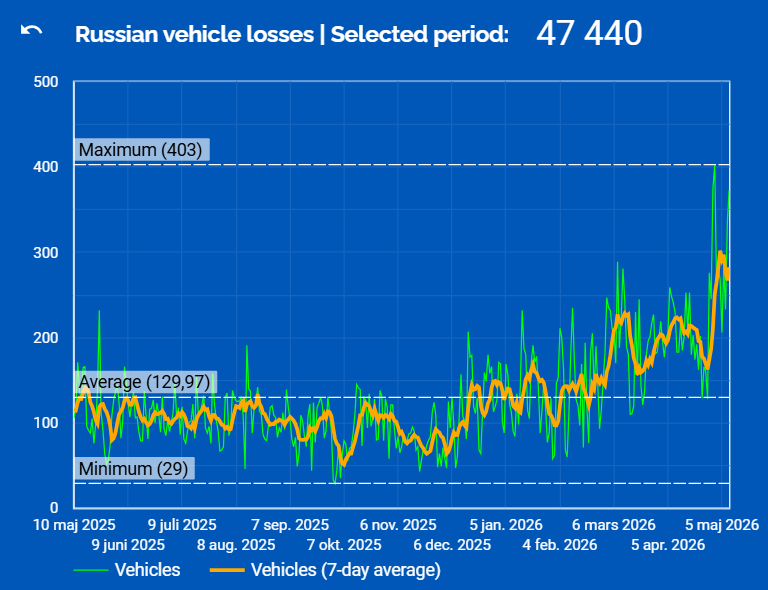
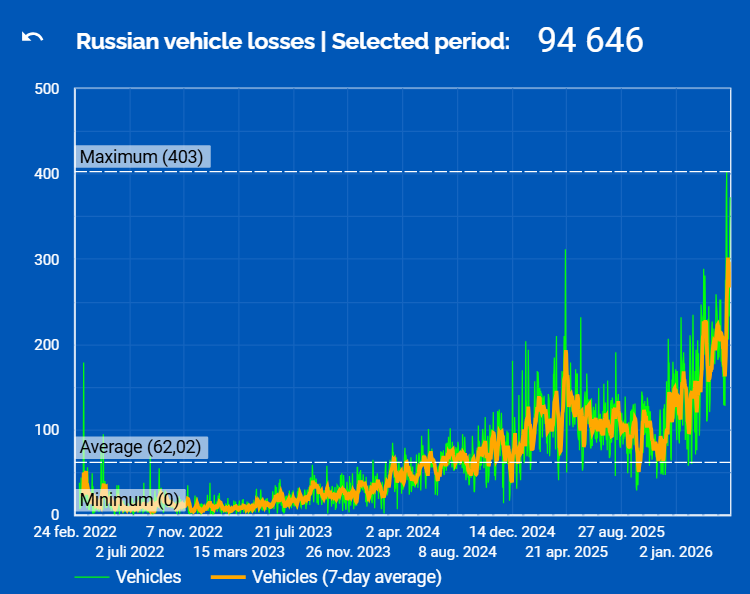
Here we see a sharp increase over the past year but also for the entire war as a whole. This is probably a combination. Today we see that the Russian army increasingly relies on simpler vehicles such as motorcycles, small buses, and trucks etc. The heavier military transport vehicles are probably running low and the costs to replace them with civilian vehicles become high. At the same time, Ukraine’s drone capability has increased both in quality and quantity so that today it is relatively easy to take out even motorcycles.
It is probably both a matter of shortage and tactical adaptation from Russia’s side combined with increased capability on Ukraine’s side.
There are more losses but each individual loss is probably smaller. Previously they took out military trucks and troop transport vehicles while today they take out motorcycles.
Losses of Russian unarmored vehicles in Ukraine one year back from today:
Losses of Russian unarmored vehicles from the start of the war:
Special equipment
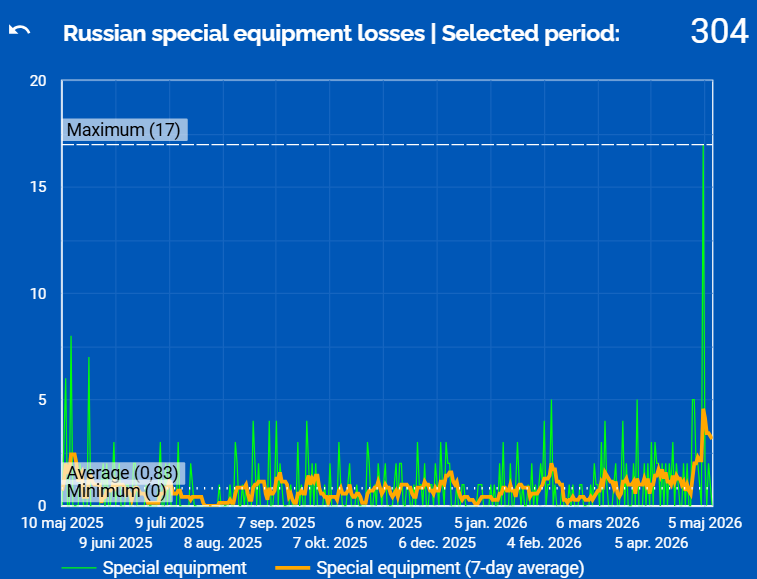
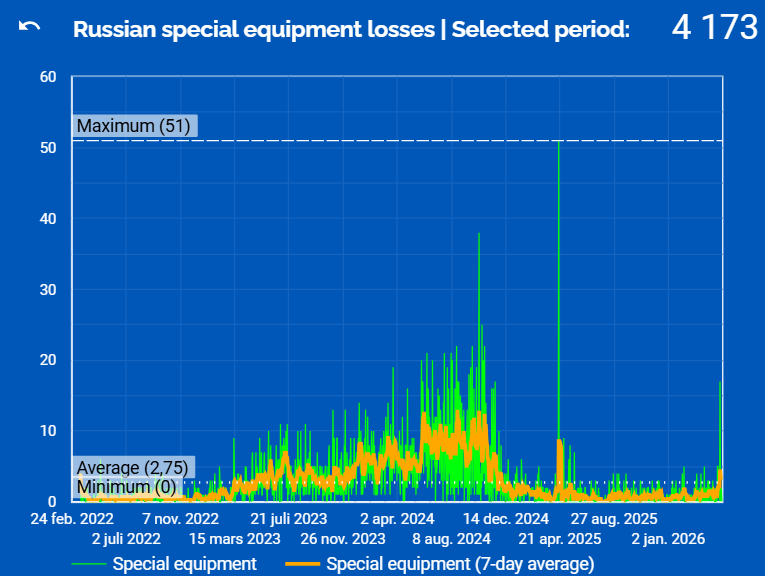
Losses of special equipment have been low during the past year, but we possibly see a slight increase towards the end, though this is probably coincidental. Looking back to when the war in Ukraine started, losses increased for a long time but now we are in a period with very low losses.
This may be a sign that Russia has difficulty producing, for example, larger radar complexes as vehicles etc., or that they simply do not dare to place them near the front. It may also be that Ukraine has taken out most of all fixed installations and that Russia has not rebuilt them, so it is simply harder to find targets. Difficult to draw any conclusions.
Losses of Russian special equipment in Ukraine one year back:
Losses of Russian special equipment from the start of the war:
UAVs, unmanned flying drones
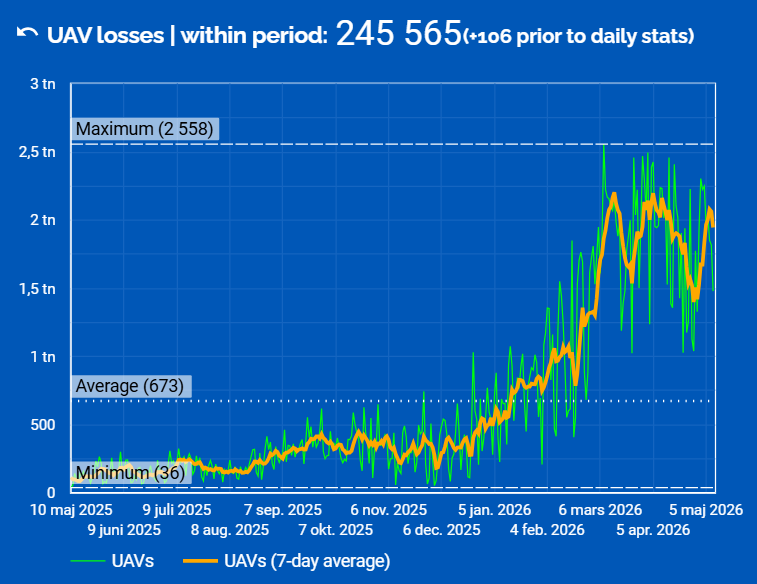
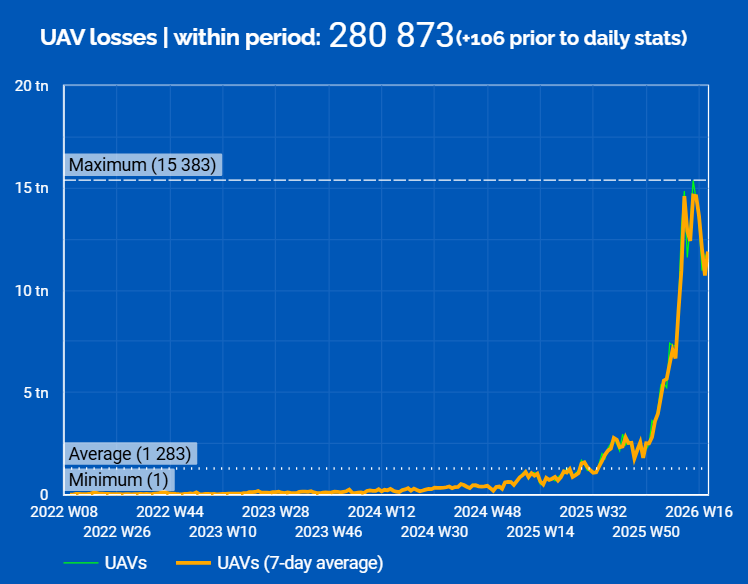
The past year shows a massive increase in losses of larger drones, while the peak seems to have been reached and towards the end we see large fluctuations. It becomes even clearer how large the increase is when looking at the war as a whole. It is obvious that Russia has greatly increased usage but also that Ukraine’s defense keeps up and manages to shoot down the majority of all UAVs. It is difficult to assess how much Russia’s production of e.g. Shaheds can continue to increase. They are cheap and relatively simple to produce. It is vital that Ukraine can expand its capability and that they get all the help they need.
If Russia continues to increase at the same pace, Ukraine risks having its infrastructure, energy production, and even its industry (military as well as civilian) destroyed.
Moreover, the constant attacks with civilian casualties wear down the population. Surveys show that more and more want to see peace negotiations even though most are still unwilling to give away land to Russia.
Losses of Russian UAVs in the war in Ukraine one year back from today:
Losses of Russian UAVs from the start of the war:
Russian air defense
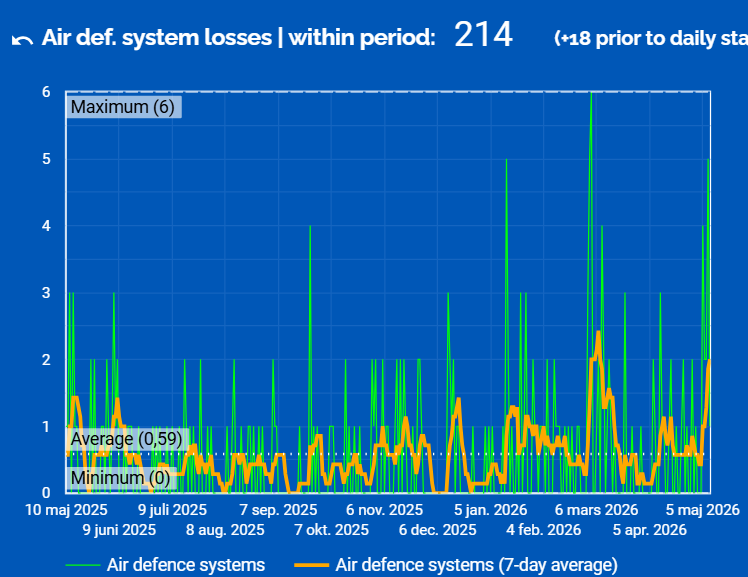
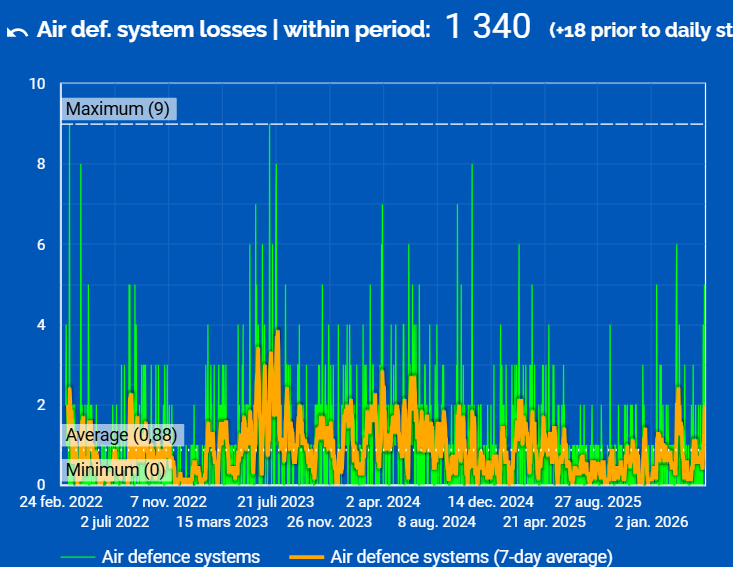
There is not much to say here. Ukraine continues to take out Russian air defense at roughly the same rate as throughout the war. It is usually between 0 to 3 per day, with 0 being the most common. The average over the entire war is 0.88 and for the past year somewhat lower at 0.59.
Losses of Russian air defense in the war in Ukraine one year back from today:
Losses of Russian air defense from the start of the war:
Russian artillery attacks
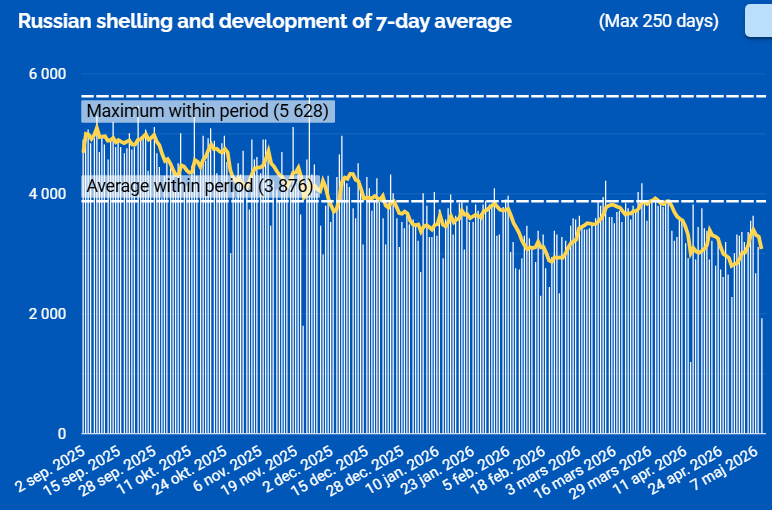
Here the statistics go back 250 days and one can see that it slowly decreases. From about 5,000 per day down to about 3,000 per day. There is no explanation regarding the numbers but I conclude that it refers to heavier artillery and not simpler mortars with short range.
Whether the decline is due to shortage, tactical adaptation, or if it is being saved as a reserve I reason about further up so I will not repeat it here.
Russian artillery attacks the last 250 days:
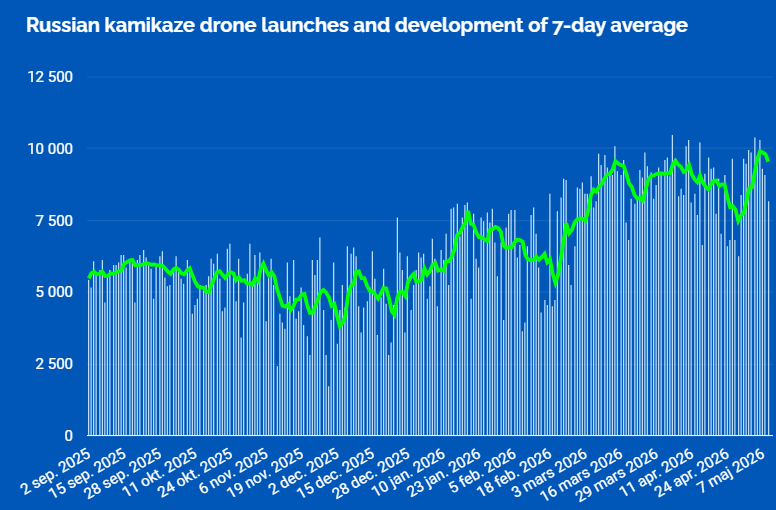
Russian suicide drones
Contrary to the above, the use of drones is increasing sharply. Here they have gone from just over 5,000 250 days ago to just under 10,000 recently. Just like Ukraine, Russia is increasingly focusing on FPV drones and we will probably see these numbers continue to increase going forward.
Regarding drones, Russia is probably dependent on China; the upper limit likely depends on China’s production capacity and Russia’s ability to pay for the components (assembly is probably done by themselves).
Russian suicide drones in the last 250 days:
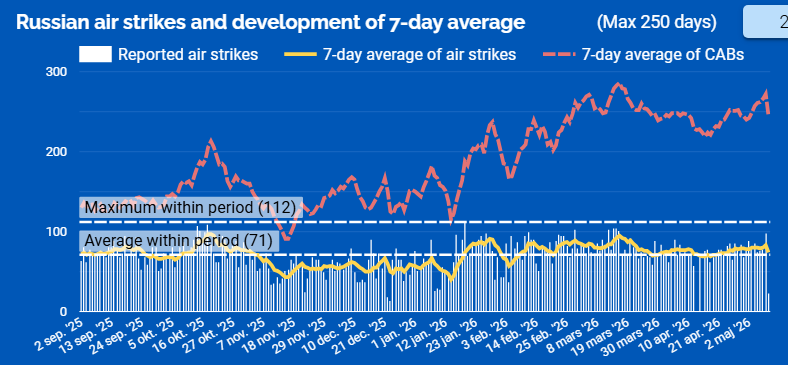
Russian airstrikes and KAB
The regular airstrikes remain at a fairly stable level of around 70 per day. The use of KAB, however, has roughly doubled in the last 250 days, but we can also see that it seems to have leveled off and stabilized in recent months. Hopefully, the Russians have reached the peak of their capability so we won’t see even higher numbers going forward. Note that the red line representing KAB is a seven-day average. We have had days where Russia has dropped over 300.
Russian airstrikes and KAB in the last 250 days:
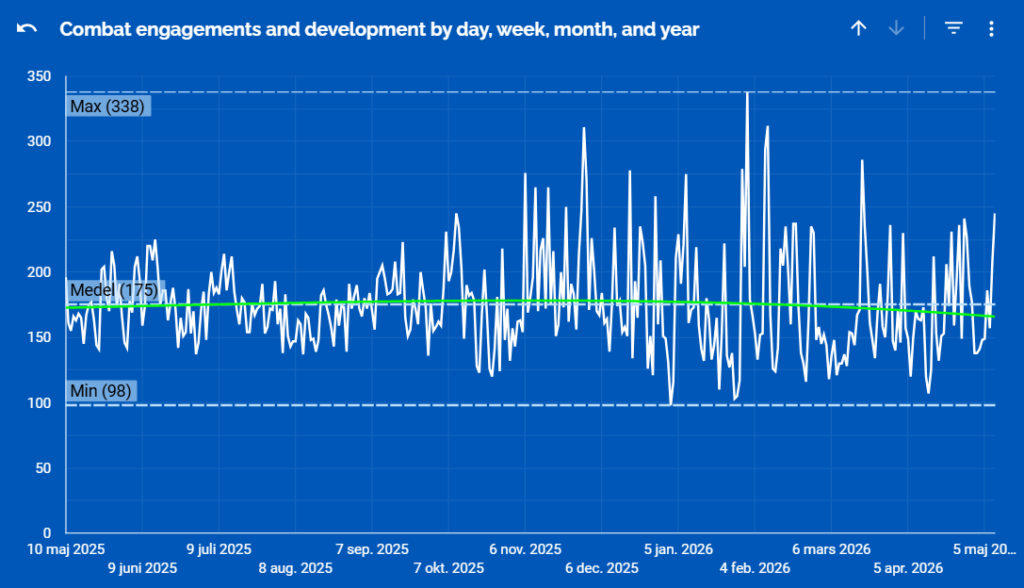
Combat engagements
The number of combat engagements varies greatly over time but has not changed significantly in the past year, and this corresponds fairly well with the Russian personnel losses.
Combat engagements over the past year
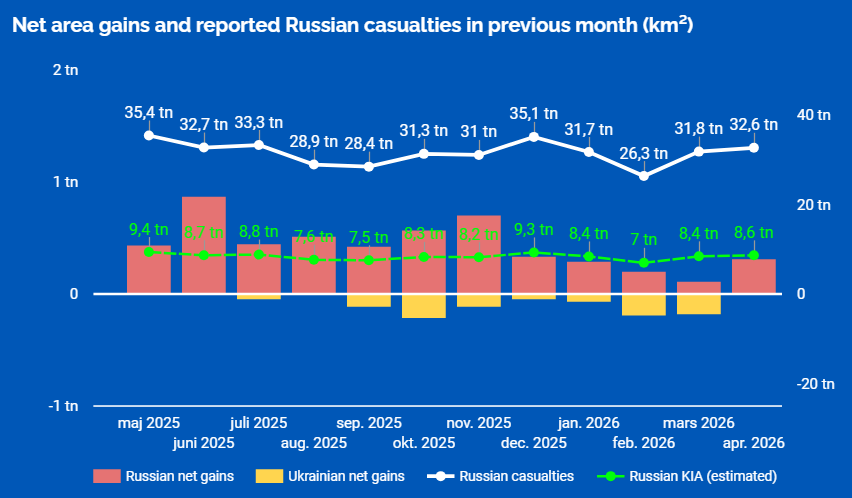
Captured territories
This shows, among other things, the size of the land area that Russia and Ukraine have captured (or rather recaptured in the case of Ukraine), represented by the red bars. Since the turn of the year, progress has slowed down for Russia, and we also see that Ukraine has retaken some areas. Although the last bar for April is somewhat higher, my interpretation is that Russia is finding it harder to continue advancing while continuing to suffer the same high losses,


Don't forget to donate, Ukraine's cause is ours! Support Ukraine!


Russian losses in Ukraine 2026-05-14
SLAVA UKRAINI
Thank you MXT! Very interesting!
Thank you!
Thank you! Interesting overview.
👍
👍👍👍
Thank you for the review. Very interesting.
👍
Johan!
I looked at your image attempts yesterday. The problem is that you are not getting the actual image link but the link to the page where the image is displayed.
Image links always end with the image’s name plus a dot and the file extension (which indicates the type of image). The most common are png and jpg, but webp is also quite common.
The names of the images depend entirely on what they have been named. But the address should end approximately like this:
putin-kissar-i-motvind.jpg
img03504.png
76BvDf83.webp
trum-mordar-barn.jfif
If the address/link does not end with .jpg or some other variant, it is instead a link to the actual page where the image is displayed, and that will not work.
I tested your Borat link with my Android.
It looked like this:
https://share.google/z1K9ec0pkijupcIda
That is a short link which then redirects to the page with another longer address where the images are uploaded, but as mentioned, it is a page and not an image link.
If I go to that link on my mobile, I also cannot directly get the image link for any of the images. However, I can click on the image and hold down for a second and then get some options. One of them is “Open image in a new tab.”
If I do that, I get a new tab where the image with its real address has opened directly. In that tab, I can then choose Share and then copy the address and then paste it on the site.
It is unnecessarily complicated but it works.
So there is nothing wrong with the website; it is the mobile phones that are designed to be easy to use and therefore have limited functions.
At the same time, they want to help you share, so there are a billion options to easily share to various social media, but not to quickly copy the image’s link/address.
Now I am working from home, and the iPhone is at work, so unfortunately I cannot check if I can find a good way to solve it with that right now.
** Russian missiles, drones pound Kyiv overnight; at least 3 killed, 40 injured as rescue efforts continue **
https://kyivindependent.com/explosions-rock-kyiv-as-russias-mass-daytime-drone-strike-becomes-large-scale-missile-attack/
** Poland scrambles jets to intercept Russian spy plane in Baltic Sea ‘provocation.’
Polish Defense Minister Wladyslaw Kosiniak-Kamysz said the “aggressive action” was intended to test Poland’s air defense systems. **
https://kyivindependent.com/poland-scrambles-jets-to-intercept-russian-spy-plane-in-baltic-sea-provocation/
The article states that they have the transponder turned off.
I have never seen an Il-20M with the transponder on because it is difficult to turn on equipment that is not installed in the aircraft.
Most Russian aircraft do not have the equipment installed!
Very well turned off transponder! 😄
Didn’t know they were without.
No, it is not generally known. Just because all Western aircraft have it, they assume that all Russian aircraft have it too, which is not the case.
Off-Topic, USA and China
“China’s President Xi Jinping says that the negotiations with the USA on Thursday morning have yielded ‘for the most part balanced and positive results,’ according to a statement in Chinese state media.
He also issues a sharp warning: If the USA ‘mismanages’ the Taiwan issue in the negotiations, it could lead to a ‘very dangerous situation,’ which could ultimately lead to an open conflict.
– He warns the American side in clear terms not to mess around, says geopolitical analyst Joe Mazur to Reuters.”
https://omni.se/xis-varning-strul-om-taiwan-kan-leda-till-konflikt/a/JO6wLJ
As I suspected, they don’t want to lose business in China.
Then they probably also prefer to make them dependent on American solutions instead of developing their own. It will be interesting to see if the Chinese companies also place any orders.
Regardless, a point goes to China right now as the USA has given in, but if China buys large quantities, it is probably the USA that ultimately benefits from it.
Wonder if Nvidia’s shares will rise now.
“Ten Chinese companies have received the green light from the USA to buy Nvidia’s second most advanced AI chip H200, Reuters reports citing sources.
Among the companies are tech giants such as Alibaba, Tencent, Bytedance, and JD.com. Lenovo and Foxconn are also on the list. The companies are allowed to buy the chips directly from Nvidia or through intermediaries, and a total purchase of up to 75,000 chips is permitted.
So far, however, not a single chip has been delivered, according to Reuters. This is because Chinese companies are said to have held back orders following pressure from Beijing.”
https://omni.se/uppgifter-tio-kinesiska-jattar-far-kopa-nvidias-ai-chip/a/L46Q34
Russia conducted a missile and drone attack overnight. Shot down:
652/675 Shahed and other type drones
0/3 Kh-47M2 Kinzhal aeroballistic missiles
12/18 Iskander-M/S-400 ballistic missiles
29/35 Kh-101 cruise missiles
The impact of 15 missiles and 23 drones on 24 locations was recorded.
https://bsky.app/profile/noelreports.com/post/3mlsg2vb7hs2g
De ryska U-båtarna sitter nu fast i näten 😄
** Russia has begun protecting submarines even 7,400 km from Ukraine, with Vantor satellite images showing anti-drone nets over 2 nuclear submarines at the Rybachiy naval base on Kamchatka. The covered vessels are Borei and Borei-A class submarines, placing improvised drone defenses around them. **
https://bsky.app/profile/noelreports.com/post/3mlsgheklh22g
** Satellite imagery shows a major fire at the Astrakhan gas processing plant after a Ukrainian drone strike. The blaze is centered on the open sulfur storage area and rail-loading node, with many fire trucks visible nearby. The facility is also heavily covered with anti-drone nets. **
https://bsky.app/profile/noelreports.com/post/3mlsgznaj7s2g
N Slobozhansky 4↗️
S Slobozhansky 22💥↗️
Kupyansk 1
Lyman 6
Slovyansk 1
Kramatorsk 3
Kostjantynivka 14💥↘️
Pokrovsk 36💥💥
Oleksandrivskij 0
Huliaipole 32💥💥↗️
Orikhivsk 8↗️
Prydniprovskij 2↗️
Localized 129↗️
Unlocalized 112↗️
Total 241↗️
Ratio unloc/loc 0.87↘️
Diagram:
https://x.com/coxoxoffoxoffic/status/2054868648066515168?s=20
UA attacks are higher, right?
If they stay above 100 for a while, you timed UA offensive start to May 12, right?
Believe the offensive start is earlier, around May 8, according to analysis of the May data ((:
The Ukrainian side has roughly doubled. May 1–7 averaged ~47/day (range 38–57). May 8–14 averaged ~87/day (range 56–121). That’s not drift — it’s a step change starting May 8. ((
Nice 205 👍
UA remains completely silent so no Twitter upheaval this year
Has DenGamle been tasked with clearing a minefield? Maybe he longs to return to his torpedo tube?
Saw that he had reinforced the walker, so not impossible.
👍
Good post 👍
+1
-1: MXT says that “Russia is conducting roughly the same number of attacks.” My charts show otherwise. The level of Russian attacks is steadily declining. However, the Ukrainian attacks have increased to the same extent as the Russian ones have fallen, and therefore the total is roughly the same. But that is not the same as the Russian attacks remaining at the same level since the total does not show only Russian attacks. The reports suggest that they have decreased.
Analysis with Claude:
The 28-day average peaked at 201 in early May 2025 and again at 179 in early December 2025 (winter energy campaign). It’s now sitting at 113–117, the lowest sustained level in the entire 12-month window.
Continued.
1. May–Jul 2025: high-intensity spring/summer campaign, AVG28 in the 165–200 range, with single days up to 259.
2. Aug 2025–Feb 2026: oscillating around 140–180, with the winter peak in late Nov/early Dec (single-day max 283 on Nov 29, 2025; 261 on Feb 1, 2026).
3. March 2026 onward: sharp step-down to ~115 and flat for ~10 weeks. This is a new baseline, not a temporary dip.
Continued.
The decline started around mid-February and was complete by mid-March. Whatever drove it — depleted missile stocks, shift to drone-heavy lower-count tactics, redirection of assets — it’s now sustained long enough to be structural rather than operational.
Continued.
The UA surge is happening into this lower RU baseline, which is why the ratio is moving so fast.
Maybe we should replace MXT with Claude? Then Claude can make the images for you too!
I do not see the relationship between localized and unlocalized attacks as sufficiently reliably established, and even if it is Ukraine that would be responsible for most of the attacks, Russia is still participating in those battles and it is Russia that is still advancing, so my conclusion is still relevant.
Moreover, I based the analysis on data from one year ago. It is not possible to look back indefinitely to see current trends.
By the way, may I ask what your prompt to Claude looked like?
There is very little data available that clearly points to only Russian attacks, so I am a bit curious.
Hello, I submitted the data (spreadsheet) that I have collected since May 1, divided by front section, summary of these, indicated the total. That is, the same information that I report above and other mornings, but for the entire period, over a year. That is, the data underlying the charts. You can also upload these charts in prompted and get roughly the same analysis.
A counter question: do you see that the increase in unlocalized attacks coincides with Ukraine taking ground (the yellow in the last chart)? For example, October 2025 had a peak in unlocalized attacks that was first reported the other day. The increases described by Claude above coincide with Ukrainian recapture of territory.
But sure, it is not confirmed by AFU. However, OSINT analysts like Girkin have suggested this explanation (unlocalized attacks are explained by OPSEC – Ukrainian attacks are not reported geographically, but included in the total). The same explanation can be obtained from Claude:
“The ratio likely measures the relationship between the total number of combat incidents and purely defensive ‘we repelled N attacks’ events per sector. What the General Staff underreports in the sector breakdown, but includes in the headline figure, is:
1. Ukrainian offensive major operations (growing linearly with the intensity of the counteroffensive — explains almost the entire trend)
2. Drone engagements in the gray zone that are not attributed to a front sector
3. Urban fighting in semi-occupied cities (Pokrovsk, Kupyansk) where ‘sector’ is meaningless
4. Sabotage group contacts behind own lines
5. Deep strikes and asymmetric operations that are not front contacts
The explanation is consistent with:
• The monthly median increase follows the chronology of the counteroffensive
• Discrete jumps after the fall of Pokrovsk (Nov-Dec 2025) and the start of the 2026 counteroffensive (Feb 2026)
• The continued rising trend during April–May 2026 matches that the counteroffensive is ongoing”
Claude’s points 2 and 3: should still be able to be reported per sector. The data inevitably comes from one sector, regardless of a drone attack in a gray zone, or combat in built-up areas. Otherwise, it probably wouldn’t be counted at all.
I do not have full access to your data, so I cannot study it in detail to, for example, make comparisons to see if it correlates with other data.
Your screenshots are too low resolution to be able to see the dates, etc.
Now I didn’t bother to screenshot everything from Ragnar.
Here we have a strike ratio for artillery, MLR, and airstrikes (the last week is of course low because it is not finished yet) and here you cannot directly see any clear trend that it would have turned. A bit more yellow in the chart but the red oscillates around the average.
It’s not all about ground battles, if we look at the use of drones (up in my post) we see no decrease there either and drones are probably today almost the most important component.
Then there is also the chart below, and there you can see that the ratio regarding equipment losses has actually turned but only in the last month.
Overall, the ratio increases in Ukraine’s favor when Russia attacks and vice versa.
But there is one exception and that is autumn 2022 when Ukraine retook large areas and Russia fled.
The increase at the end can therefore just as well be interpreted both ways but we have not seen Ukraine make any major breakthroughs. It is positive regardless and it may be because Ukraine is attacking. But compared to your numbers, the ratio has probably changed over a longer period?
At the same time, this table is based on Oryx, so the timing can be uncertain depending on how busy they have been and what they have managed to do.
It can both support and not support the theory that it is Ukraine that now has the initiative and that Russia no longer carries out as many attacks.
But I will continue to stick to “Russia is carrying out roughly the same number of attacks,” it is not my place to decide what conclusion the blog should draw.
Ah, come on now!
It’s just me going through the statistics and drawing my conclusions from them.
It’s not any kind of official stance from the blog that everyone has to agree with.
It’s good that you question it, but you have to expect that I will defend my position.
The idea of allowing comments on a blog is to discuss and debate things so that readers can then form their own opinions.
Keep questioning and arguing.
There came the ceasefire thanks for May 9th.
The same story every year – ridiculous
Has the Lithuanian government fallen?
Yes, it has 😐
But it was Latvia.
Question – if a country does not have a government, can they then invoke NATO Article 5 if they need to?
Can a NATO country whose government has been overthrown by an occupying power invoke Article 5? Lex Kyiv February 22, 2022..
Boring.
“The Swedish artillery piece Archer from BAE Systems is being rejected in a British procurement. That is what DI writes.
Instead, the choice is expected to fall on the RCH 155 with an order for a total of 72 units, in a deal worth around the equivalent of 13 billion kronor. The system is manufactured by a consortium jointly owned by the German Rheinmetall and the Franco-German KNDS.
The announcement was also expected, as the UK shortly before the turn of the year signed a smaller agreement with Germany for two test versions of the RCH 155, the newspaper notes.”
https://omni.se/svenska-archer-nobbas-i-brittisk-miljardaffar/a/Ok615V
AP – Sweden was totally defeated by UA drone groups.
Swedish defense Twitter can go to hell – they are trying to make it seem like it is Russian influence.
The Supreme Commander says that we must learn.
This is already beyond urgent now and Sweden is probably ahead of many other countries in Europe.
Why we haven’t trained broadly in Ukraine already is a big mystery to me.
https://x.com/ap/status/2054581234030854191?s=46&t=Vah3JXV31B9lXwZOK5gF7w
China promises to help Trump with Iran.
What do you think they got in return?
Where can you find it?
Xi promised to buy Trump coins and 10,000 golden shoes? (By the way, weren’t those the shoes made in China?).
https://edition.cnn.com/politics/live-news/trump-china-visit-xi-meeting-hnk
Putin on his way to China now in May.
Did you read yesterday’s thread comments, Lynx, about our discussion?
Xi meets both Trump and Putin in May.
The last meeting will probably be all three at the same time, one might guess?
Then Taiwan becomes a Hong Kong?
When you want peace, you have to prepare for war BEFORE it comes – only Finland has done that as usual.
The rest of Europe is left behind.
Hot tip – let our battalion stay in the Baltics all year, reinforce with the light battalion, and then let the Danes come there according to the schedule this summer.
Saw the answer about the pictures and nice of you to post your swimsuit picture as well 👍
When you can press the picture button, an image will be uploaded from the phone or computer, then damn, there will be pictures from me 👍
UA shot down surprisingly little in this attack – any ideas why?
Has Trump stopped patriot?
UA has an acute shortage?
95% is not so bad, is it?
The drones or the robots?
The robots got through, right?
Belarus has had 42 military exercises this year
Thank you for the interesting post MXT.
Thank you!
Interview with controversial Palantir CEO in SVD.
Harsh verdict: Europe is ten years behind.
Europe is at least a decade behind in military technology development. The brutal verdict is delivered by Palantir’s CEO Alex Karp in an interview with SvD. At the same time, he says that Sweden stands out positively – and reveals what he wishes from Ulf Kristersson.
Published: May 14, 2026 06:42
The first visit took place in June 2022. Alex Karp crossed the border on foot and then continued towards Kiev in a convoy escorted by what he describes as guerrilla fighters. Along the way were burnt-out cars and tanks. During the more than ten-hour car ride from the Polish border, the feeling, according to Karp, was that the dead had just been buried.
Now Alex Karp has just returned from his second visit to Ukraine since the full-scale invasion.
– You could hardly tell that we were no longer in Poland, he says.
The biggest difference was in the Ukrainian attitude.
– In 2022, the feeling was that we probably wouldn’t survive, but we would fight to the end. Now the general feeling is that we will win.
Alex Karp is not just any business leader. As co-founder and CEO of Palantir, he has become one of the most influential people in both Silicon Valley and the defense industry. Under his leadership, Palantir has become an important supplier of software to both military forces and other authorities – and a highly controversial company. Palantir has, among other things, been accused of contributing to Israel’s warfare in Gaza and mapping individuals for the US immigration police ICE.
This is the first time Alex Karp has been interviewed in Swedish media.
Palantir’s role in Ukraine
The interview time is postponed several times – getting a publicly traded CEO out of a war zone proves not to be easy. When it takes place, it is done together with journalists from Danish Berlingske and Dutch De Telegraaf. For security reasons, nothing may be published until Karp and his team have left Ukraine.
Seven minutes after the scheduled time, the Palantir CEO appears in the video meeting. He is talking to someone off-screen.
– We were at this drone manufacturer… Oh, I can’t tell this story now, says Karp when he sees the three journalists on the screen.
Palantir’s role in Ukraine is not only to give the military a better situational picture. The company also works with mine clearance, war crimes investigations, and training AI models on real combat data.
The main success is perhaps the Brave1 program, which collects data from Ukraine’s drones. Palantir states that more than 80 different AI models have been trained to, for example, recognize the outline of a Russian Shahed drone, and according to the company’s European head Louis Mosley, the country can today combat 95 percent of the drones. Through Brave1, the data can also be made available to partners in the European defense industry. Palantir owns the software, Ukraine owns the data.
Alex Karp says Ukraine is fighting a data-driven war.
– They look at metrics such as the number killed per square kilometer, follow every mission, and feed it into the system to get constant feedback. They break it down at the unit level, so that each unit gets the equipment they need.
But what the next step in aid to Ukraine concretely involves he does not want to go into.
– We want to give Ukraine infrastructure components. What that means is not appropriate for me to talk about here.
Meeting with Zelensky
After the visit, Ukraine’s president Volodymyr Zelensky writes on X:
“We discussed areas for technological development – both related to military operations and civilian needs. We agreed that our teams will keep in touch.”
Defense Minister Mykhailo Fedorov adds:
“Today, our partnership is defined by concrete results: from advanced analysis of air strikes and AI-driven intelligence processing to precision planning of attacks deep inside enemy territory.”
Alex Karp is dressed in a purple shirt, with his curly hair askew. He quickly jumps between different topics – from growing up in a pacifist left-wing family to how boring many business leaders are – and gives the impression of speaking completely spontaneously.
The Palantir CEO describes the relationship with Ukraine as trusting. Initially, Palantir helped the country without charging. How the margins look nowadays is not something the company openly reports, but Karp says the reason for supporting Ukraine is neither to make money nor to test new technology.
– The greatest value in helping Ukraine is that our employees want us to do it, and feel good about it.
He continues by saying that we Europeans do not understand how the debate in the US looks.
– You see it like this: USA/Iran – controversial. Israel — super controversial. Ukraine – not controversial. But helping Ukraine is very controversial in the US. You can only imagine what I have to defend. It shouldn’t be like that, but it is.
Karp: Europe must wake up
His main message on the way home from Ukraine is simple: Europe needs to wake up.
– As things stand now, Europe is at least a decade behind when it comes to defense technology. The only part of Europe’s defense industry that keeps up is Ukraine.
Alex Karp is among the most ideological and outspoken tech CEOs in the world. In his book “The Technological Republic,” he argues that the software industry must help the US and its allies build military strength, and he pushes the development of AI for military purposes. On Swedish debate pages, he has been described as the man behind a “villain manifesto,” and accused of having a “sick worldview.”
– I really believe that Europe needs to have the ability to defend itself, even if it in some ways goes against my own business interests. I have no problem supporting things that are not in my own interest.
What do you think about the growing concern in some European countries about becoming dependent on American technology?
– That is something Europe itself must sort out. Sovereign states need a plan B if everything goes to hell. Even if you trust me blindly – and I believe Ukraine has high confidence in us based on what we have delivered – you still need an alternative in case I get hit by a car or change my mind.
Last year, problems arose in Ukraine when access to certain American intelligence information was cut off. Were they ever cut off from your products?
– Founder-led companies have a big disadvantage: you have to live with our opinions. I’m not going to cut anything off for Ukraine, and we never have.
What Sweden can learn
For Alex Karp, Ukraine shows that a new type of warfare works. Drones and remotely controlled ground vehicles reduce the risk for soldiers and make software increasingly important. What works best, says Karp, is small units with integrated technical personnel.
His message to countries like Sweden is that technical knowledge must be treated as a scarce resource.
– You can’t afford to put weapons in the hands of your engineers, even if they want it themselves – they have to work in the technical units. That is very important.
In summer 2025, Karp and co-founder Peter Thiel met Sweden’s Prime Minister Ulf Kristersson to discuss Sweden’s AI strategy. Now Karp says he has delivered a clear message in private talks with many European heads of government.
– It is crucial to have someone who reports directly to the prime minister, who understands these issues and can build a special system to manage the transition. Otherwise, the reforms will take another ten years. That is Russia’s problem.
Do heads of government listen to your advice?
– Usually not.
Dark picture of Germany
According to Karp, it is smaller countries like Sweden, Denmark, and the Netherlands that represent Europe’s best hope.
– Your intelligence services – some of them you don’t even know exist – are small and extremely competent. Your armed forces are small and very competent. You have more flexible procurement systems. You can make it work.
Karp is American with German origins, speaks fluent German, and earned a PhD in social theory at Goethe University in Frankfurt. But he has a dark view of both Germany and France.
– They have much larger bureaucracies and big economic interests in the defense industry. They don’t say: we procure company X even though we know it is worse than company Y. Instead, they pretend that company X has a better product. And that is much more dangerous.
– If Europe is to be reformed militarily, it will be the smaller countries that do it.
Before Alex Karp rushes on to the next meeting, he also manages an unusual compliment – directed at Sweden.
– You actually have a real tech sector. That is otherwise a huge problem for Europe.
https://www.svd.se/a/pBd46G/palantirs-vd-alex-karp-europa-ligger-tio-ar-efter-i-militar-teknik
I am worried about what will happen after the election this autumn. What we are ahead in now can quickly change with the wrong parties in government.
Well, if the left were to win and by a small margin so that VP and MP can control and decide, it could go completely wrong. The risk exists, of course, even if S manages more on their own, but I still believe they understand the seriousness and will not make any major changes.
Just saw this.
“Sweden must take the experiences from the Aurora 26 defense exercise with the utmost seriousness. That is what the Social Democrats’ defense policy spokesperson Peter Hultqvist says after reports that Swedish soldiers were ‘crushed’ by Ukrainian drone pilots in a simulated scenario on Gotland.
Here there is a clear deficiency, according to the Social Democrat leader.
– We have long had a need to do significantly more on the drone front than we are currently doing.
Hultqvist thinks that the government is already doing some things well, but that it is not enough. Among other things, he wants conscripts to be trained as drone operators and for cooperation with other countries to be strengthened.”
https://omni.se/s-toppen-ukrainsk-kross-bor-tas-pa-djupaste-allvar/a/QJ52lq
I have zero confidence in Hultqvist after he stood at a press conference and said that if SD is allowed to have a say in decision-making, it is a threat to democracy.
I agree 😬
Thanks for the interesting post! 👍
Referred to Pehr’s post further up.
Some connection to the subject.
Mistral could be our Plan B if we want to avoid dependence on the USA. Unfortunately, they are probably not quite sharp enough yet to compete.
“The EU is somewhat desperately looking for a powerful AI model focused on cybersecurity after the American company Anthropic denied the union access to their much talked-about model Mythos. That writes Semafor.
Mythos has created great attention and concern because it is claimed to be able to carry out advanced cyberattacks more or less on its own. Anthropic themselves have claimed that the model is too advanced to be released widely.
The EU is now instead looking at advanced cybersecurity models from the French Mistral and Open AI, according to Semafor.”
https://omni.se/efter-nobben-fran-anthropic-eu-soker-ny-ai-for-cybersakerhet/a/d4vQw1
Very readable. Thank you.
Off-topic, USA, China Iran
There was not much of a secret stamp about it if it is written about.
“A classified intelligence report shows that China is taking advantage of the war in Iran to strengthen its position against the USA in military, economic, and diplomatic areas. This is stated by two sources to the Washington Post.
According to the report, China has, among other things, sold weapons to the USA’s allies around the Persian Gulf as they struggled to defend themselves against Iranian retaliatory attacks. China is also said to have helped countries around the world meet their energy needs after the closure of the Strait of Hormuz.
At the same time, the USA’s weapons stockpile is reported to have been rapidly depleted, something that according to the report could have serious consequences in a future conflict with China over Taiwan. The war has also given China the opportunity to analyze the USA’s warfare and draw lessons for future military operations.
The report was produced earlier this week and is said to have raised concerns within the Pentagon about the geopolitical costs of the war in Iran, according to the sources.”
https://omni.se/kallor-kina-starker-sin-position-till-foljd-av-kriget/a/pBdOJj
”
The Ukrainian snipers who were widely praised by allies at the beginning of the war against Russia have basically been made unemployed by drone development, writes the Wall Street Journal.
In 2023, Vyacheslav Kovalsky, 60, set a new world record when he killed a Russian officer at a distance of four kilometers. Both civilians and military personnel used to ask for his autograph, and he was included in a kind of unofficial hall of fame for the best snipers in history. Today he works supporting drone pilots and has not fired a shot in several years.
– Drones are simply cheaper and more effective, he says.”
https://omni.se/hyllade-prickskytten-dronare-ar-battre-och-billigare/a/m05E4l
Are you still replying to comments in old posts on MXT?
I get a lot of emails about it 😀
I needed to test a few things so I commented on the very first post of the blog.
Deleted them when I was done.
A post will come tomorrow
Were you here today Lynx or did you miss two batches of comments in yesterday’s and the day before yesterday’s posts?