
Russia’s illegal war of aggression against Ukraine has now been ongoing for four and a half years. To get an overview of how the war is developing, both during the past year and throughout the entire conflict, a comprehensive review of Russian losses up to today is presented here.
NOTE! If you are not interested in Russian losses and want to go directly to today’s post with fresh news (2026-08-05) regarding the war in Ukraine, click here.
Review of Russian losses in the war in Ukraine
Summary
Russian losses have been higher in several categories earlier in the war, while we see that losses of, for example, artillery and logistics vehicles have increased sharply, and regarding that increase, it is not hard to guess that it is due to Ukraine now having drones with even longer range and higher precision.
Russia’s use of drones has also increased significantly, which is probably another reason why their UAV losses have skyrocketed.
Losses of tanks and other armored vehicles have decreased and have been low for a longer period. This is likely not because they are short of them anymore but rather a conscious choice. Cheap drones, even if several are required, can relatively easily take them out, and in a war of attrition where the economy and production capacity will probably decide the war, that equation does not add up.
While the use of drones has increased sharply, we can still sense that this increase has somewhat leveled off regarding Russia. We hope this trend continues and perhaps even reverses downward.
Drones dominate increasingly both on the battlefield and in deep strikes. Ukraine and Russia are now both experts in this and adapt and develop these capabilities. Europe and NATO must keep up to manage a war against Russia.
Another development we have seen during the year, and perhaps the most decisive for the war, is Ukraine’s ability to use long-range drones etc. against Russia. They have struck hard against their oil refineries (it is now said that Russia has lost about 50% of its capacity) and recently also against Wildberries warehouses. Unfortunately, this particular statistic is not covered here, but it also points to the fact that the ability to develop capabilities even during full-scale war is crucial and that drones are decisive in this war.
Introduction
Here I first go through the different categories of losses, partly with a more detailed chart showing the situation so far this year, and partly with a chart of losses per month over the entire war up to July this year. Sometimes this is supplemented with additional charts. Towards the end, there are also further figures such as drone usage etc.
Many thanks to Ragnar Gudmundsson (https://bsky.app/profile/ragnarbjartur.bsky.social) from whom the blue charts are taken; the others come from https://index.minfin.com.ua/en/russian-invading/casualties/
Wounded and Killed Russian Soldiers (KWIA)
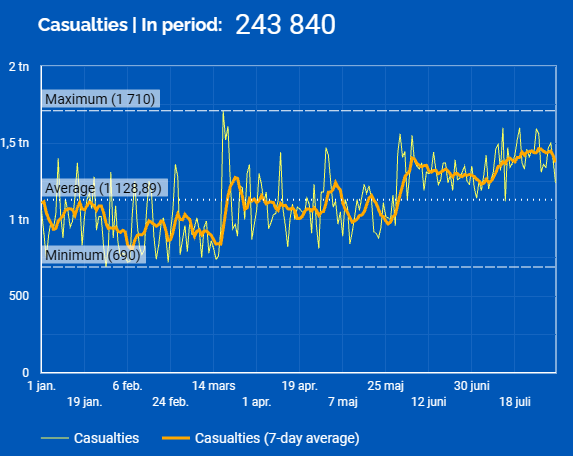
The development during the year resembles a three-step staircase where the loss level has markedly increased each time. The peak for this year is still from March, but regarding average losses, we are at the highest now towards the end.
Looking instead by month and over the entire war, July was the fourth highest month.
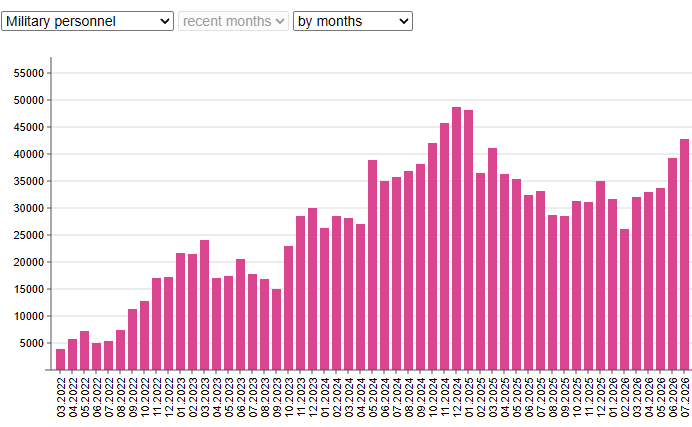
Here is another type of overview showing the development of soldier losses throughout the war.
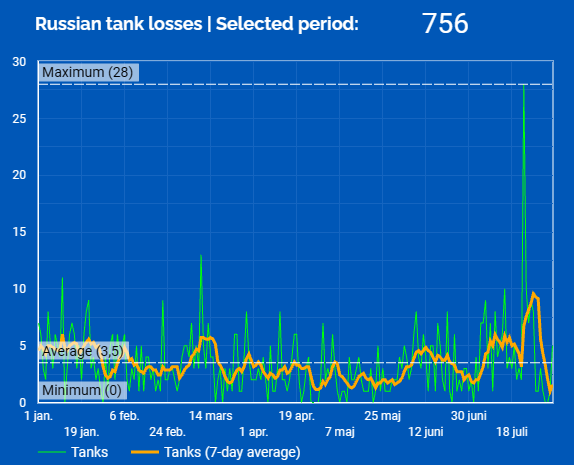
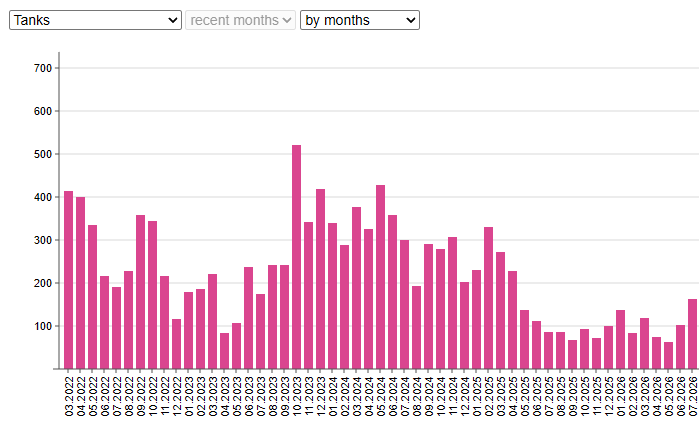
Russian Tank Losses
Overall, there have been fairly small variations during the year, although it can be seen that Russia has made some attempts with larger mechanical offensives recently.
Most believe that Russia has lately been conserving its tanks, partly because it is wasteful to use them due to all the drones and partly to build a large reserve to, for example, use in the Baltics. There are some indications pointing in that direction, such as reports that they have gathered some near the border with Finland and the Baltics, and those who count Russian tanks via satellite images also argue that they should have a few thousand tanks left. The stockpiles seem almost depleted, but they have not been able to track where they have gone after reaching the factories where they are refurbished.
On one hand, we are talking about Russia. It is clear that it is in their interest to appear strong and project a threat against all of Europe and NATO so that we rather strengthen our own defense than choose to give everything to Ukraine. So it is not entirely impossible that they actually have a shortage of functioning tanks and that those they have must be kept in reserve in case other conflicts arise. On the other hand, it may of course be that they are preparing to expand the war, and we cannot ignore that; we must prepare for war against Russia and a possible attack on the Baltics. The most important thing is that we do not stop supporting Ukraine with the equipment they need.
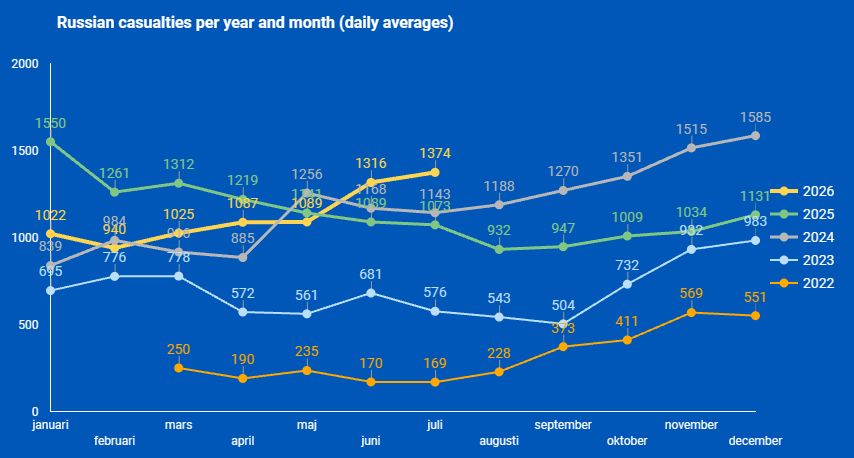
Here you can see a comparison with last year:
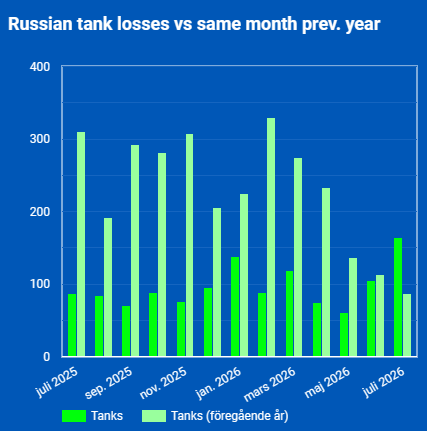
Viewed by month, there was a clear decrease during the summer of 2025, but it also shows that there was an increase in July.
Other Armored Vehicles
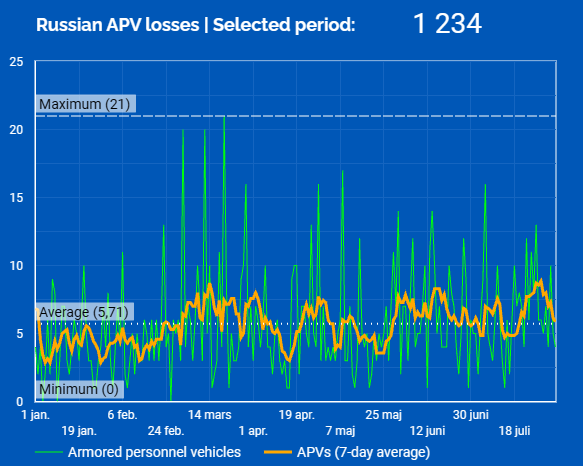
Here you can see a slow increase during the year, almost doubling Russian losses of armored vehicles.
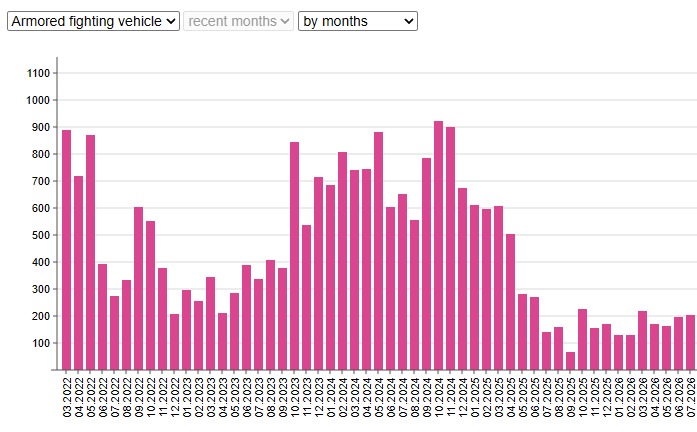
Over the entire war, the level is low but not at the lowest level, and towards the end, there is a slow increase.
Russian Artillery Losses
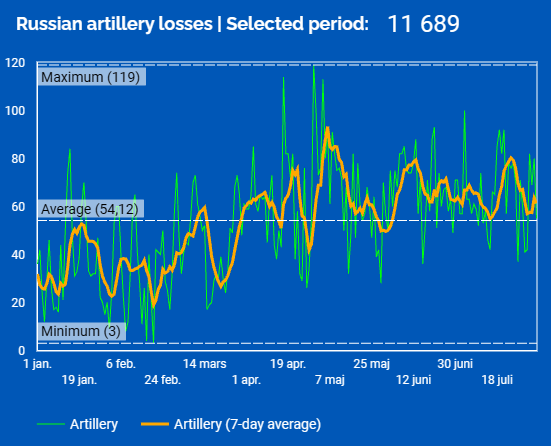
Despite drones becoming increasingly common, we see a clear increase in artillery losses during the year. This could be interpreted as Russia suddenly having more artillery than before, but it is more likely that Ukrainian drones reach further and find it easier to take it out. Or maybe a combination.
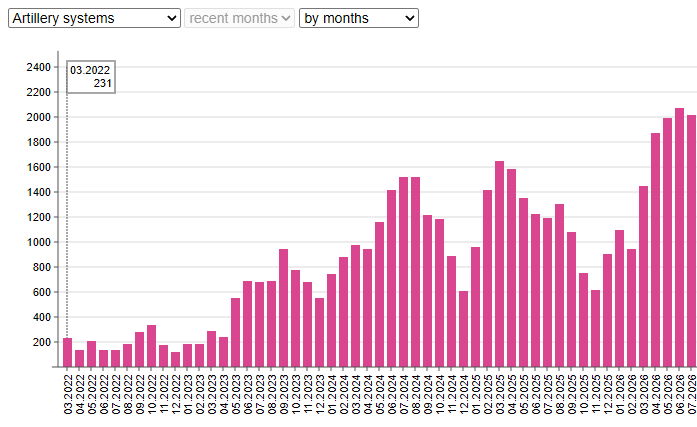
Over the entire war, artillery losses have increased in waves, with June being the record month.
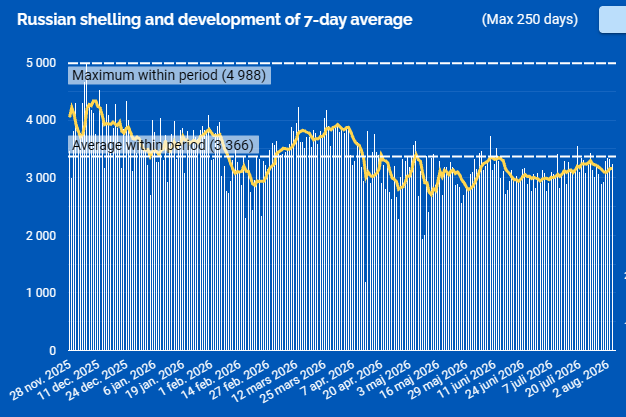
Looking at artillery usage, however, it is slowly decreasing. This covers the last 250 days and may of course be a consequence of Ukraine taking out more and more.
Russian MLRS Losses
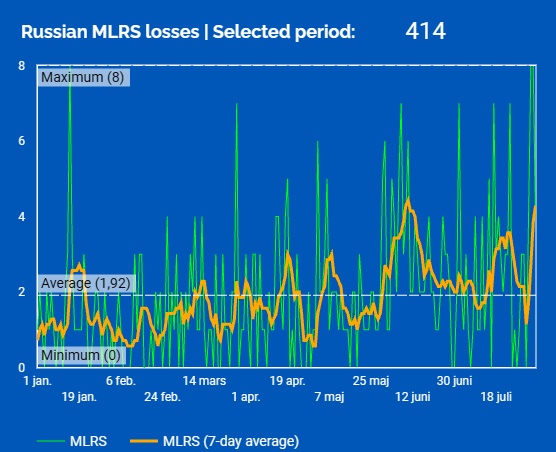
Losses of MLRS have also increased during the year.
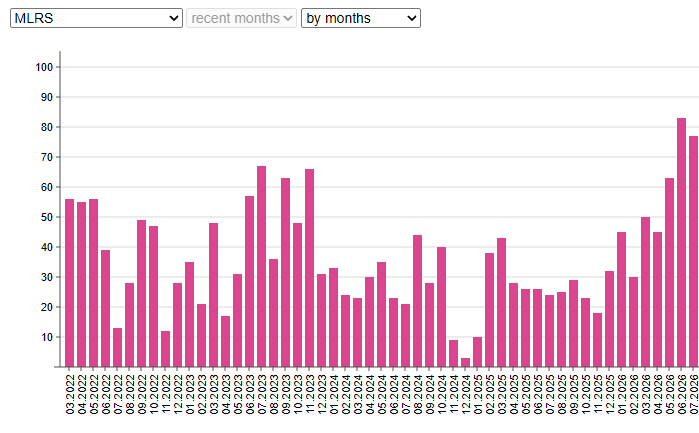
Even over the entire war, it has increased with June as the highest month and July as the second highest.
UAV Losses
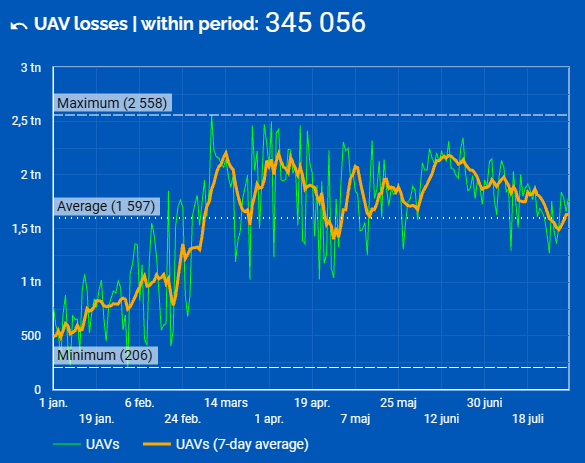
UAV losses have risen enormously compared to earlier in the war; during the year, however, it can be seen that they have not increased since mid-March and have even decreased in the last two months. Regarding UAVs, it is difficult to know exactly what is included, but I interpret it as referring to Shaheds and other drones that are not the simpler FPV drones, though one cannot be completely sure.
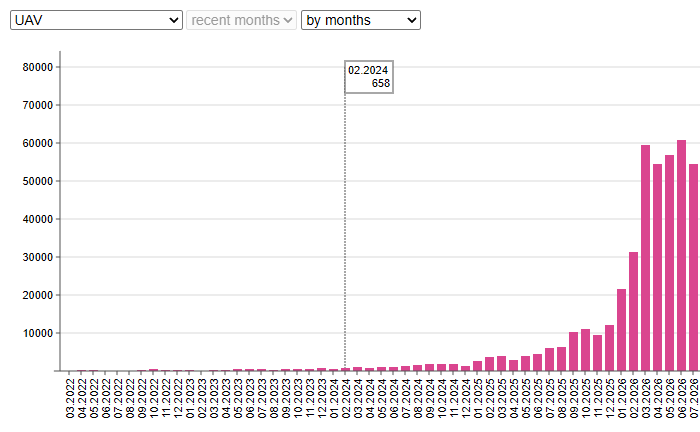
Looking at the entire war, it is even clearer how much it has increased but also that it has leveled off at a steadier level.
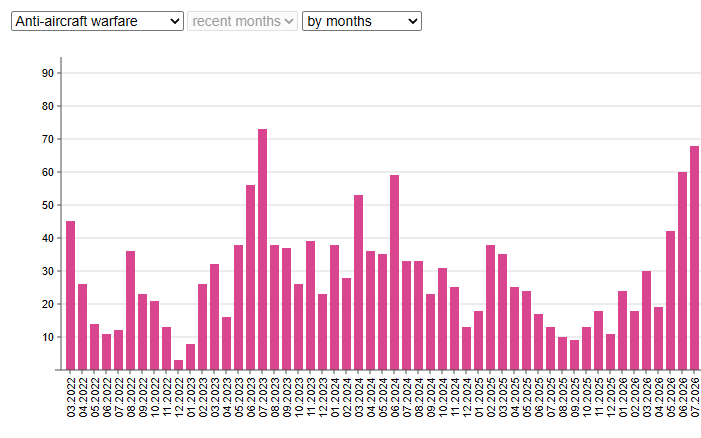
Russian losses of air defense in Ukraine
Here you can see that there has been a clear increase during the year, and it is probably not wrong to conclude that this is due to an increased ability to take them out through various types of drones rather than indicating increased usage.
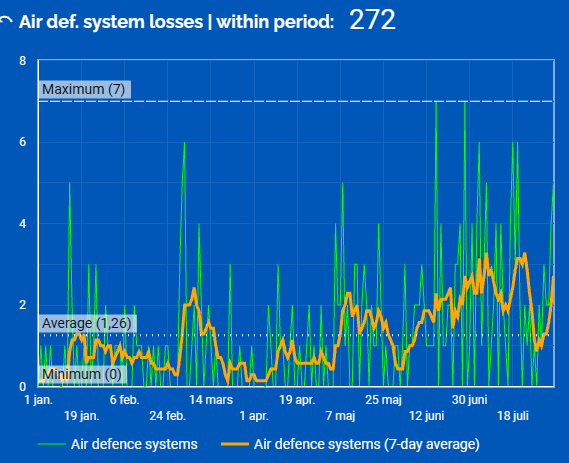
Also seen over the entire war, it is high, with July as the second highest month and a sharp increase since the low point in September 2025.
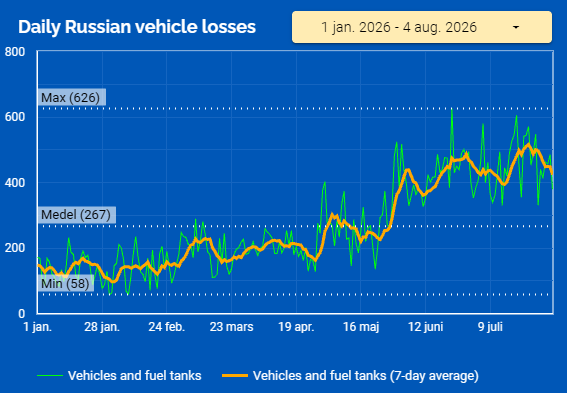
Other vehicles for logistics etc.
The increase during the year has been astonishing. Here too, my guess is that Ukraine’s drone warfare has developed and makes it possible to reach deep.
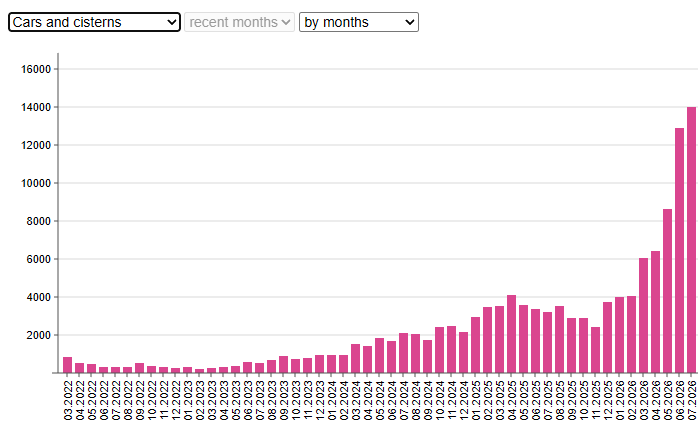
Seen over the entire war, the sharp development in losses becomes even clearer and July is the record month.
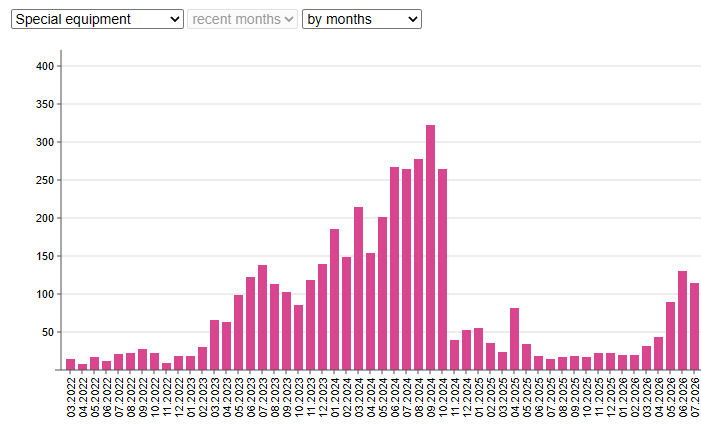
Special equipment
Ragnar seems to have removed his statistics regarding special equipment but seen over the entire war there is a clear increase towards the end, albeit from a fairly low level.
Captured territory
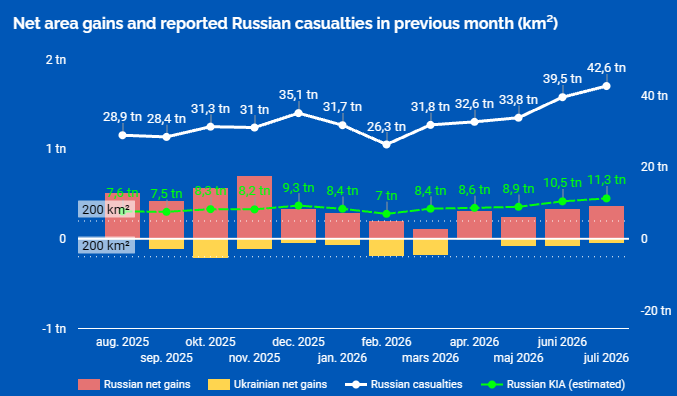
Here you can see that Russia unfortunately still takes more land areas each month except for February and March, but also that it costs them enormous losses of personnel. Apparently, both Putin, the army, and the rest of the Russian population think it is worth it, as there are very few if any protests at all.
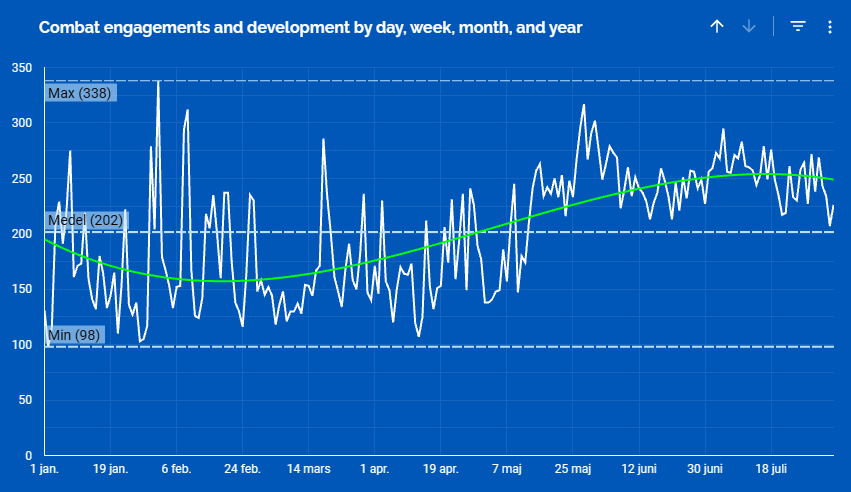
Combat engagements
Number of combat engagements so far this year. Regarding the number of battles, one might think it should correlate quite well with KWIA, but we do not know how large the engagements are. What we can suspect is still a connection here with the increase in battles in May, with the third step regarding the increase in killed and wounded Russian soldiers that I went through earlier.
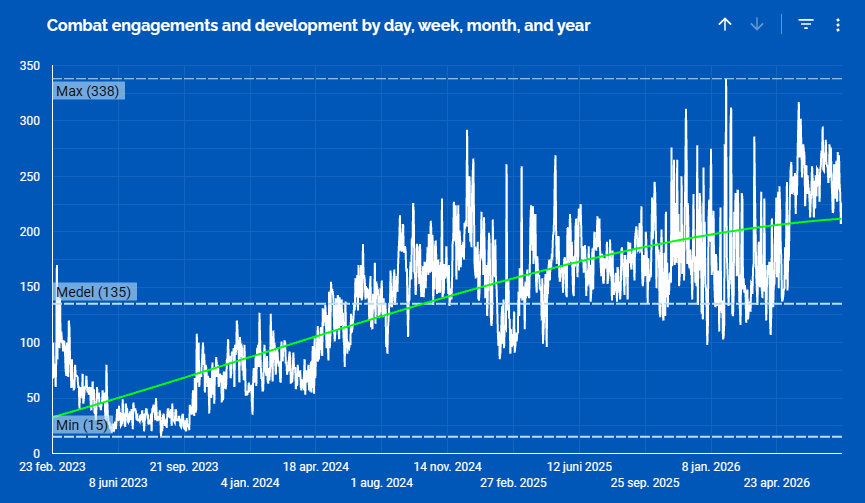
Looking over the entire war, you see that the number of battles is among the highest so far.
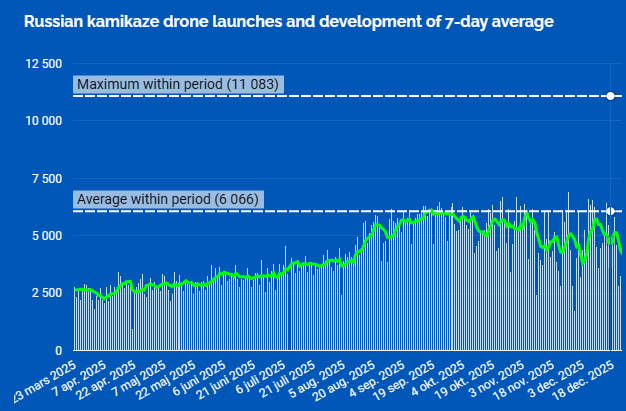
Suicide drones
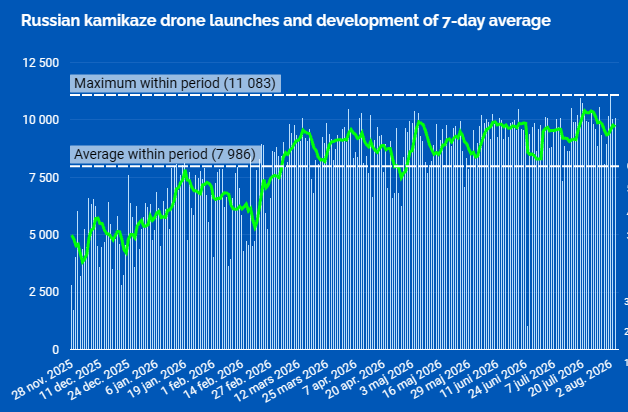
My theory is that this statistic applies to the simpler FPV drones used in attacks at the front and not UAVs in the form of Shaheds and larger surveillance drones. Whether this is true or not, you can see that the increase over the last 250 days has been high, but that the rate of increase has decreased significantly since March. Since the chart can only show 250 days, I first present from -500 to -250 days and then -250 days up to today so you can see how it has developed. At the end of 2024 (not shown below) it was at ~1,500/day and today the seven-day average is up to ~10,000/day.
If you have any comments, your own interpretations or anything else regarding the statistics above, please leave a comment below.
(For today’s post with news regarding the war in Ukraine, click here.)


Don't forget to donate, Ukraine's cause is ours! Support Ukraine!


Don’t miss the MXT statistics post today, it is posted before this 👍👍