
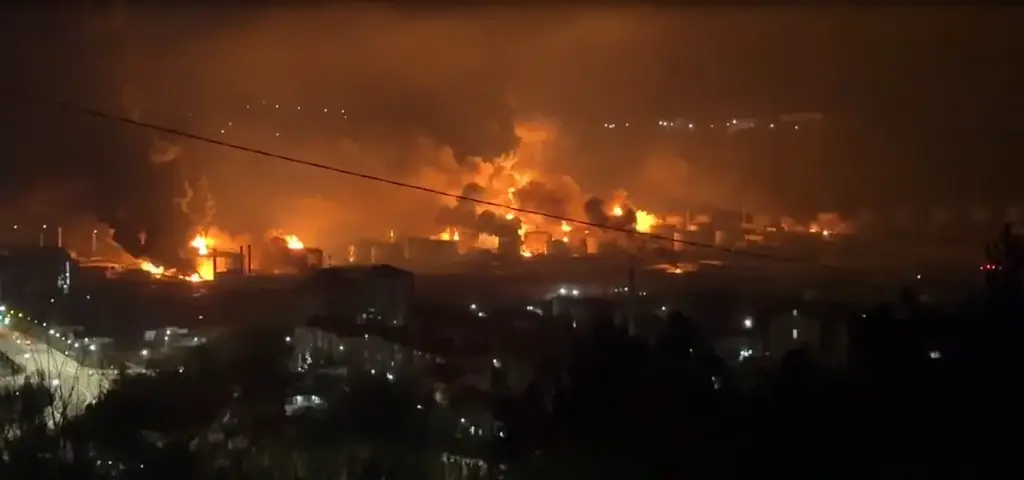
The Tuapse oil refinery in Krasnodar Krai was attacked by Ukraine during the night, and residents have reported extensive explosions. Images and videos show a large fire has broken out. It is reported, among other things, that two large tanks have caught fire. The governor of Krasnodar Krai has confirmed the attacks and stated that one person has been killed, but without making any more detailed statements. Read more at Kyiv Independent here and see a couple of posts from Bluesky here and here. The fire is raging violently, and it is likely that the fire will spread.
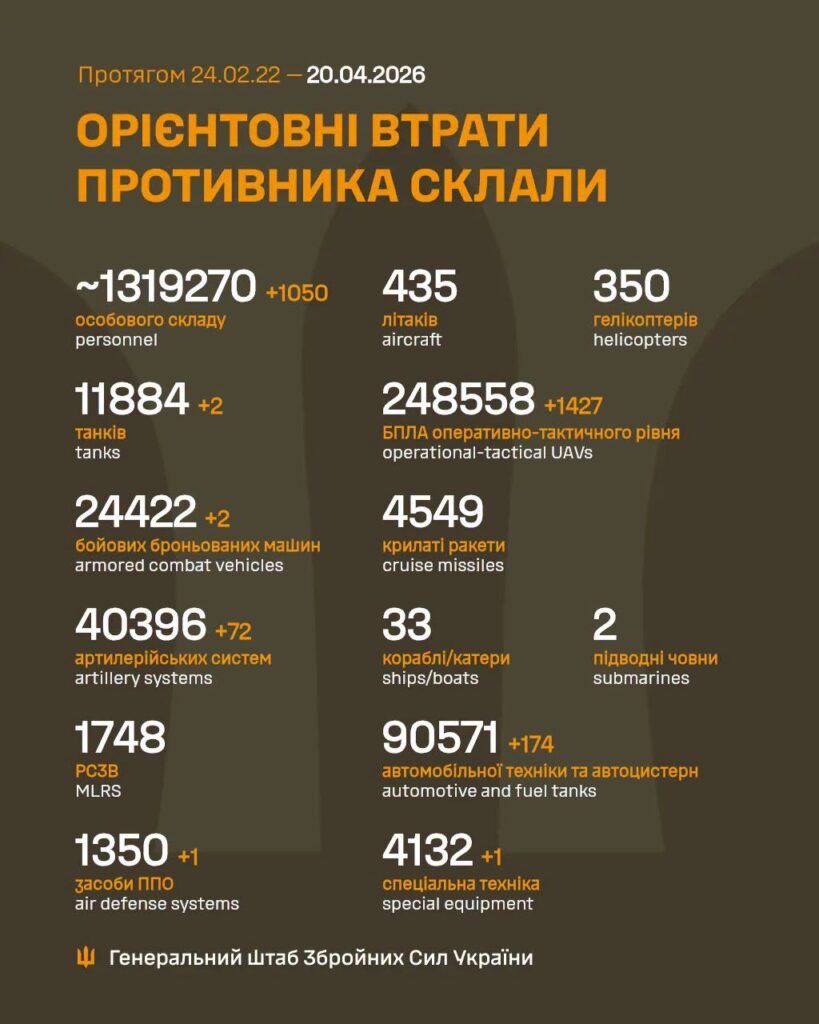
Russian losses in Ukraine
Today’s loss report looks good with over 1,000 KWIA and high losses of artillery and soft vehicles.
- 1050 KWIA
- 2 Tanks
- 2 AFVs
- 72 Artillery systems
- 1 Air defense system
- 1,427 UAVs
- 147 Vehicles and Fuel tanks
- 1 Special equipment
Russian activities
- 206 combat clashes
- 71 aviation strikes
- 253 KAB/CAB controlled air bombs
- 7,767 kamikaze drones
- 2,916 shells (including 85 from MLRS).
SLAVA UKRAINI


Don't forget to donate, Ukraine's cause is ours! Support Ukraine!


“13/142 drones shot down 👊”
https://bsky.app/profile/maks23.bsky.social/post/3mjvs46x3mc2j
There I choked, 13 out of 142, the worst result in a long time. Something serious must have gone wrong.
Luckily, it’s supposed to be 113/142.
“Occupied Melitopol overnight 💥👀”
https://bsky.app/profile/maks23.bsky.social/post/3mjvscop4w22j
Den Gamle: what is “busy”?
“❗️On the night of April 18-19, 2026, the special unit of the Main Intelligence Directorate of the Ministry of Defense of 🇺🇦Ukraine “Prymary” (“Ghosts”) struck two large landing ships of the 🇷🇺Russian Black Sea Fleet in Sevastopol
— the Ropucha-class landing ship Yamal (Project 775, ~$80 million) and the Alligator-class landing ship Nikolay Filchenkov (Project 1171, $70 million).
The unit also destroyed an enemy Podlyot-K1 radar station ($5 million). Both ships have been put out of action. ”
https://bsky.app/profile/militarynewsua.bsky.social/post/3mjvsb3lbb22q
“🔥Large landing ships and Russian radar in Crimea – “Prymary” of GUR hit the aggressor’s high-value targets VDK of project 775 “Yamal” and VDK of project 1171 “Nikolai Filchenkov”.
▪️ “Yamal”. $80 million.
▪️”Nikolai Filchenkov”. $70 million.
▪️”Podlyot-K1″ radar station. $5 million.”
https://bsky.app/profile/maks23.bsky.social/post/3mjvrtljhi22j
“Tuapse 🤩😻🔥”
https://bsky.app/profile/maks23.bsky.social/post/3mjvruzdwac2j
“Tuapse refinery 🔥” Film:
https://bsky.app/profile/maks23.bsky.social/post/3mjvsszzwes2j
Off-Topic Kriget i Iran och oljepriset.
“Priset på olja stiger på nytt och handlas åter över 95 dollar för ett fat brent.
Uppgångarna kommer bland annat efter att Iran återigen valt att stänga Hormuzsundet och att USA meddelat att man beskjutit och bordat ett Iranflaggat fraktfartyg under helgen.
– Om saker och ting fortsätter som de är, kommer man förmodligen att se en gradvis uppgång till cirka 105–115 dollar, säger Haris Khurshid, investeringschef på Karobaar Capital LP till Bloomberg News.
Innan kriget i Mellanöstern inleddes i slutet av februari handlades oljan runt 70 dollar fatet.”
https://omni.se/oljepriset-stiger-pa-nytt-efter-helgens-attacker/a/q6yqnE
“Ungerns avgående premiärminister Viktor Orbán säger att han kommer fortsätta hålla hårt i sitt veto mot EU:s miljardlån till Ukraina, så länge den ryska oljan inte släpps på. Det skriver han på X.
Men samtidigt har Orbán fått signaler via Bryssel att Ukraina kan vara redo att återuppta oljeleveranser via Druzhba-ledningen redan i dag, vilket skulle kunna få honom att vända i frågan.
”När oljeleveranserna återupptas kommer vi inte längre att stå i vägen för att godkänna lånet. Utbetalningen av lånet innebär ingen ekonomisk börda eller förpliktelse för Ungern.”
Volodymyr Zelenskyj sa tidigare i april att han kommer att reparera oljeledningen som skadades i slutet av januari, efter påtryckningar från EU.”
https://omni.se/orban-kan-vanda-i-fragan-om-miljardlanet-till-ukraina/a/Exl165
Offensive in Donetsk, and a bit in the north. Is this a temporary peak as has often happened recently? If so, it is lower than the last peak (see graph above). Or is it the beginning of something more protracted, possibly escalating? The ground is probably stable now? The answer will likely come in the next few days.
One Ukrainian attack per two Russian. Relatively high ratio seen over the last 12 months. A development that came during the autumn.
N Slobozhansky-Kursk 0
S Slobozhansky 10💥↗️
Kupyansk 10💥↗️
Lyman 6
Slovyansk 4
Kramatorsk 2
Kostjantynivka 21💥
Pokrovsk 42💥💥↗️
Oleksandrivskij 4↘️
Huliaipole 33💥💥↗️
Orikhivsk 2
Prydniprovskij/Dnipro 5
Sum sectors 139↗️
Unlocalized 67↗️
Total 206↗️
“🦅 Meanwhile, FP-1/2 has already launched a new raid on Russian facilities.”
https://bsky.app/profile/maks23.bsky.social/post/3mjvtxqbvzc2d
What does FP1/2 mean?
Questions for Dengamle who doesn’t know but doesn’t dare to ask himself 😳
FP = Fire Point
FP1 has a range of about 200km
FP2 has a shorter range but can handle heavier loads.
At least FP-2 is mainly used at the front line.
Massive retaliation is a doctrine. It can be observed preventively. It works so that the one who attacks/threatens to attack is aware of the consequences.
Users of the doctrine: Sweden, Denmark, Norway, Finland, Greece, Romania, Iceland, among others via NATO. Israel, USA.
Hamas was well aware of the doctrine. And it also applies when the attacker is martyrs and has the population’s mandate to act with risk of consequences for their own population.
A doctrine is stronger than a policy. It is hardcoded into the user’s defense DNA.
Sweden can abandon the doctrine by leaving NATO and never cooperating with the organization again. This gives Sweden an opportunity to develop its own defense doctrine. Play dead? Turn the other cheek? Reverse / swap the positions of the road signs? Proportional response?
Then you learned something new again👍
Unfortunately not, that is not correct.
But the question is whether it works against (religious) fanatics.
You are now chasing after an old nuclear weapons doctrine from the 1950s. Back then, the idea was that a Soviet attack could be met with a very powerful nuclear-based response.
There is nothing in NATO’s current statutes about using “massive retaliation” if any state is attacked.
That doctrine was abandoned already in ’67.
The argument “Hamas knew the response would be enormous, which would legitimize Israel’s actions” does not hold legally for a second. They have committed excessive force, period.
Being attacked does not grant a legal right to any kind of unrestricted revenge where the entire population is collectively punished. You might think that is right, but it is irrelevant when it comes to international law on war crimes.
Proportionality in international law means that one must not commit excessive force.
The idea that Sweden, through NATO, would be part of any doctrine of “massive retaliation” is pure invention.
You should read up on both NATO and the UN, etc.
https://www.nato.int/en/what-we-do/introduction-to-nato/collective-defence-and-article-5
https://www.nato.int/en/about-us/official-texts-and-resources/harmel-report
https://www.un.org/en/about-us/un-charter/full-text
https://ihl-databases.icrc.org/en/customary-ihl/v1/rule14
You have the same laws when it comes to you as a private individual here in Sweden. If someone slaps you, you do not have the right to murder that person, or kill their entire family and, to feel satisfied with your revenge, also all their friends and coworkers.
Luckily, that is the case, otherwise everyone could hide behind “He/they started it”.
“.. a Soviet attack could be met with a very powerful nuclear-based response.”
What is “very powerful”?
The USA, the United Kingdom, and France have their own formulated doctrines. NATO, which does not have any nuclear weapons of its own, reflects the countries’ doctrines but also expresses how the alliance jointly views the role of nuclear weapons, normally through special declarations and in the now open strategic concepts. The three countries and the alliance would only use nuclear weapons under “extreme circumstances” and where an adversary threatens any of the countries’ or their allies’ central security interests. The USA also adds that partners may be included in the group of countries that the country could defend with nuclear weapons. The countries state that they would not use the weapons against any state that does not have nuclear weapons and has signed and follows the non-proliferation treaty from 1968 (Nuclear Non-Proliferation Treaty, NPT). The countries reserve the right to use nuclear weapons first in a conflict, meaning that they do not have a “no-first-use” policy. The reason for the latter is that there may be circumstances where an adversary can strike or threaten the countries’ core interests with non-nuclear weapons, for example with chemical or biological weapons, and therefore the West’s three nuclear powers reserve the right to use their nuclear weapons first.
Haven’t we passed that stage, both regarding Russia and Iran “where an adversary threatens any of the countries’ or their allies’ central security interests”? The reason the USA agreed to bomb Iran last summer was that Israel otherwise threatened to use nuclear weapons against the country. An Iran with nuclear weapons is clearly a threat to Israel’s security interests. But are we the only ones in NATO allowed to take strong measures?
FOI: Northern European and Transatlantic Security (NOTS)
NATO and nuclear weapons: policy, capabilities, and organization, Albin Aronsson, February 2023
https://www.foi.se/rest-api/report/FOI%20Memo%208098
The passage “The USA, the United Kingdom, and France have their own formulated doctrines. NATO, ……. use their nuclear weapons first.” from the linked article.
“The responsibility for this path falls directly on Hezbollah’s leaders”
Just like in the case of Hamas:
Regarding the question Jan W raises above about whether it works against religious fanatics, the question is rather whether it is the only thing that works. Israel’s doctrine is developed from the war in Lebanon 2006.
From Jerusalem Post, January 2026:
“Given this change in the world’s stance, it is crucial to understand the tactic Israel is likely to use in a future fight with Hezbollah. This is known as the “Dahiya doctrine.” It is a method of warfare that uses massive firepower to cause widespread, intentional destruction to the civilian infrastructure that supports and hides the enemy. This idea came into focus after 2006, when the southern suburbs of Beirut were seen not just as a Hezbollah stronghold, but as an essential part of its military machine.
Over time, this tactic has grown into a full theory of deterrence. It argues that hitting the enemy’s support system, meaning its economic and social networks, can change the course of a war faster and more completely than just attacking its fighters.
Current military signals suggest that if a new war comes, this doctrine will be used in a harsher, more total way. Israel sees these suburbs as the central nervous system for Hezbollah’s disguise, secrecy, and supply. Taking this layer out first is seen as the key to breaking the terrorist group’s ability to survive and rebuild.
Studies of city fighting explain that this suburban warfare strategy aims at the structures the enemy uses for cover and support. This includes hiding places, secret routes, and communication centers. The entire community that hosts Hezbollah, therefore, becomes part of the battlefield.
Military experts believe this strategy would not be limited to one spot, but would be applied across the whole zone that forms Hezbollah’s lifeblood. The expected campaign would involve precise, devastating attacks aimed at the complex web of deception the terrorist group has built over the years, exposing it immediately.
It is predicted that this civilian infrastructure would collapse quickly under such intense bombing. The resulting chaos in movement and supply would trigger huge waves of people fleeing, both inside Lebanon at great cost, and in a panicked, disorderly rush across borders.
Hezbollah weaving military forces into civilian life
The responsibility for this path falls directly on Hezbollah’s leaders. For years, they bet on weaving their military forces into the fabric of civilian life, thinking it would protect them. Instead, it has made those very communities a legitimate military target.
Research groups that follow the conflict say this total mixing of fighters and civilians has made the support system a direct part of Hezbollah’s warfighting. This makes it far more likely that the entire area will be hit, promising a cost much higher than in past wars.
Watching Hezbollah now reveals a stark contradiction. The group’s stubborn refusal to consider disarming or stepping back, which it calls strength, is actually what allows Israel to justify using the most extreme version of its destructive strategy. By blocking every path to a political deal, Hezbollah invites a scenario like the one in Gaza.
[In Gaza], Israel pursued a strategy of total destruction above and below ground, through constant bombing, destroying tunnels, killing leaders, and hitting supply points so thoroughly that Hamas had no room to recover.
This was a profound shock to Hamas, which found that using urban areas for cover could no longer stop the Israeli military. The result was immense damage to Gaza’s foundations, a divided territory, and a historical burden for its leaders, notably Yahya Sinwar.
Hezbollah faces the same cliff edge. By staying stubborn and refusing to change course, the group may end up destroying its own base of support with its own decisions. From southern Lebanon to the Beqaa Valley, its network of hideouts and supply centers could become mountains of rubble. Ruin is forecasted to be the defining story of the next chapter.”
https://www.jpost.com/opinion/article-882476
Hamas knew and Hezbollah knows that Israel uses overwhelming force until they reach their goal, which for Hamas was to get the hostages home. For Hamas and Hezbollah, the civilians are nothing more than sacrificial lambs to turn the civilized world against Israel.
Israel, in turn, knows from experience that low-intensity responses do not work against terrorists; they will keep causing trouble until they get beaten, it’s just a pity that the terrorists have found a way to exploit this to Israel’s disadvantage by sacrificing civilians.
Well summarized, CB500four
And as shown above, the organizations have based their military strategy on weaving themselves into civilian society.
You captured it well.
I can only agree with the reasoning about how Hamas and Hezbollah think.
However, what Israel’s settlement policy aims for is nothing other than ethnic cleansing, apartheid, and in most cases outright land theft.
Off topic but still related.
The controversial AI company Palantir has published what several media outlets describe as a kind of manifesto.
The text is a 22-point summary of CEO Alex Karp’s book “The Technological Republic,” which was released last year.
In the manifesto, the company argues that Silicon Valley has an obligation to support the state and contribute to national security. It is emphasized that the future balance of power will be determined by AI and military technology.
“The question is not whether AI weapons will be built, but who will build them and for what purpose.”
Several critics, including Bellingcat founder Eliot Higgins, warn that the arguments are of a kind that can undermine democratic principles. Tech site Engadget’s writer Cheyenne MacDonald sarcastically writes that the text resembles “the ramblings of a villain in a comic book.”
https://omni.se/a/d47Vqq
Now the FSB is confiscating personal weapons from citizens.
and Moscow is wide open
https://x.com/gianl1974/status/2046130627150262286?s=46&t=Vah3JXV31B9lXwZOK5gF7w
this year is the year 🤩🤩🤩
Cannot vouch for the link
Surely the Kremlin / FSB is behind the confiscation of Swedish hunting weapons.
Which dictatorship allows the population to carry arms? Russia may have exceptions in rural areas but to me it seems that already in the early 2000s they had stricter gun laws than Sweden.
The gun laws in a country are a good thermometer of the democracy in the country.
I fully agree with Mr. Eklund.
It also says a lot about what the USA is and is not. On that scale, the USA is far less of a dictatorship than many other Western democracies, including Sweden. The right to bear arms is also something that the founders of the US Constitution saw as a safeguard against dictators, hence a cornerstone.
The USA is somewhat of an extreme when it comes to how easy it is for just anyone to acquire weapons.
Sweden was rapidly on its way to becoming an extreme in the opposite direction when politicians and activist authorities, including the police authority, in their eagerness to show decisiveness against the availability of illegal weapons, wanted to punish those who were holders of legal weapons and one of the most law-abiding groups in society, through new counterproductive laws and regulations. These did not limit criminals’ access to smuggled or converted weapons but only undermined the shooting movement and made life miserable for Sweden’s hunters.
The problem is the number of modern semi-automatic and fully automatic weapons that kill so many more than a regular pistol or revolver.
In Sweden, the majority of weapons are hunting weapons.
Yemen and Lebanon, not to mention the USA, have more legal guns per capita than Sweden. It doesn’t feel like I am living in a democratic deficit compared to those countries.
Battle in a town is SO difficult, ask von Paulus.
UA does it without own losses.
https://x.com/front_ukrainian/status/2045907090925842552?s=46&t=Vah3JXV31B9lXwZOK5gF7w
or the fortification clearances in a numerical disadvantage 1:3 – in the military service we would have 3:1 in superiority and counted on the lifespan of the armored infantry as that of a mayfly. We had those vests on us and at the end of the assault at least half the platoon was lying and wheezing on the ground IF one managed to take the fortification system.
Was exercise leader during the resoff training and cheated led a platoon without vehicles that defended itself for a whole day against a tank platoon and an armored infantry company, if not more. Some Skåne armor so by definition worthless of course.
Was supposed to simulate a battalion so they were probably revived and got to come again or something?
Heroic deeds but the platoon went to zero, in the end the last group was out on a peninsula with fields behind and three tank barrels in their faces.
It went so well because the platoon was in constant motion for a whole day.
When 121 came and we tried against them it was even harder, their damn sights were tricky.
Would like to have a discussion someday with the gentlemen (presumed) who always wanted to argue about my “world’s best infantry.”
And the drone war where the infantry can now handle FPV themselves. The Russian bastards are still trying to run away from the drones.
This is such an enormously high capability that it’s almost ridiculous, more warriors than soldiers nowadays and in the army, national guard and territorial.
Putin has stirred up the wrong hornet’s nest and he’s probably starting to realize that now.
Centurion was the platoon’s main battle tank, by the way, not the turretless 103
The USA’s biggest battles in modern times were Fallujah 1 and 2 – did NOT go well but are probably listed as major victories on the wall, and it was marines + rangers or similar.
Good that you keep things going a bit, Johan!
I’ve run out of time again, so there won’t be many more posts from me today.
What is good about that MXT? 😳
FP-1/2
Raff is burning in India
https://x.com/osint613/status/2046192750928835066?s=46&t=Vah3JXV31B9lXwZOK5gF7w
💥 🛢️ 🔥
someone – I don’t know who besides the USA/Israel wants to create a fuel crisis.
Maybe Iran RU?
not China and not Europe
China has large stocks, and now they will be able to sell large quantities of solar panels and electric cars. And if they run short of gas, they can increase coal burning because they do not need to buy European emission allowances.
And in Australia…
About Bulgaria.
How can one want to fight corruption while at the same time wanting a more favorable attitude towards RUS?
Clown deluxe!
The Bulgarians obviously want a socialist in power again. It worked so well last time behind the Iron Curtain…
Doublethink à la 1984 maybe…
Partial cross-language.
It’s happening 🤩🤩🤩
https://x.com/majakovsk73/status/2045871746910130212?s=46&t=Vah3JXV31B9lXwZOK5gF7w
Good summary, hardly needed to open the link 👍
Good, I was a little worried at first 👍
The rumor that I don’t praise your posts should stop.
👍Italian, but it was immediately visible in the pictures!
Belarus is building DEFENSE against Ukraine.
Everyone seems to be getting it wrong.
RU is starting to run low on quite a lot – UA factory and depot attacks are beginning to pay off.
Then you have the human factor on top of that as a multiplier on RU shortages.
Starting to look REALLY good now 🤩🤩🤩
https://x.com/raging545/status/2045986107062366292?s=46&t=Vah3JXV31B9lXwZOK5gF7w
There will probably be a RU escalation against us in some way, but it doesn’t change anything in the UA war.
RU is too slow and their offensive is ongoing, so maybe everything will happen at the same time.
UA will carry out a VIOLENT offensive this year – 100% guaranteed
https://youtu.be/au-yKwZMM98?is=w2zVLTWrgQYkKW_E
Mathematics is wonderful. I give it 50% either it happens or it doesn’t.
Just like a scratch card, 50% chance of winning. 😊
I never win on those damn things 😡
I buy one a week when I’m home to try to manage the finances.
Sometimes on that box in the lower right corner when you scratch, there’s an ancient face laughing out loud, do you get that too?
The one with an extra chance on? It usually says x10, so I got ten losing tickets for the price of one…
If the Russian scum tries anything against, say, Narva, NATO and Sweden should go full throttle not only at Narva but also sink the entire Baltic Sea fleet.
Shut down all sea traffic to Russia
and completely neutralize the Kaliningrad exclave.
The rest of Mordor will be handled by Ukraine.
Well, that answer must not get stuck in any long delay; the Baltic Sea will be resolved in a couple of hours and the fleet at the bottom within a working day
🔥💥🎯
RU attacks are smashed with drones already during the advance, completely crazy
What a privilege to be able to follow this
UA takeover is now not in a year and they probably know that very well
https://x.com/maks_nafo_fella/status/2046231036648968473?s=46&t=Vah3JXV31B9lXwZOK5gF7w
VDV takes a beating at Stepnohirsk
What??
Very Stupid Vatniks
Off Topic but since this was brought up a few days ago, I’ll throw it in
Lars Lindgren on Facebook
”
Emma Fastesson Lindgren is press secretary for the Social Democrats and one of the party’s worst spreaders of nonsense on X. I want to emphasize that we have no family ties.
What Fastesson does not mention in the screenshot post from the news on Omni is that the agency National Property Board of Sweden (SFV) is responsible for the interior of the Prime Minister’s residence, the Sager Palace. The Director General of SFV is the Social Democrat Max Elger.
According to Wikipedia, Max Elger was State Secretary to Finance Minister Magdalena Andersson throughout her tenure as finance minister from October 2014 to November 2021. Among other things, when the framework for green credit guarantees was introduced and when the AP funds made their first investment in 2021 in Northvolt of 3.3 billion.
Max Elger advanced to Minister for Financial Markets in Magdalena Andersson’s government. During that time, the AP funds made their second investment in 2022 of 2.4 billion in Northvolt. As Minister for Financial Markets, he was responsible for the AP funds, which Magdalena Andersson was extremely clear about in the hearing in the Constitutional Committee last week.
Never trust socialists.”
Unfortunately, I have no link. The words about socialists are Lindgren’s words, not mine, but I thought it was best to include the entire post.
Do not trust socialists…. and especially not power-hungry Social Democrats…
Russian bomber aircraft were detected on Monday over the Baltic Sea, and two Swedish Jas 39 Gripen jets were ordered up to follow them, reports Expressen.
Hegseth does at least the next best.
SUN TZU: THE ART OF WAR: PLANNING AN ATTACK
In general, the following principles apply to military operations: Preserving the enemy’s capital is the best, destroying it is the next best. Preserving the enemy’s army is the best, destroying it is the next best. Preserving the enemy’s battalions is the best, destroying them is the next best. Preserving the enemy’s companies is the best, destroying them is the next best. Preserving their troops is best, destroying their troops is next best. For this reason, it is not the highest perfection to achieve a hundred victories in a hundred battles.
To subdue the enemy’s army without fighting is the true pinnacle of excellence.
Thus, the highest realization of warfare is to attack the enemy’s plans; next is to attack their alliances; next is to attack their army; and the lowest is to attack their fortified cities. This tactic of attacking fortified cities is only used when it is unavoidable.
He who is skilled in using the military thus subdues others’ armies without going into battle, conquers others’ fortified cities without attacking them, and destroys others’ states without prolonged fighting. He must fight under heaven with preservation as the foremost goal.
In this way, his weapons do not become dull and the gains can be preserved.
This is the strategy for planning an offensive.
I don’t know exactly what is disinformation or correct, but it is clear that raffineries, oil depots, and infrastructure are under attack in a third country now.
Certainly up to 10-15 as has been written about.
https://x.com/az_intel_/status/2046450980321976756?s=46&t=Vah3JXV31B9lXwZOK5gF7w
This is outside the MENA and RU conflict zones.
Who isn’t?
Not Europe anyway, I don’t think China either but maybe they are striking back against the USA?
RU and Iran – absolutely.
We will have a very severe fuel crisis from this…
Just in time for the financial crisis to roll in.
All created by war or sabotage.
I thought this would come in the winter of 2026 but it came now – the attack on our energy systems.
It will hit us hard this winter if it continues…
All that is needed is for Trump to calm down, act thoughtfully, and listen to his advisors. So then there’s nothing to worry about… or is there? 😳
Yes, exactly, it will calm down soon 👍
Also unrest in Europe, many demonstrations from all kinds of people.
Now it has started 😐
A way forward, support Ukraine.
Everything else is bad options.
That’s right!
Supporting Ukraine to victory is the world’s salvation! ✊
Sweden has been good at this, I think. Then I wonder if Sweden is not also quite advanced when it comes to support on a voluntary basis.
Finally, a new post came out:
https://johanno1.se/sv/explosioner-och-stromavbrott-i-rostov-ryska-forluster-och-aktiviteter/
New thread gentlemen ✊✊✊
OT gangs
On X, they refer to an article in Aftonbladet stating that the police have found a drone prepared to drop hand grenades.
Soon they will probably be chasing each other (and the rest of us?) with FPV drones?