
Today it will be a bit of a mixed bag without a clear direction, but since you all probably started Friday with a Norrlands Guld for breakfast, I think I can get away with it.
I think this video shows the drone weapon in a rather disturbing way; on a side road, there is a long line of Ukrainian FPV drones waiting for target detection, they look like creepy beetles. The video is said to be from a Russian reconnaissance drone. Those of you who only read johanno1.se will have to run to the Substack post for the videos.
Then maybe you remember the NATO video of shooting down drones on a shooting range; there are a couple of videos circulating, so I’m including a representative shooting range video.
https://www.youtube-nocookie.com/embed/XViyICt8GME?rel=0&autoplay=0&showinfo=0&enablejsapi=0
Here you have a Ukrainian fighting drones with a machine gun, and we don’t even see the drone buzzing behind a tree. The fact that he is also using a heavy weapon doesn’t make the shootdown any less impressive.
The point is that to be able to shoot down drones as a soldier, you need extremely realistic training; they rarely are colorful and hover in the air until you shoot them down.
In fact, the operators are constantly performing evasive maneuvers precisely so that you won’t shoot them down. I don’t know exactly how the AI drones work, but I guess they dive from higher altitude so you get minimal reaction time instead?
If nothing else, this is the reality for every soldier from now on and a skill you need to have until drone interceptors are widely available down to the squad level. A soldier in the squad with a handheld platform that has cassettes with interceptors and a loader with more cassettes.
Since over 90% of the losses in Ukraine are from the drone weapon, this is probably among the most important skills and capabilities you can acquire for guest appearances on today’s battlefield.
EW weapons are quite tricky, and we have probably all seen all the videos we need of a Russian soldier standing with some futuristic weapon and dying when the drone hits – kinetic interceptors that can actually be as small as you want as long as they are fast, and having more than the drones is a must.
Going forward, we will get fewer and fewer drones released from larger drones, making them even harder to shoot down.
EW weapons should then be used as a complement to the kinetic anti-drone weapons, but both are needed down to the squad level throughout the organization.
A company resource with some rocket launchers that are AI-automated on a cheap platform, 7.62mm and up?
That is why I am of the opinion that this should have been started earlier and not ordered the frigates and trained for the last war at Aurora 2026 – this threat is here to stay and the defense must exist down to the squad level in the organizations.
Having your own drone weapon is next, and how far down in the organization you spread it is important. All fighting units must have access to reconnaissance drones and drone weapons all the time, because if you are in combat without these capabilities, it becomes a significant deterioration.
The digital battlefield to coordinate all indirect capabilities and reconnaissance resources must almost also go down to the squad level, I think?
Ukraine often attacks with a platoon or squad supported by the drone weapon and reconnaissance resources and has real-time communication, so it is not possible to command from the battalion level anyway.
Decentralization must be the future, somewhat like instead of dedicated anti-tank units, distributing anti-tank weapons to the rifle squads.
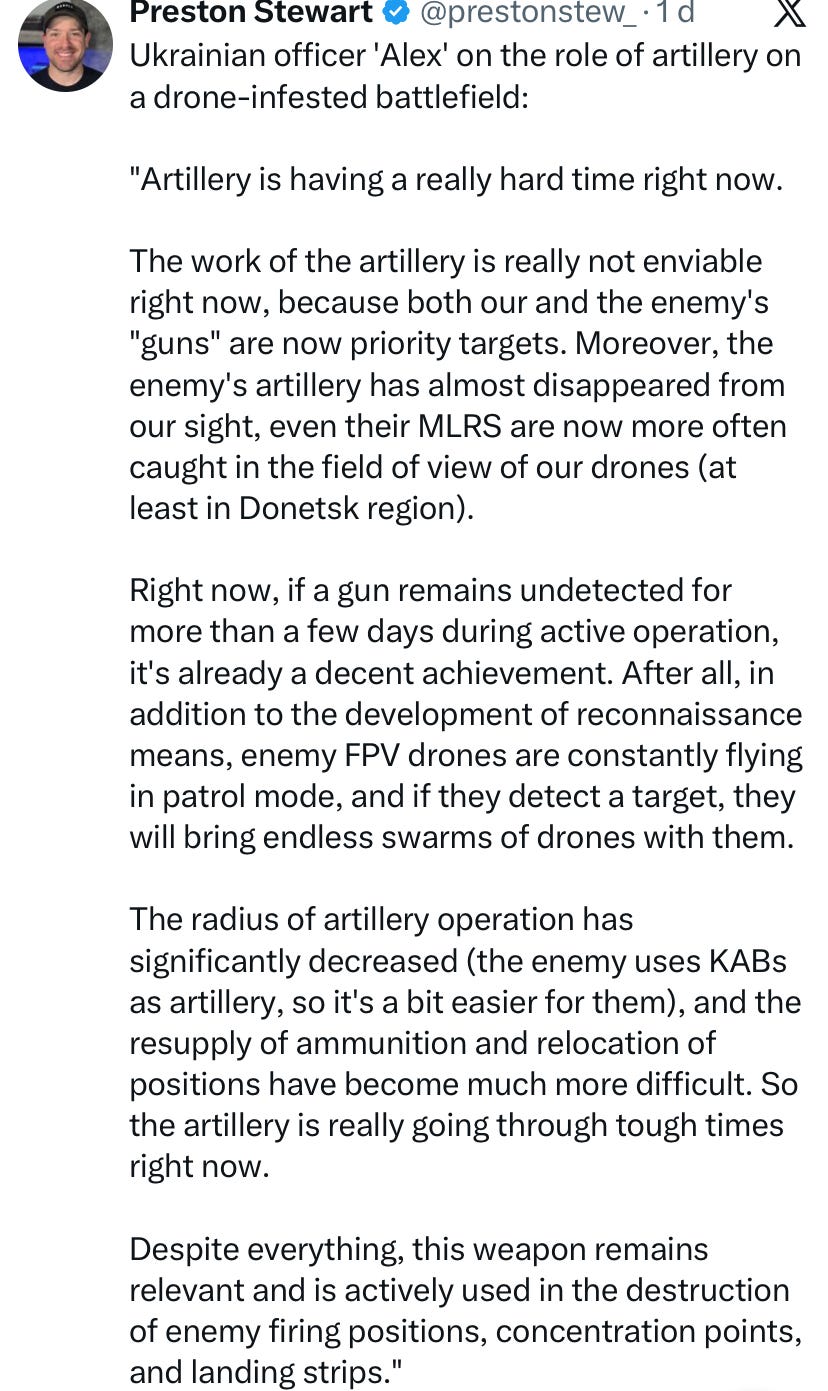
Here is a firsthand source on how much harder it is for artillery to operate on today’s battlefield.
All traditional capabilities are still needed, and if you have drone superiority, you can fight mechanized.
However, our doctrine with constant regrouping is obsolete if it is within 50 km of an active front. In that case, you must either extend the range of the artillery or protect them with an anti-drone weapon 24/7.
Since drones increasingly have IR cameras, camouflage is also not effective, and you have to work with different materials instead; we have Barracuda, for example.
Probably artillery will also change going forward – range and size of platforms.
I have long felt that large expensive platforms with short range (in this context) of which you have few are not preferable. Cheap platforms that deliver accurate effect on the target will surely be one leg, and the other heavier platforms that have the range that you can still regroup in depth according to our doctrine.
Reconnaissance resources and then our equivalent to the Ukrainian Delta are critical in this context, of course. I think we should be able to buy ready-made packages from them that we improve to cut time, but of course, there is a defense industry and its lobbying that wants to sell their own technology.
What probably has not yet hit the planners in the face is the extent of the drone weapon that must be equipped in units, and that all parts depend on each other for the whole.
The new thing in the First World War was the trenches and machine guns; before, you would line up and may the best man win (I am simplifying and trenches existed earlier!).
The counter to the trenches was the tanks, which performed rather poorly, but when they didn’t get stuck or have engine failure, there was no counter weapon.
Then in WW2, the tank was the new black, and anti-tank weapons were a whole range from ground attack aircraft to 20mm rifles up to larger anti-tank guns towed or mounted on vehicles.
At the risk of being wrong, I think Germany was first to widely deploy man-portable anti-tank weapons in the organization with their Panzerfausts; otherwise, there were “bazooka,” PIR, or Panzerschreck together with anti-tank guns as a company or battalion resource quite often.
Partly, the Germans’ larger anti-tank guns were easy targets for ground attack, and then they were overwhelmed by Allied and Soviet armor numbers, so the counter became an anti-tank weapon for every soldier with a pat on the shoulder.
Sweden introduced the anti-tank weapon and GRG at the squad level after WW2, and today they are as natural as the ration tin.
I see the drone weapon somewhat the same way, where you need interceptors at the squad level, otherwise you become as helpless as when Rommel’s tanks come rushing and the company sent the anti-tank gun to the wrong map coordinate.
We don’t have that today, and the likelihood that we get properly slapped is high, especially since the drone weapon accounts for 90% of the losses in the Ukraine war. We solved the task during Aurora 26 by removing the drone weapon, but I am quite sure that historically, wars have rarely been won that way; I believe I have some support in the literature for that bold claim.
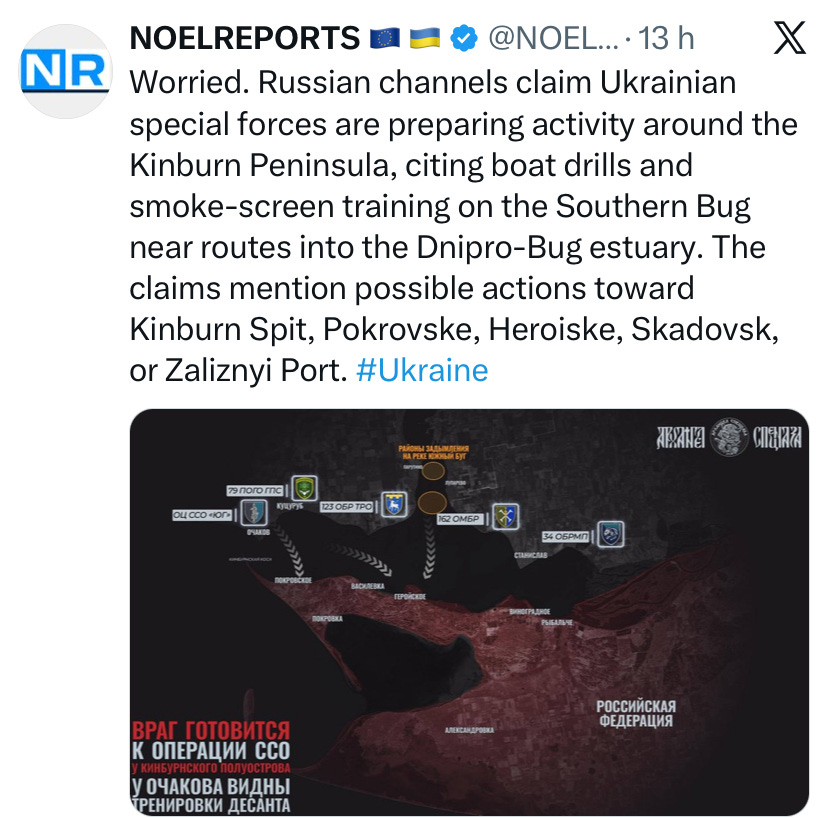
The Ukraine war, Russia is worried about all the exercises with vessels over by the Dnieper.
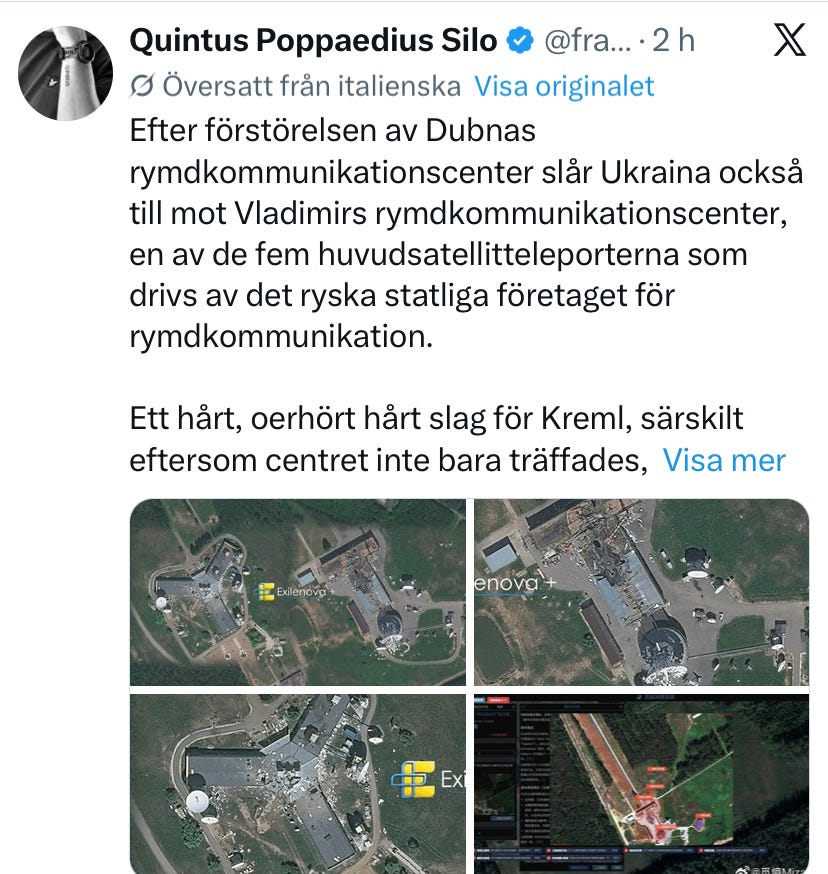
Ukraine has knocked out Russian “space communication centers” for a while now – previously it was totally forbidden because Putin would cover us with nuclear weapons. Another red line he can only cry over now that it has been crossed.
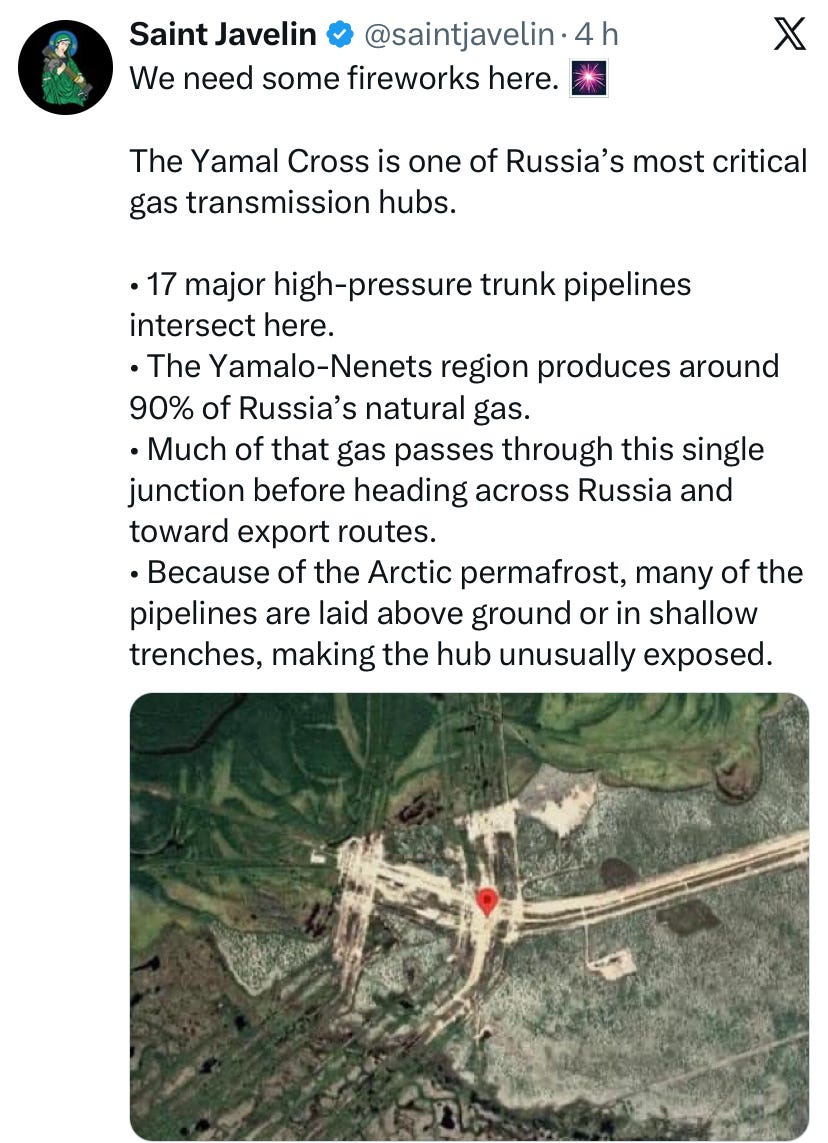
I keep nagging about the Yamal cross until I turn blue, but if they cut it off, 60% of Russia’s heat supply this winter will be gone. We know that it is a target already entered in the Excel sheet, but why they keep holding the trigger, we do not know.
Recently, Russia struck a major conference for the Ukrainian arms industry, which probably devastated the participants so much that UA had to fudge the number of dead – RU also has good real-time intelligence gathering.
That is also something Ukraine excels at, and many times an interview has led to a target being engaged within days.
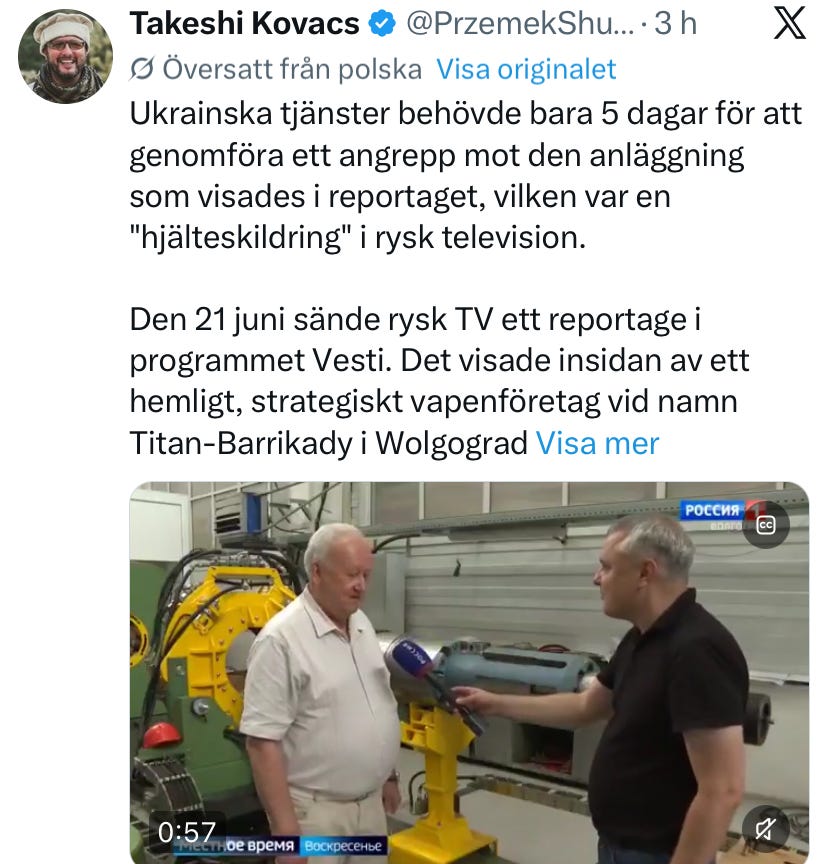
Refusal to attack is present among Red Storm.
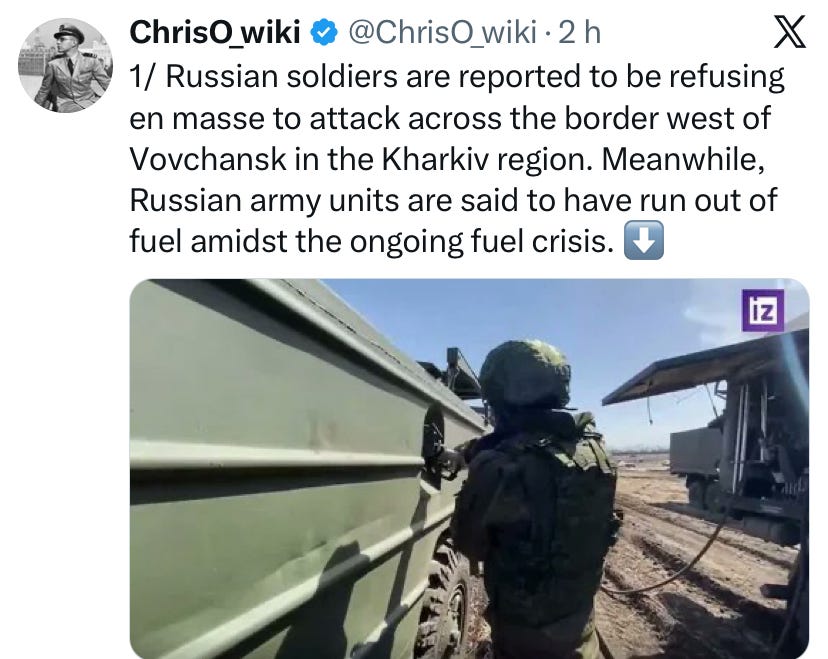
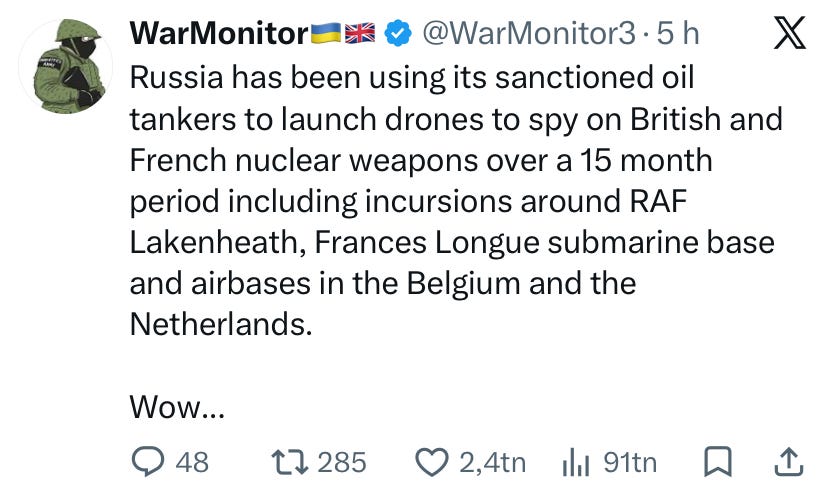
Now it is confirmed at least, even though I can’t be bothered to find the source – something I have discussed for a long time that RU uses the shadow fleet as drone platforms. As long as they are scouting, that’s one thing, but a first strike before we realize it’s war could be unpleasant for us.
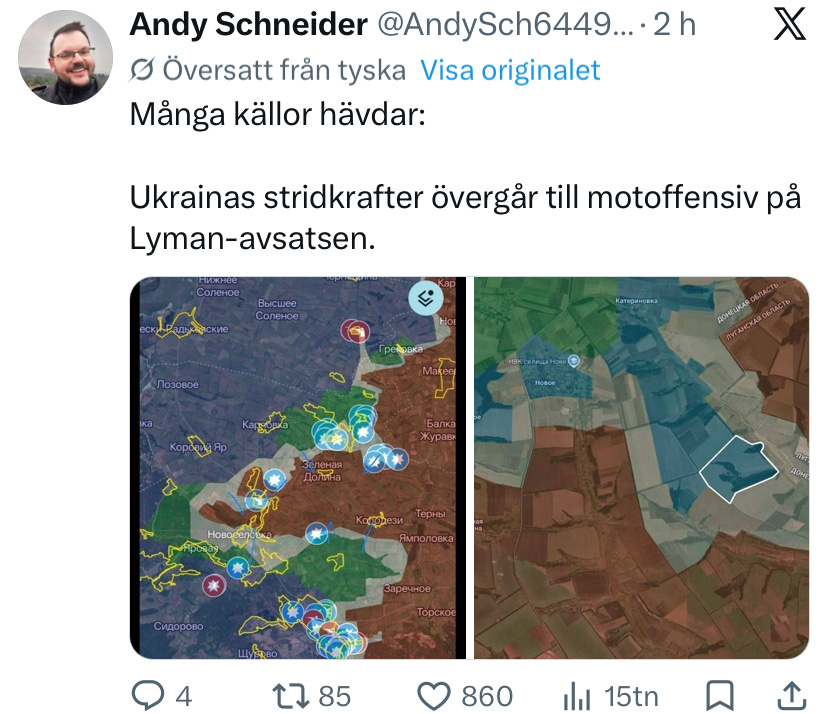
Here you have an unofficial map for Lyman by the way, the source is pretty decent so it’s probably accurate. Haven’t posted these before but it’s Friday and you are drunk, so I’ll probably get away with it.
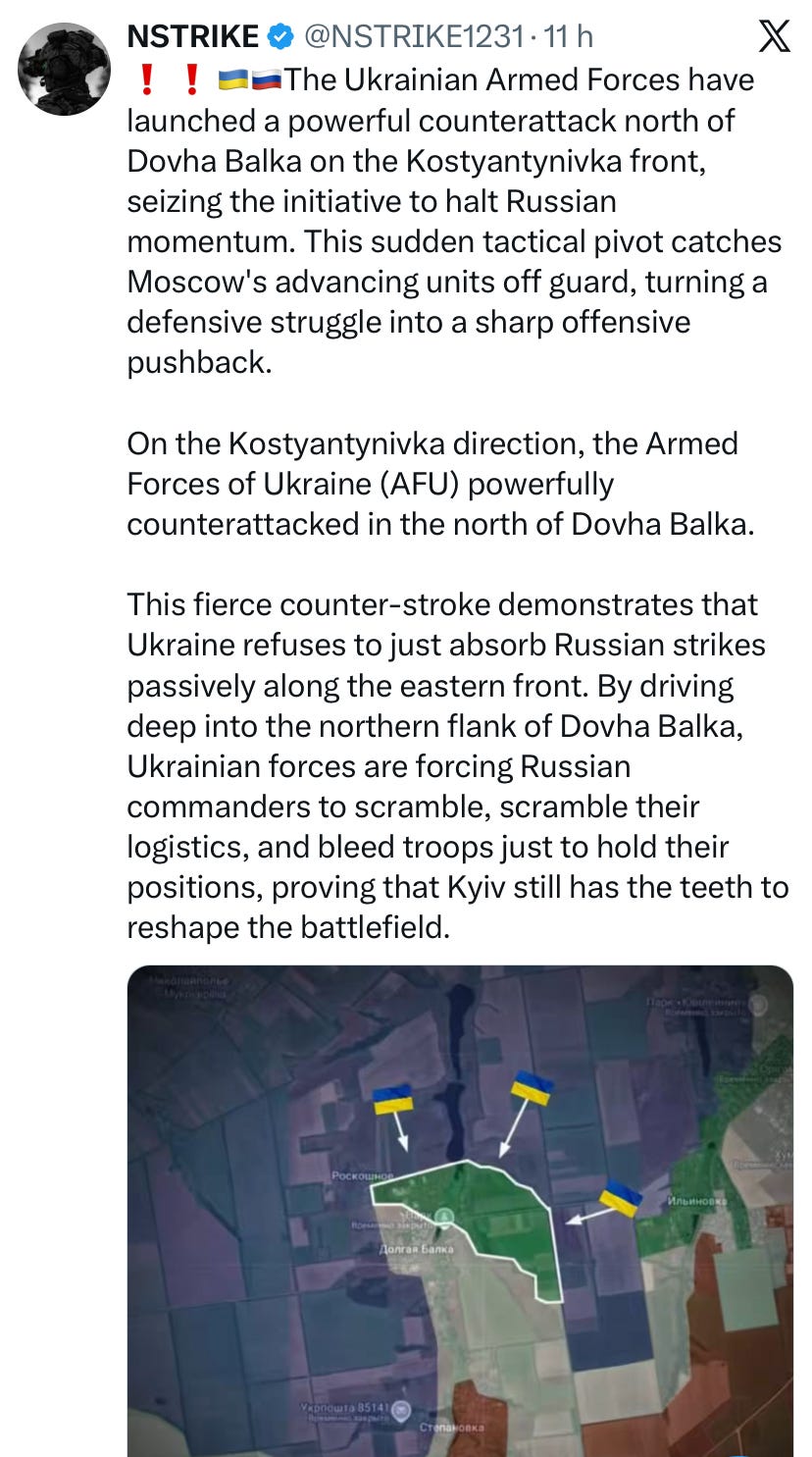
Here you have the counterattack at Kostyantynivka described a bit better, I covered it in a post.
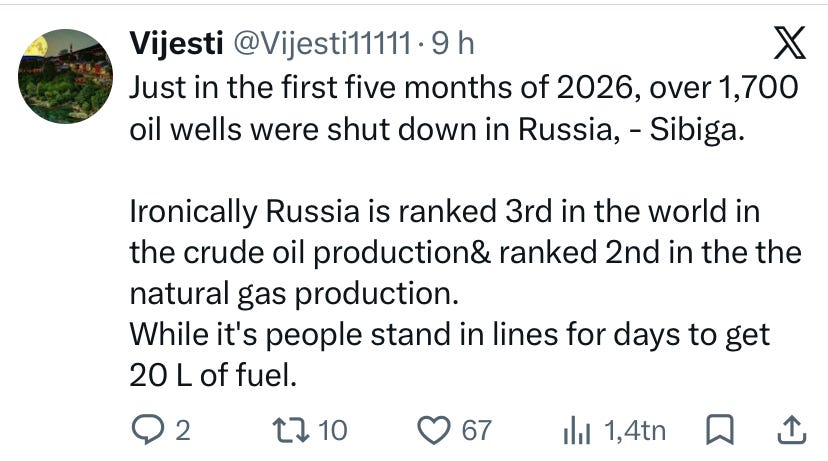
Then I want to highlight the environmentally friendly aspect of Ukraine’s warfare, 1700 Russian oil wells have shut down in the first half of this year.
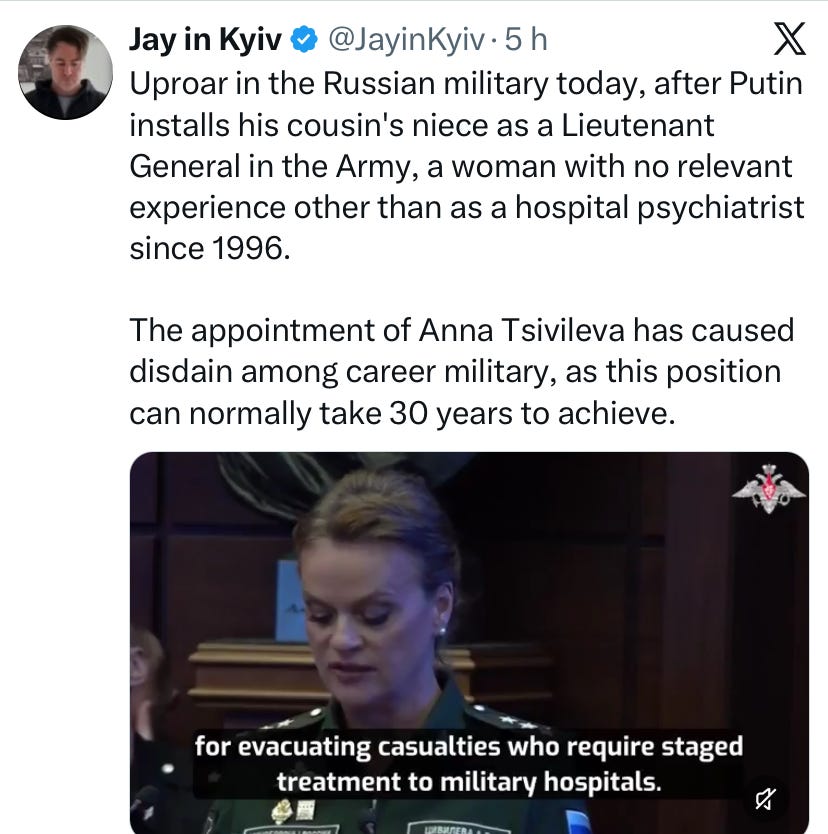
Something funny, Putin has made his cousin’s daughter a general in the army, completely bypassing the career ladder since she was a psychiatrist without military experience. Apparently, the officer corps is less amused, and that’s very good – when nepotism becomes too much even for the world’s leading nepotism country Russia, then it has gone quite far.
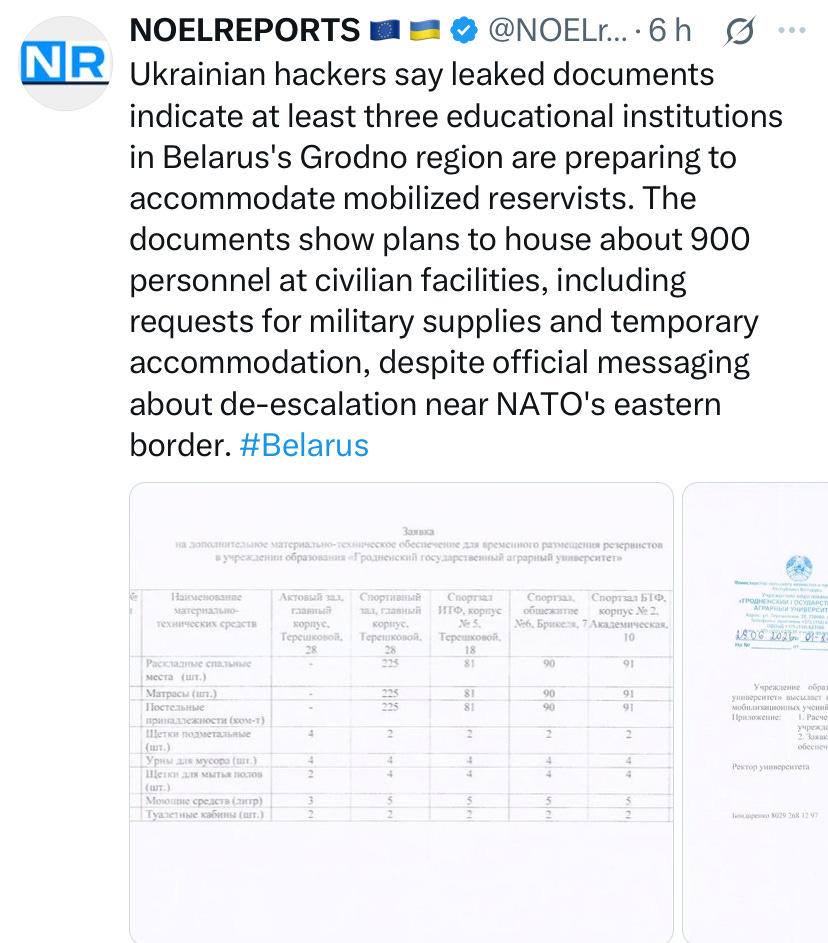
Ending with hackers discovering that Belarus has prepared accommodations in larger buildings for mass mobilization.
Have a nice weekend and Ukraine’s cause is truly ours, especially if we don’t want the war in our own backyard going forward.


Don't forget to donate, Ukraine's cause is ours! Support Ukraine!


Russian losses in Ukraine
SLAVA UKRAINI
Extensive Ukrainian attacks during the night!
Ukraine has attacked several logistics facilities (Wildberries/Ozon). In addition, several oil refineries are also said to have been hit, as well as a port. The areas and regions that have been the focus of the attacks appear to be Volgograd, Tatarstan, Krasnodar, and Dagestan.
Volgograd In Volgograd, one of Wildberries’ distribution centers is said to have been attacked; the logistics hub covers 44,000 square meters.
The Lukoil-Volgogradneftepererabotka refinery was also attacked during the night. The facility is one of Russia’s largest oil refineries and produces gasoline, diesel fuel, aviation fuel, and other petroleum products.
Krasnodar From here, there are reports of a fire at an oil refinery in the city of Tuapse. There is no information about the cause. It could be a smoker and not Ukrainian drones, but it is burning regardless.
Tatarstan In Tatarstan, there are reports of another attack on a Wildberries facility in the city of Zelenodolsk; at the same time, there are videos from there showing that it is the competitor Ozon. It is, of course, not impossible that more than one facility has actually been hit.
In Nizhnekamsk, in Tatarstan, it was also reported that the TAIF-NK oil refinery was attacked.
Dagestan In Kaspiysk, Dagestan, there are reports of explosions at the port.
To summarize, this could therefore involve:
In addition to this, there are also posts about an attack on a train transporting fuel.
We will see during the day what the reports show.
Adding more posts below with links to posts, etc.
** Wildberries facilities, oil refineries reportedly struck in Russia.
Multiple Wildberries facilities and oil refineries were reportedly hit in Russia’s Volgograd, Tatarstan, and Krasnodar regions overnight on July 31. **
https://kyivindependent.com/wildberries-warehouse-oil-refineries-reportedly-attacked-volgograd-krasnodar/
** Ukrainian drones struck targets in Volgograd, Russia. Reportedly the local Wildberries facility has been torched. Also, the local refinery has been attacked. ** Movie:
https://bsky.app/profile/tendar.bsky.social/post/3mrvxmdifrc2t
** Ukraine destroyed a Russian fuel train enroute to try to resupply occupied Crimea. ** Movie:
https://bsky.app/profile/igorsushko.bsky.social/post/3mrvwr2bd2k2e
** The size of the smoke cloud over Volgograd, Russia, is impressive. Could be burning oil, could be burning plastics, could be both. ** Movie:
https://bsky.app/profile/tendar.bsky.social/post/3mrvxw6xdu22t
** 🔥 Stalingrad, Russia **
** 💥 Ukraine is predictably targeting Ozon e-commerce distribution hubs as well now. Zelenodolsk, occupied Tatarstan. ** Movie:
https://bsky.app/profile/igorsushko.bsky.social/post/3mrw55vsbec2o
This is not Wildberries but Ozon, as you can see in the movie.
** Another Wildberries facility is being targeted this morning in Kazan, Russia. While the damage appears minimal by current footage, the image of ordinary Russians having to flee their warehouses continues to spread the reality of the ongoing failures by the RU gov’t in a closed society.** Movie:
https://bsky.app/profile/slavaukraini033.bsky.social/post/3mrw6nvcbvk2f
** Drone attack on Russia: oil refineries and Wildberries warehouses are on fire. In Volgograd, the Lukoil-Volgogradneftepererabotka oil refinery and a Wildberries logistics center are burning.
  In Kaspiysk, Dagestan, residents report drone attacks and explosions in the port area.
  In Kazan and Zelenodolsk, Tatarstan, Wildberries facilities were struck.
  In Nizhnekamsk, Tatarstan, the TAIF-NK oil refinery also reportedly came under attack. **
https://x.com/Gerashchenko_en/status/2083046185883869285
**Updated Wildberries warehouse center bingo card 07/31.**
https://bsky.app/profile/slavaukraini033.bsky.social/post/3mrw7e7h5vc2f
** The burned-out Wildberries logistics hub in Volgograd after the overnight attack. **
https://bsky.app/profile/specialkhersoncat.bsky.social/post/3mrwdcqvllk2a
Summary of the Ukrainian General Staff
Good morning.
The drone weapon is definitely here to stay and the new normal, not to say basic.
Ukraine’s kinetic sanctions continue to deliver results 💪
Good morning! Or maybe good lunch fits better now.
Yes, drones are definitely here to stay (until we come up with something even better)!
Response to foreign researchers who, like Svenska Freds, argued that it would be a mistake for Sweden to leave the Ottawa Treaty.
“Our neighboring countries that have left the Ottawa Convention have made a clear-sighted assessment of the threat landscape. That decision deserves respect, not suspicion,” write debaters in a reply.
Published 2026-07-29 11:00
Updated 2026-07-29 11:46
This is an argumentative text intended to influence. The opinions expressed are those of the author.
REPLY | ANTI-PERSONNEL MINES
Sally Longworth, Henrique Garbino, and Priscyll Anctil Avoine do not want Sweden to leave the Ottawa Convention (SvD Debate 26/7). Their article highlights important humanitarian aspects but also illustrates the conflict of objectives that all security policy ultimately concerns. The crucial question is not whether anti-personnel mines are a good or evil weapon system. War and mines are abhorrent, but for small democratic countries whose freedom is threatened, the evil may be necessary for survival.
The central question is how Sweden and NATO will stop a Russian attack on the Nordic countries and the Baltics. They give no answer to that question. Instead, the debate is reduced to the humanitarian and international law consequences of anti-personnel mines. But the alternative is not between mines or no mines. It is between being able to stop a Russian invasion before it reaches our communities or failing and thereby giving Russia the opportunity to gain ground, commit war crimes against the civilian population, and lay far larger quantities of uncontrolled mines than any democratic country would do. That conflict of objectives must be taken seriously.
Russia has long seen itself in conflict with the West, the country has shifted to a war economy, and a new large mobilization may be imminent. According to Ukrainian reports, about 35,000 North Korean soldiers are now expected to join the Russian forces. It is against this reality that our defense decisions must be judged, not against an idealized image of how the world should work and decisions made at a time when the illusion that a great war was obsolete still prevailed.
When the Ottawa Convention was discussed in Finland, several military experts warned that the agreement risked becoming more symbolic politics than security policy. A central conclusion, formulated in the 1990s by then research director at FOI, Bengt Andersson, was that anti-personnel mines primarily serve to complicate the clearing of anti-tank mines and to limit the attacker’s operational freedom of action. They force the enemy to choose advance routes that allow the defender to shape the battlefield for more effective combat. Delay fighting remains today a fundamental part of credible territorial defense and buys time until NATO allies can mobilize and provide relief.
The authors argue that technological development has made anti-personnel mines less relevant. Experiences from Ukraine point in the opposite direction – mines force the attacker to concentrate in areas where drone countermeasures become easier to carry out. Moreover, the need for own soldiers on the most dangerous front sections is reduced, which means fewer own losses. However, the authors choose to omit the technical development of anti-personnel mines, which means programming so that they have a limited active time, making our mines thus not pose the same danger for our civilian population for a long time after a conflict.
Sweden no longer has responsibility only for its own territory. As a member of NATO, Sweden constitutes a central part of the defense of the Baltics and northern Finland. That Sweden cannot use the same weapon systems as the countries where Swedish ground forces are to operate complicates operational cooperation with our allies, whose civilian populations bear the consequences.
Security policy is about choosing between imperfect alternatives. Those who want to forgo the cost-effective mines, safely stored in peacetime, must also show how the same military effect is to be achieved otherwise. It is not enough to state that the weapon has humanitarian consequences; even not using the weapon must be weighed in the humanitarian balance.
It is no coincidence that Finland, Estonia, Latvia, Lithuania, and Poland have all drawn the same conclusion and, within the framework of international law, left the Ottawa Convention. It is not that the decision-makers of these democracies value humanitarian principles less, but that they have made a clear-sighted assessment of the threat landscape. That decision deserves respect, not suspicion.
Sweden should draw the same conclusion – preferably it should already have been done, as it takes time to leave the treaty.
Stefan Forss
Associate Professor at the Finnish National Defence University
Karlis Neretnieks
Major General (Ret.), former rector of the Swedish Defence University
Patrik Oksanen
Strategic Advisor at the Centre for Total Defence and Society’s Security at the Defence University
All three authors are members of the Royal Swedish Academy of War Sciences
https://www.svd.se/a/xr97bj/ottawakonventionen-aven-sverige-bor-tillata-truppminor-skriver-forsvarsdebattorer
Today, however, they came with a final reply that at least does not convince me.
“Minefields can delay an advance, but rarely stop a qualified opponent or decide a war. A credible defense does not require access to all kinds of weapons,” write debaters in a final reply.
Published 05:45
This is an argumentative text aimed at influencing. The opinions expressed are those of the author.
FINAL REPLY | ANTI-PERSONNEL MINES
Stefan Forss, Karlis Neretnieks, and Patrik Oksanen claim in a reply to us that Sweden’s security requires withdrawal from the Ottawa Convention. Thus, they reduce a complex strategic choice to a false ultimatum: leave the convention or stand defenseless. However, research and military assessments provide no clear support for Sweden facing such a choice. The military value of anti-personnel mines is disputed, while their devastating humanitarian consequences are well documented. Wars have always been fought under limitations, and a credible defense does not require access to all kinds of weapons.
The authors remind us that Finnish critics once dismissed joining the Ottawa Convention as “symbolic politics.” Yet that label fits better today’s rush to leave. The defense ministers of Estonia, Latvia, Lithuania, and Poland called the withdrawal a “clear message”: a political signal, not proof of indispensable military capability. Meanwhile, the convention continues to save lives through its ban as well as requirements for mine clearance and victim assistance.
There is no military consensus. After Russia’s full-scale invasion, Finland’s military leadership assessed that alternative capabilities had replaced anti-personnel mines. In December 2024, the Estonian Defense Forces saw no need to leave the convention, while the Latvian Defense Forces had formally advised against it. These shifting positions show that withdrawal is not militarily obvious.
The authors claim that anti-personnel mines have “proven their value” in Ukraine. Military history tells a different story. Even extensive minefields have been broken through or bypassed by coordinated attacks with multiple weapon types, for example during Operation Desert Storm. Minefields can delay an advance, but rarely stop a qualified opponent or decide a war.
In conventional wars, anti-vehicle mines, which can disable armored vehicles, have had greater significance on the battlefield. As Forss and others point out, anti-personnel mines are used to complicate clearance of anti-vehicle mines. However, the Ottawa Convention does not prohibit anti-vehicle mines with clearance protection that triggers the mine if a clearance device tries to lift or manipulate it.
Anti-personnel mines have had limited and situational tactical value in Ukraine’s war of attrition. But it is not the anti-personnel mines that have defined the conflict. Military analyses primarily highlight the interplay between drones, artillery, and long-range strikes.
The authors claim that we ignore “smart” or non-persistent anti-personnel mines. We do not. Self-destructing and self-deactivating mines existed already when the Ottawa Convention was negotiated, but states still chose a total ban. Such mechanisms can reduce harm, but not eliminate it. Some mines do not function as intended and remain deadly. Even deactivated mines contain explosives and must therefore be located and cleared.
Neither do “smarter” ways of using anti-personnel mines solve the problem. Drones can enable more selective placement near the enemy, but also spread mines quickly and remotely over large areas – thereby increasing rather than limiting contamination. That does not tip the humanitarian scale in favor of anti-personnel mines.
The debate has shifted from interoperability to Sweden’s own use of anti-personnel mines – two issues with different consequences. Advocates must clarify what they mean and show the military gain.
The authors are right: Sweden no longer determines security policy alone. But the five allies that have left the convention do not decide the issue for all of NATO either. Sweden and 25 other NATO countries are still parties. Their withdrawal complicates cooperation, but alliances exist to manage disagreements. Members already have different international legal obligations and national restrictions. A Swedish withdrawal would not remove friction, only shift it to cooperation with other allies – while civilians bear the cost. That is not collective security, but a failure to protect those NATO exists to defend.
Photo: Henrik Ekman, Anders G Warne, Guillaume Lamy
Sally Longworth
Doctor of International Law, Stockholm University
Henrique Garbino
PhD candidate in War Studies, Swedish Defence University
Priscyll Anctil Avoine
Lecturer in War Studies, Swedish Defence University
https://www.svd.se/a/gkJK3A/truppminorna-skapar-falskt-lofte-skriver-debattorer
Tips to Swedish Peace:
Wouldn’t it be time for Sweden to unilaterally impose a ban on drones? They are demonstrably used by Russia against the civilian population.
Just think how many civilian lives we could save if only the attacker had these dreadful weapons.*
*the segment may contain traces of irony
🎯
Maybe a bit strange, but if a madman suddenly jumps on me and my family, I don’t want to have one arm tied behind my back..
One could argue that ordinary firearms also cannot stop an enemy and that we should therefore rather use the more environmentally friendly alternative of the bow, so we avoid polluted nature as well.
I am fully in favor of the world agreeing to limit mines, cluster munitions, incendiary bombs, flamethrowers, chemical weapons, etc., but that only works when everyone follows the rules.
Russia completely ignores this (the USA is probably not participating in many of the restrictions either).
If I get into a fistfight and the opponent pulls a knife, I would also do the same since it means I then have a chance to get away alive.
The same goes for mines. Ukraine would rather take the risk with the mines, even though it will cause the population a lot of suffering afterward, than let Russia defeat them.
I suggest conducting extensive surveys on matters like this. What does the Swedish population really say? But then the surveys must be fair as well, where they not only explain the consequences of the mines but also the consequences that may arise from not using them.
The thing is that both mines and cluster bombs can be self-destructing, meaning no danger to the civilian population except for a limited time.
Krasnov is unsure whether he should grant Ukraine the right to license-produce Patriot missiles.
**Latest news on the war between Ukraine and Russia: Trump says he is “unsure” about letting Kiev build Patriot missiles
Trump’s comments come as Kiev attacks two more Wildberries warehouses and oil facilities in Russia
Arpan Rai & Alex Croft
Friday 31 July 2026 08:10 BST
16
Comments
Bookmark window
Removed from bookmarks
Close window
Six family members killed after Putin fired “North Korean ballistic missile” at Ukrainian village, says Zelenskyy
Get an international news bulletin every week
Email*
SIGN UP
I want to receive emails about offers, events, and updates from The Independent. Read our privacy policy
US President Donald Trump said he was “not sure” if he would allow Ukraine to build Patriot air defense missiles.
“It is a very extraordinary weapon, and we have to be a little careful about who we license to,” the president said in his comments to the FT yesterday. This comes weeks after offering to share the license for the coveted air defense systems with the war-torn nation.
On 10 July, at the NATO summit in Ankara, Turkey, Trump said: “We will give them the right to manufacture Patriots. We will show them how to do it,” Trump said. “I think they can produce them quite quickly.”
Ukraine has requested that the US provide Patriot missiles to shoot down incoming Russian missiles, drones, and bombs.
His comments come just hours after Russia fired a North Korean ballistic missile at a Ukrainian village, killing six members of a single family, said President Volodymyr Zelenskyy.
Ukrainian drones attacked two more warehouse locations belonging to the Russian online retailer Wildberries, triggering fires at both sites, the company and a regional official said on Thursday.
RECOMMENDED
North Korean missile likely used in Russian attack that killed five family members
Ukraine says it hit a large Russian oil refinery hours after Zelenskyy’s meeting with Trump
How the wars in Iran and Ukraine collide in the world’s largest lake
Wildberries: Why Ukraine is blowing up Russia’s “Amazon” with massive attacks
KEY POINTS
Trump says he is “unsure” if Ukraine will build Patriot missiles – report
Ukraine attacks two more warehouses belonging to Russian online retailer Wildberries
Ukraine’s envoy tells Washington “we need the missiles”
Romania pursues jets as air targets detected near Ukraine’s border
13 minutes ago
Ukraine’s envoy tells Washington “we need the missiles”
Ukraine hopes that a new push for ceasefire talks with Russia can stop the war before a potentially brutal winter, but needs new anti-ballistic missiles now to defend itself against attacks from Moscow, the country’s envoy to Washington said.
Olha Stefanishyna told reporters that Ukraine was in discussions with the Pentagon about a license to produce Patriot PAC-3 missiles themselves, but that the process could take 12 months to five years.
“The devastating effect of every nightly attack right now is incredible,” Stefanishyna said.
“Last night and the night before, there were 30 to 40 ballistic missiles.”
While Ukraine could defend itself against Iranian- and Russian-built drones, it had not yet developed an effective way to defend against ballistic missiles, whose production is rapidly increasing under Russia’s President Vladimir Putin.
“He intends to destroy Ukraine, and that is why we are looking for other capabilities. We have been successful in everything, but so far, for this winter, we need the missiles.”
Discussions were also ongoing about Ukraine agreeing to a long-term purchase of PAC-3 missiles and then swapping positions in the production line with another buyer.
https://www.independent.co.uk/news/world/europe/ukraine-russia-war-live-putin-trump-zelensky-wildberries-missiles-b3025070.html
Even other news media are picking up the news.
https://www.theguardian.com/world/2026/jul/31/ukraine-war-briefing-trump-says-he-is-not-sure-about-letting-ukraine-build-patriot-missiles
Off topic that has nothing to do with the war in Ukraine but has dampened the holiday spirit here on the west coast despite brilliant midsummer weather.
“During the police investigation following the serious ship accident on July 28, suspicions of crimes have emerged against the captain of the Norwegian merchant vessel. The suspicions concern negligence in maritime traffic and causing another person’s death in Hakefjorden in Kungälv municipality.”
https://www.aklagare.se/for-media/pressmeddelanden/2026/juli/en-person-anhallen-efter-fartygsolyckan-vid-tjorn/
Wasn’t it a Russian crew? I guess a bit prejudiced that they were completely drunk.
Saw that they secured the black box, it will be interesting to see what it might reveal (if we ever find out).
The shipping company has confirmed that the entire crew, including the captain, were Russians.
(Regardless of everything else, they should not have been allowed to enter a Swedish port).
I have exactly the same prejudices regarding drunkenness at sea.
The ship had a Swedish pilot and no one in the crew has tested positive for alcohol, claims the shipping company.
A tragic accident where the police and prosecutor have obviously concluded that the captain failed in his responsibility.
** 🔥 Smoke from burning Taman oil has reached the shores of Turkey, – Crimean Wind The smoke plume’s length exceeded 380 kilometers. This may be a new record. **
https://bsky.app/profile/beefeaterfella.bsky.social/post/3mrwmynifjk2z
** More from Volgograd now 🤩 **
https://bsky.app/profile/beefeaterfella.bsky.social/post/3mrwmw7wza22z
** 🔥 Volgograd, Lukoil refinery is smoking after the night attacks. ** Movie:
https://bsky.app/profile/maks23.bsky.social/post/3mrwmw4qgys2k
KAB?
** A powerful explosion was reported in Khmelnytskyi [Ukraine] despite no air raid alert being active, according to local media. Repeated detonations are reportedly occurring. Authorities have not yet released official information. **
https://bsky.app/profile/noelreports.com/post/3mrwmrftqh22b
** Ukraine’s Security Service, together with Ukraine’s Defense Forces, successfully struck Russian military, logistics, and oil refining infrastructure:
▪️ A production facility at an aircraft plant and two hangars used to store aircraft in Yevpatoria, Russian-occupied Crimea
▪️ The infrastructure of the Port of Taman in Russia’s Krasnodar region
▪️ The Lukoil-Volgogradneftepererabotka oil refinery, one of Russia’s largest oil refineries, with a processing capacity of about 15 million tons of crude oil per year.
Ukrainian Warriors also struck a Pole-21 electronic warfare complex near Holubivka in Luhansk region,an ammunition depot near Naumivka in occupied Crimea,& a command post near Bakhmut in Donetsk region. Glory! ** Movie:
https://bsky.app/profile/antongerashchenko.bsky.social/post/3mrwmnrfk622a
** Ukraine has asked President Trump to persuade Elon Musk to allow Starlink to guide Ukrainian drone strikes inside Russia. President Zelensky reportedly argued the move would help target Russian missile launchers as Kyiv faces dwindling supplies of Patriot interceptors. **
https://www.kyivpost.com/post/81447
Up to the test for Elmo.
Do the right thing!
If so, it is probably done quietly. He has probably been very clear that Starlink should not be used for military purposes.
Starlink is already being used by Ukrainian forces on a broad front in the defense.
** 🇺🇦 Operators of group “F” 1 of detachment 144 of the Special Operations Forces center infiltrated the settlement for further execution of the task. It was possible to establish control over a certain sector of the settlement, capture an enemy serviceman and conduct a cleanup of the territory. ** Movie:
https://bsky.app/profile/maks23.bsky.social/post/3mrwlx6i3ns2z
Good wall today too Johan! 👍👍👍
👍😄
** ❗️After a nighttime attack, the Wildberries warehouse in Volgograd almost completely burned down. **
https://bsky.app/profile/militarynewsua.bsky.social/post/3mrwsd5ct5l2f
Many thanks to the six of you who, despite summer and vacations, have donated now in July! ⭐👍
Shame on me 😳
Now it became a little contribution just in the nick of time.
Thanks for that! 👍
Note! Donations are completely voluntary, not meant to pressure anyone!
Got it. But I like the page and appreciate the work you put into it. 👍
Do not control the ads at all, but I think it’s because the site doesn’t have content that can be matched with very serious advertising and therefore all sorts of junk appear.
I often get crappy ads about sleep apnea and other suspicious ads that claim to cure this and that. 😄
If you get tired, visit some bigger site that runs ads and you’ll see theirs for a while.
I’m thinking about putting together some pages with content just to attract better advertisers and maybe get paid properly as well, because right now it barely covers a couple of Obolons a month.
Just fake?
Criticism of Russia among Swedish parties in the EU Parliament
The graphic shows the extent to which members from the Swedish parties in the EU Parliament have voted for a more critical stance towards Russia since 2019.
Sweden Democrats
93.7%
Christian Democrats
93.1%
Moderates
92.5%
Liberals
83.2%
Centre Party
82.6%
Green Party
81.3%
Social Democrats
75.5%
Left Party
54.7%
Graphic: Europaportalen Source: Votewatch Created with Datawrapper
Good with this statistics.
It also shows that the parties, not least SD, have taken previous criticism to heart and changed their voting pattern compared to the previous term.
https://frivarld.se/sakerhetsradet/sds-rysslandsroster-sticker-ut-i-europaparlamentet/
If that’s true, it’s quite surprising, isn’t it? Yes, except maybe that V is doing the worst, of course.
Do you have a link?
No, just what is at the very bottom
Ceuta is interesting.
We wrote earlier that Spain was the last opening for hybrid warfare migration since all other countries around the Mediterranean have closed their borders.
Population of 90,000 and 50,000 have gotten in. Apparently quite a lot of concern there that they will be overwhelmed now.
I connect a lot to the fact that Canada and Spain have the most troops in the Baltics 😄
In this particular case, I don’t really know if the Russian bastards were involved.
Spain has apparently signed some sort of cooperation agreement with Algeria, which has infuriated the Moroccan regime.
It’s not the first time this has been used as leverage against Spain, by the way.
Also doubtful that Russia is involved, but one can never be sure. They may have done what they could to convince them that this is a smart move.
Otherwise, there is speculation that Morocco intends to claim the islands.
“That tens of thousands of people crossed the border into the Spanish enclave of Ceuta in one day is no coincidence. This is what unanimous analysts in Swedish and international media write. ”This would have been impossible without the passivity of the Moroccan authorities,” writes Miguel González in El País. Several analysts write that Morocco has eased its border surveillance in recent days and did not react when thousands began to cross. They believe this is a direct response to Spain’s Prime Minister Pedro Sánchez visiting Morocco’s arch-enemy Algeria on July 20 and promising to conclude a high-level agreement later this fall. Analyst Taleb Alisalem tells TeleMadrid that waves of Moroccans to Spanish Ceuta and Melilla always come when Morocco wants to put pressure on Spain or the EU. According to him, the country is on its way to claiming the two Spanish exclaves.– This is not a conspiracy theory, but concrete statements from Morocco’s Prime Minister, he says. The situation creates enormous problems for Sánchez, both domestically and internationally. This is what Mats Larsson writes in his analysis in Expressen.” Spain will hold elections no later than next summer and Sánchez is already pressured by a number of corruption scandals.” And Donald Trump, he writes, who has been upset by Sánchez’s criticism of the war in Iran and who himself is closing the US borders, ”is unlikely to remain silent about what is happening in Ceuta.” “
https://omni.se/a/16r01l
Others say that it is Israel and the USA as revenge for the Iran war 😄
Question to you doubters – do you think Morocco dares to do this alone against the EU?
Or do you think they have support from someone?
By the way, RU has significantly strengthened its African corps in the past six months.
—
but one thing we agree on, right, this is an organized action?
Of course it is organized in some way. 50,000 people are not going to cross the border on the same day. It was also obviously clear from the videos that the Moroccan border guards were letting people through.
Well, it must be organized, getting 50,000 young men to carry out an operation like that probably requires coordination. Now many have probably gone back, it was mostly just a fun thing for them.
Trump has been upset with Spain, and he is now trying to score points from it ahead of the midterm elections. That of course does not mean that he is behind it, but he is naturally trying to take advantage of it.
Not only young men, sixteen-year-old girls with mascara running after the swim make me guess at something that has spread via social media.
Mats Skogkär picks up on what Johan has written here about hybrid warfare and the arson.
“The smoke from forest fires lies thick over parts of Europe. The fires are in most cases caused by humans – intentionally or unintentionally. That some of these have been set by foreign powers as part of hybrid warfare should not be ruled out.
It is burning in Europe this summer as well. Large forest fires are raging in France and Spain. There are also fires elsewhere: in Greece, in Italy. Over 250,000 hectares are believed to have fallen victim to the flames across Europe so far. Hundreds of thousands of people have been evacuated. Firefighters have lost their lives during the extinguishing efforts.
High temperatures combined with extreme drought create perfect conditions for the fires. A warmer and drier climate with longer summers extends the fire season. The depopulation of rural areas plays an important role. What used to be fields and pastures and functioned as natural firebreaks have become overgrown and grown back. There is no longer anything to stop or delay the flames where the fire spreads.
The economic losses will be significant. The costs for the forest fire in Västmanland in 2014 alone amounted to about one billion kronor. There, only 13,800 hectares of forest burned, a fraction of the area scorched by fire in Europe this summer.
So far, Sweden has been spared. But the conditions for a major fire exist here as well. On Thursday, there was a high or very high fire risk in Götaland, large parts of Svealand, and southeastern Norrland. According to SMHI, the risk is locally extremely high. Eleven counties are experiencing water shortages.
In France, over 160 people have been taken in for questioning, suspected of having deliberately or unintentionally caused fires. According to the French Prime Minister Sébastien Lecornu, nine out of ten forest fires are caused by humans. Mostly by carelessness and thoughtlessness. In some cases, intentionally. A volunteer firefighter has admitted to setting a fire in the Fontainebleau forest outside Paris.
Johan Sjöström, forest fire researcher at the research institute RISE, tells SVT that 10 to 20 percent of fires in Europe are deliberately set. Sjöström notes that it is not climate change itself that causes the fires, but it changes the conditions, increases the explosiveness of the fires, and makes them harder to stop.
Read also: Skogkär: A hybrid war that is becoming increasingly tangible
There is a perspective on these fires that has not yet been spoken about openly, but which it is time to highlight: arson forest fires as part of hostile foreign powers’ hybrid warfare.
It would be extremely surprising if, for example, the Kremlin is not already playing with the idea, if not also with fire.
Perhaps such plans have already been put into action. That Russia in recent years has engaged in extensive hybrid warfare in Europe is well known. However, there does not seem to be any evidence that forest fires have been part of this warfare.
Hybrid warfare is a state of conflict between war and peace. Common weapons are sabotage, influence operations, and cyberattacks. It is hard to imagine a cheaper and more effective weapon in hybrid warfare than forest fires. Setting a fire can be done in a flash. The risk of detection is likely minimal in most cases. All that is needed is a matchstick – which burns up and leaves no distinguishable traces behind. A matchstick and the flammable material that nature offers in abundance during a dry, hot summer like this. The effects in terms of evacuations, economic damage, and strain on the political system can easily become large, if not enormous. Not least in a Europe where many states have weak and for many reasons unpopular governments and where polarization in the population is strong, politically as well as religiously and culturally.
Since most forest fires are caused by human factors or lightning strikes, it is difficult to prove that a particular fire was set by a foreign security service. Difficult to prove and for the same reasons easy for the guilty party to deny.
It is also likely not difficult to find people willing to do the bidding of foreign powers. A hybrid warfare state does not need to use its own agents, although both Russia and other hostile powers surely already have such in place in Sweden as well as in the rest of the EU. It is always possible to find people who, out of political conviction or purely economic reasons, are ready to take on such a mission. If nothing else, criminal groups can be used.
Sweden and the EU need to raise preparedness and strengthen protection against forest fires. For several reasons, some quite obvious. The hybrid war threat is one such obvious reason. Because if this weapon has not already been deployed, it probably will not be long before it actually is.
Read also: Skogkär: Iran – rogue state without restraints
Mats Skogkär
Educated at the Journalism School in Gothenburg. Reporter at TT News Agency for 15 years. Editorial writer at Sydsvenskan for 15 years.
mats@bulletin.nu”
https://bulletin.nu/skogkar-dodligt-vapen
He is in here reading that bastard 😳
I promise it’s not me moonlighting as a forest-loving writer at Bulletin and stealing your ideas!
Then it was written a bit more calmly even though you have the same basic idea.
It’s not certain that it’s Russia… yet.
I also think it would be much worse than it actually has been if they started firing, but as I said, maybe that will come.
Thank you for the support 👍
Would be surprised if it doesn’t come.
Always exciting entertainment with odd ads on this page (please don’t remove them. They are actually quite entertaining if you have the right attitude 😉 ).
Today I have been flooded with Titan cutting boards. It was already revealed over two years ago that it was a huge scam from China with a questionable alloy that also made the knives dull.
😂
Do not control the ads at all, but I think it is because the site does not have content that can be matched with very serious advertising and therefore all kinds of junk appear.
I often get crappy ads about sleep apnea and other suspicious ads that claim to cure this and that. 😄
If you get tired, surf over to a bigger site that runs ads and you will see theirs for a while.
I’m thinking about putting together some pages with content just to attract better advertisers and maybe get decent pay as well because right now it barely covers a couple of Obolons per month.
Now I also saw cutting board ads, right after an ad about nail fungus. 😂
I only get Russian dating sites 🧐
It must be because when you conduct your analyses, you are forced to wade through obscure Russian sites to gather current information, and then Russia tries to reach you through some kind of honey trap, hoping that you will fall in love and move to Russia so they can then send you to the Gulag and silence you?
You should simply feel honored that they are making such a hard effort!
That was kindly written.
The old joke was meant as, gets most medicine for back, hair loss, and Ozempic 😀
I thought I would save you a little nicely.
Well, the old favorite never gets old 😀
The best ones fell into that trap years ago
It still happens sometimes. “But why do you show porn ads on your website???”
Hysterically funny every time.
There are now up to 60,000 who have made it into Ceuta.
There is probably reason to start thinking in terms of defense, actually.
Melilla is also under pressure as far as I can see?
The residents have probably started organized resistance now to stop the looting. It could end in a real disaster.
Some migrants don’t seem to understand what they are doing, many young people. Do they think they can invade a country in such numbers and then be received in a reasonable way with food and shelter?
Many have apparently turned back home when they realized it wasn’t so fun anymore.
Wonder if anyone is monitoring social media in Morocco, I almost get the feeling that it must have spread that way. Like some kind of huge flash mob.
Wonder if Morocco is behind this and assumes that there will be violence so that they can then do a Russia and invade with the excuse: “We just want to protect our population who are being killed by Spain!”
There will probably be a government crisis in Spain
Besides this, Spain’s amnesty has probably reached 3 million or thereabouts?
There will probably be border control against them soon.
Well, that is probably what some are already starting to babble about to grab political points ahead of the election.
Sanchez is already under pressure.
France currently has border controls against Spain.
The EU has only issued harsh words.
Meloni freaks out!
https://omni.se/italien-vill-stanga-ute-spanien-fran-schengen/a/V6dXG3
I myself increasingly believe in an unplanned action where most will soon have gone home again since it seems to be mostly young people.
Moreover, the risk is very small that they can get further into the rest of Europe if they do not intend to swim very far again.
The risk as I see it is that it will spiral out of control locally with fights and injuries.
Perhaps it is better to wait and see what happens rather than start getting worked up and make it sound like an invasion of refugees where apparently everyone naturally comes here to Sweden…
We’ll just have to wait and see 😀
Yes, exactly!
The word refugee is now used in the debate in Swedish media about Ceuta.
Has that definition shifted?
I find it very difficult to see that those who have entered Ceuta are refugees in the sense the word is defined?
An attempt to enter Europe for a better life is absolutely that, but then one should presumably go through the route of a visa or work?
If one does not qualify, one has their own country to live in?
Now Spain has granted a general amnesty which is something else, but in this particular incident the term refugee is used in a way that is probably outside the definition?
Or am I wrong?
According to some, everyone is a refugee. It is a concept that has been diluted like many others since 2015.
One is a refugee according to the UN Refugee Convention if one is outside their home country and has a well-founded fear of persecution based on one of the following five grounds:
Race
Nationality
Religious or political opinion
Gender, sexual orientation, or membership in a particular social group
War apparently does not count, which seems strange, but apparently it does not apply according to the convention. However, someone fleeing war can obtain refugee status depending on the daily form of the migration agency…..
That’s difficult.
Would a large group of drunk Swedes landing in Åland be able to claim refugee status and then take the boat home five hours later? 😂
I don’t understand why Spain is so exposed?
The only thing I can think of is the Baltics and that they are anti-Israel.
We in Europe are doing absolutely nothing at least.
Especially since Spain has not been one of the biggest contributors to Ukraine…
Sounds more and more like a government-driven flashmob where the participants realized that it might not have been such a good idea.
“Over 48,000 of the Moroccans who entered the Spanish exclave Ceuta in the past 24 hours have returned. This is reported by the Spanish Interior Ministry according to AFP. At least 57 people have died, according to Spanish authorities. At 2 p.m., Spanish authorities stated that 25,000 have returned voluntarily. At the same time, the authorities increased their estimate of the number who crossed the border from 49,000 to 60,000, according to The Guardian.”
https://omni.se/a/m0vn3q
Cornucopia has completely lost it with its hatred of the Sweden Democrats. LW is driving it and should rename the blog to
“We who hate the Sweden Democrats and sometimes support Ukraine.”
Welcome back, the atmosphere is always great here 😀😀✊✊
Glad to hear from you again👍
I am not surprised by what you write. I have not visited the site for several years after the author declared that I was persona non grata and blocked me on Twitter because I had the audacity to express support for Medborgerlig samling.
Yes, it is actually not healthy. I believe LW has a great anxiety within him that he finds difficult to control.
The other blogger seems to be suffering from something, and it just seems to become more and more irrational.
The bursts of accusations of “power tactics,” racist/fascist followed by triumphant kickbans are becoming more frequent.
It would be an amusing thought if ads for this excellent blog, where freedom is greater and the ceiling higher, started to appear in the other blog’s ad feed.
😂
“Johanno1.se, if you want high ceilings”
“Johann1.se, if you have been kickbanned!”
“Johanno1.se, when you don’t master the technique and are accused of domination technique”
“Johann1.se, when you vote for SD but still put up with MXT”
I think you’re going too far when you write that we put up with you… but I understand 👍
And I managed to send in a monthly allowance, you definitely deserve it.
Great! I feel honored! 👍
Would it be possible to have targeted advertising on the other blog for this blog… I am willing to contribute to a crowdfunding.
The question is whether such advertising would have any impact on the number of flare-ups from the author, blogger, and universal genius or if it would cause any cardiovascular incidents.
Difficult to target the advertising. What you can do (with Google Adwords) is to block the sites you do NOT want to advertise on. That means you need to block all the sites in the world except one site.
If you voluntarily sign up for that, I’m in. 😄
Then I am of the opinion that LW has probably done more than most for Ukraine if we exclude those who go down there to fight or who are recurring volunteers, or those who have donated enormous amounts of money.
That he makes himself unpopular with people on his blog, even if in many cases it may be undeserved, weighs less for me; Ukraine driving out Russia is the goal and weighs heavier.
Johanno1.se Rules over technology.
By the way, where was “205”?
Haven’t seen any posts from him in a couple of days. Is he on vacation maybe?
He got a little upset but will probably read it and hopefully come back 👍
No one gets kickbanned here, mostly because MXT is admin so I don’t have the passwords to kickban him 🧐
There must be freedom of speech, it just must be, otherwise there will be no discussion.
I refrain from further comments.
Afraid of getting kickbanned if Johan finally figures out the admin system that he has full access to…
Yes, the shadow fleet with associated drone cassettes I already brought up last year (2025)… Nice that people are starting to understand what we might be facing.
So the recurring question, damn it, how do we civilians protect ourselves against drones?
Ideas? Brainstorm!
We hide in the ground 👍
Johan, A.K.A the ostrich! 😉
Are we turning the road signs around?
Sorry.
EW is probably the best solution for the long-range drones where fiber is not enough, but at closer range it is not good at all. If we are talking about the Russians, the most important thing is to keep them at a distance.
More submarines that can sink them before they get too close.
If we are talking about all kinds of terrorist attacks with drones, there is probably no solution today.
The bureaucrats will insist that the requirement for a drone certificate is the solution, even though the only ones who get it are those who want to behave properly while everyone else is laughing themselves to death.
We make sure they don’t come here.
Exactly!
Alright…
BLT has had beef with SD before, the journalist who wrote the article.
They were the source of the Nazi attack in Sölvesborg that AB and Sydöstran’s editorial pages made a big deal out of, referring to SD. Then the Twitter elite took over and added another layer of democracy threat, including some members of parliament.
As you know, I wanted GM.
and I was upset about election influence from the media a month before the election.
However, S has the right to be upset.
Dare you guess who GM was?
—
He is probably a mentally ill man with roots in Kosovo who stands somewhat outside society.
It was something like that one guessed when the crime was roughly described, no psyops from S, no hate crime from SD. A half-crazed guy from Gävle.
—
BLT has definitely gone too far, they knew who it was because they were on site and the article they wrote smelled a mile away.
Members of parliament who talked about threats to democracy and the Nazis in a certain party.
The editors who admittedly are “independent social democrats” but went too far.
The month before an election…
the low point has been reached.
Meetings today so have been a bit absent 👍
There is obviously a connection between Morocco and Russia.
** Russia imports 30,000 tons of Moroccan AI-92 gasoline amid severe domestic shortages. Russia has imported a sea shipment of about 30,000 tons of AI-92 gasoline from Morocco, Reuters reported on July 31 citing two industry sources.
This was done to strengthen its domestic market after repeated Ukrainian drone attacks on refineries triggered internal supply shortages.
A Panama-flagged tanker loaded the fuel at Morocco’s port of Tangier in mid-July and is currently unloading the cargo at Russia’s Arctic port of Murmansk. The Russian energy giant Lukoil acted as the supplier for the transaction, the sources told Reuters.
Subsequent trade data from the St. Petersburg International Mercantile Exchange (SPIMEX) showed that AI-92 gasoline is now offered for rail distribution from the Kola station, which directly serves the Murmansk port terminal.
The unusual sea shipment indicates the growing strain on Russia’s energy infrastructure caused by Ukraine’s long-range drone campaign against domestic oil refineries. To limit rising retail prices and prevent regional fuel shortages, Moscow has introduced a series of emergency market controls, including a ban on fuel exports along with increased gasoline imports by rail from neighboring countries Belarus and Kazakhstan, according to Reuters. The delivery aligns with earlier official statements acknowledging potential energy shortages. In mid-July, Russia’s Deputy Prime Minister Alexander Novak stated that Moscow would begin purchasing foreign oil products to balance the domestic market amid unplanned refinery outages and rising seasonal demand.
The sea-borne import follows a strategic shift by Ukrainian military planners, who have recalibrated their long-term drone campaign to target critical, hard-to-exploit industrial components rather than broad refinery infrastructure in an effort to maximize operational disruptions and deepen fuel shortages across Russia.
**
https://united24media.com/world/russia-imports-30000-tons-of-moroccan-ai-92-gasoline-amid-severe-domestic-shortages-21240
Interesting! 👍
36th day of the 40-day campaign soon coming to an end.
In other words, four days remain. What awaits next?
https://wsocial.eu/profile/eugenemcparland.bsky.social/post/3mrxoduxxls27
If Russia hasn’t caught on:
https://youtu.be/ga4wASz39Fc?si=89M1f0zy3S1KssQ3
Apparently many remain in Ceuta according to the inhabitants themselves who are trying to reach the media.
Is it over the narrative that may have been created?
Or the opposite? Who benefits from maintaining the image of chaos and having it seen as a great threat?
Downplaying the problems is almost impossible in the long run. Sure, you can temporarily calm the population and the outside world, but the moment it turns out that you have lied, you lose all credibility and are done for.
“Not a single person who has made it from Morocco to the Spanish exclave Ceuta in the past two days has continued to the mainland. This is written by the EU Commissioner for Home Affairs and Migration, Magnus Brunner, in a post on X. The information comes from the Spanish Foreign Minister José Manuel Albares, whom Brunner spoke with on the phone during the evening. The Foreign Minister himself writes on X that ‘practically everyone’ has returned and that the integrity of the Schengen area is ‘absolutely guaranteed.’ ‘It is not possible to move from Ceuta and Melilla to the mainland without identifying yourself at a police checkpoint,’ writes Albares.”
https://omni.se/a/Bx6BWE
Speculations about the causes.
https://bbc.com/news/videos/c171nnql1j4o
“Kyiv is under a massive Russian ballistic missile attack
Monitoring channels on TG report at least 10 ballistic missiles and Zircon hypersonic missiles from Crimea. Deafening explosions heard in the Ukrainian capital”
https://bsky.app/profile/euromaidanpress.bsky.social/post/3mrxzoxgsgf2z
Justice still works in the USA. I feel hopeful.
“The U.S. Department of Justice is dropping the charges against former Olympic canoeist David Hearn, who was accused of vandalizing the reflecting pool at the Lincoln Memorial. Reuters reports. In a written document, the department states that the damage to the pool’s sealant was caused by ‘faulty installation.’ – The Trump administration dropping the charges today does not erase the abuse of power in arresting and charging a patriotic American who did nothing wrong, Hearn’s lawyer said in a statement according to CNN. Donald Trump spent the equivalent of 140 million SEK to renovate the reflecting pool in a direct procurement. After that, the pool filled with algae and the bottom paint peeled. Trump and U.S. police claimed that vandals had cut the new pool liner with a razor blade.”
https://omni.se/a/wr9Lvo