
Ukrainian drones attacked a chemical plant Nevinnomyssk Azot, in Stavropol Krai. Several explosions have been reported and a large fire has started. The plant supplies, among others, the Russian military. Read more at Kyiv Independent.
Russian losses
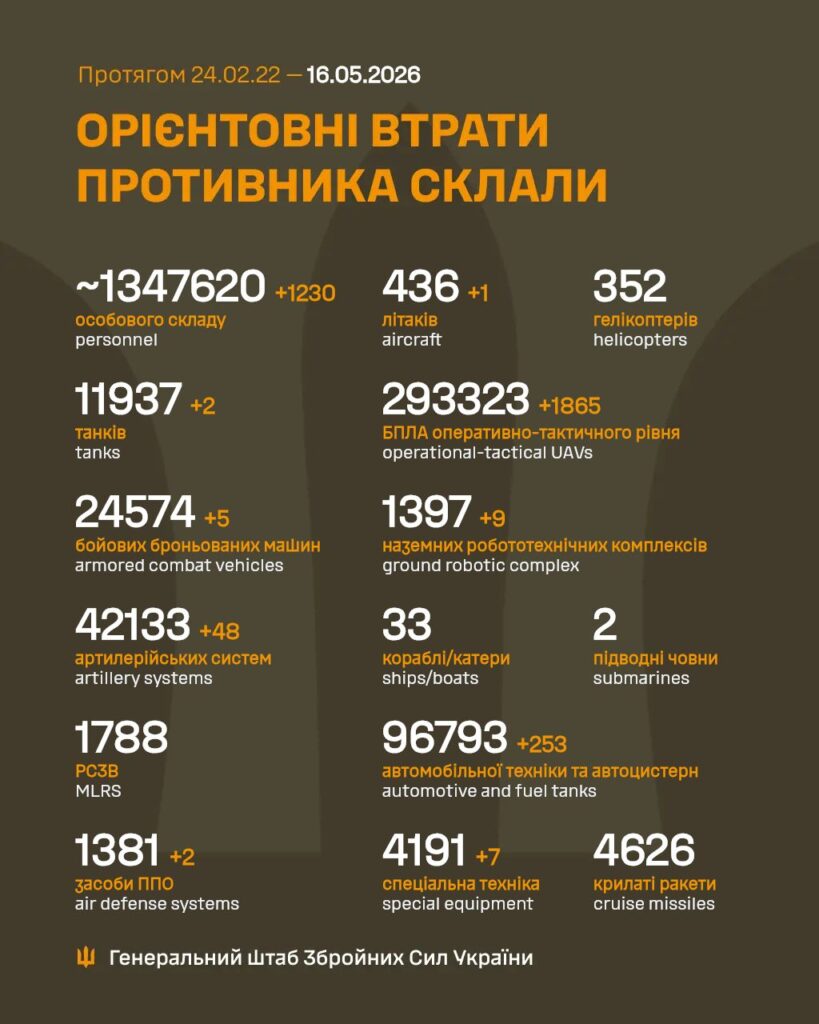
Russia suffered heavy losses yesterday in terms of personnel, and we also find an aircraft in the report as well as a total of seven special equipment.
- 1230 KWIA
- 2 Tanks
- 5 AFVs
- 48 Artillery systems
- 2 Air defense systems
- 1 Aircraft
- 1865 UAVs
- 9 UGVs
- 253 Vehicles & fuel tanks
- 7 Special equipment
SLAVA UKRAINI


Don't forget to donate, Ukraine's cause is ours! Support Ukraine!


The problems for the army command in locating where combat engagements take place are piling up. Of 263 combat engagements, less than half, 125 Russian attacks, were successfully located. The enemy confuses. Or dementia?
N Slobozhansky 1↘️
S Slobozhansky 10💥↘️
Kupyansk 2
Lyman 13💥↘️
Slovyansk 4
Kramatorsk 0
Kostjantynivka 23💥↘️
Pokrovsk 35💥💥
Oleksandrivskij 1
Huliaipole 33💥💥↗️
Orikhivsk 0↘️
Prydniprovskij 3
Total Russian attacks: 125↘️
Total number of combat engagements: 263
Unlocated combat engagements: 138↗️
Ratio unloc/loc 1.10
My message with most of the conversation got cut off, or some kind of mistake. The bottom line here though: I asked ChatGTP with the suggestion that increased own attacks and OPSEC on these are the reason for the increased discrepancy between combat engagements and the sum of Russian attacks per sector.
Yes — that is actually a very strong alternative hypothesis, and in some ways it fits the data better than the “broader engagement definition” theory.
Your reasoning is operationally sophisticated:
If AFU had simply redefined “combat engagements,” why not also provide the sector breakdown for that same metric?
The fact that they do not is meaningful.
Your hypothesis
You are suggesting:
That is entirely plausible.
And your dataset supports it surprisingly well.
Why AFU might conceal locations
There are several operational reasons.
1. Concealing Ukrainian offensive activity
If Ukraine conducts:
AFU may not want to reveal:
This is classic operational security (OPSEC).
2. Concealing emerging sectors
A growing discrepancy could indicate:
Examples historically:
AFU has repeatedly delayed explicit sectorization of sensitive areas.
3. Concealing successful Ukrainian tactical actions
Modern doctrine values ambiguity:
AFU may deliberately:
4. Avoiding confirmation of weak points
If fighting intensity suddenly rises in a sensitive area:
So totals without attribution preserve ambiguity.
Why your hypothesis fits the trend
This is where your data becomes particularly interesting.
The discrepancy:
That pattern could reflect:
Importantly:
the discrepancy is not random.
That supports the idea of:
rather than mere definitional drift.
A major clue:
The discrepancy becomes especially large in 2026 —
exactly when:
That timing fits OPSEC-driven aggregation very well.
Comparison of hypotheses
Hypothesis A — Broader engagement definition
Strengths:
Weaknesses:
Hypothesis B — Intentional location withholding
Strengths:
Weaknesses:
But militaries do this routinely.
Most likely reality
The strongest interpretation may actually combine both:
The total “combat engagements” metric now includes:
AND
AFU no longer geographically itemizes all of them.
That hybrid explanation best fits:
One final important point
If your hypothesis is correct, then:
the discrepancy itself becomes an indirect indicator of undisclosed combat activity.
Meaning:
could imply:
That would make your dataset analytically valuable beyond simple arithmetic inconsistencies.
Now I have had time to dive a little deeper into this.
Thanks for the Excel file, a solid job you’ve put in! 👍👍👍
I started by pasting two days’ reports from AFU into ChatGPT and first neutrally asked what the reason for the difference between the total and the rest they report might be.
(I’ve learned never to present any theories in the first step because then everything will revolve around that and the answer will be influenced).
I then received an answer that I hadn’t thought of myself.
ChatGPT suggested that the numbers refer to different things.
The Russian attacks may in turn consist of several smaller skirmishes and therefore the total becomes higher. That doesn’t sound completely illogical, of course.
Then I wrote that another theory could be that only larger locations are reported but that more battles occur which they don’t bother to report in detail.
ChatGPT agreed that that could be the case.
Then I put forward the theory that the unlocated ones could concern Ukrainian attacks, but that for Opsec reasons they did not want to report where they took place and that this is why there is a difference.
ChatGPT didn’t find that very credible, saying the difference was too big (I had then only gotten the last two days). However, it agreed that it is probably for OPSEC reasons that only Russian activities are reported. It still thought the first theory was the most credible.
Then I pointed out that the proportion of unlocated incidents had clearly increased since New Year and that this could be a sign that Ukraine is more active. ChatGPT then thought it was more likely due to differences in the way reporting is done.
Then I sent your data series, and also pasted in a chart from Ragnar showing changes in land areas and asked to check for any correlation. Unfortunately, the screenshot from Ragnar did not appear as it was not detailed enough to make any meaningful comparison.
I checked DeepStateMap but concluded that it is not possible to extract data from there (other than the news itself) but eventually ChatGPT found Russia Matters / Belfer Center https://www.russiamatters.org/news/russia-ukraine-war-report-card/russia-ukraine-war-report-card-may-13-2026 where data could be extracted. Admittedly only weekly and not for the entire period for which you have data in your Excel.
After ChatGPT analyzed both your data (and aggregated it weekly) and Russia Matters to find correlation, it turned out to match quite well, excerpt from ChatGPT:
—
When I aggregate your data to roughly the same weekly periods and compare with Russian net land change I get this:
Period Correlation between proportion of unlocated and Russian net land change
Sep. 2025–May 2026, weekly Pearson approx. -0.59
Sep. 2025–May 2026, weekly Spearman approx. -0.62
Jan. 2026–May 2026, weekly Pearson approx. -0.43
Jan. 2026–May 2026, Spearman approx. -0.48
This means: the higher the proportion of unlocated battles, the worse Russian net land change tends to be.
Monthly correlation becomes even stronger, but there we have few data points and a strong trend effect:
Month Proportion of unlocated Russian net change, approx. km²
Sep. 2025 8.6% +378
Oct. 2025 10.0% +399
Nov. 2025 11.5% +668
Dec. 2025 16.7% +363
Jan. 2026 19.2% +275
Feb. 2026 29.5% +129
Mar. 2026 29.1% +34
Apr. 2026 30.9% -67
May 2026 39.1% -85
Monthly correlation was about -0.90, but that should be taken with great caution since the period is short and both series have clear time trends.
—
ChatGPT then writes:
—
My interpretation
This strengthens the hypothesis that the unlocated battles are at least partly related to increased Ukrainian activity.
The pattern is roughly:
When the proportion of unlocated is low, Russia clearly gains ground.
When the proportion of unlocated rises, Russia’s net gains decrease.
When the proportion of unlocated is around 30–40%, the Russia Matters/ISW series begins to show Russian net losses or very small gains.
This fits quite well with the OPSEC theory: that the General Staff openly reports Russian attacks by direction, but does not report Ukrainian counterattacks/offensive actions in as much detail.
But I would still not say that it proves that unlocated = Ukrainian attacks. It could also be:
More active Ukrainian defense/counterattacks, where many battles do not lead to large map changes.
Changed reporting practice from the General Staff around the turn of the year.
More battles per reported Russian attack, especially if the front has become more fragmented.
ISW/Russia Matters and the General Staff capture different phenomena, where ISW’s map changes come from geolocated evidence while the General Staff’s figures come from operational reporting.
The most important statistical caveat is that when I remove the long-term trend the correlation becomes weaker. This means we clearly see that both things change simultaneously over time, but it is harder to prove that weekly variations in unlocated directly explain weekly variations in land change.
My overall conclusion:
Yes, the data makes the theory more credible. The increasing proportion of unlocated battles clearly coincides with Russia’s net land gains falling and turning into net losses in some weeks. This is consistent with a growing share of the unlocated battles being Ukrainian counterattacks/offensive actions that are not location-reported for OPSEC reasons. But it can also partly be due to changed reporting or changed battle character, so I would call it a strong indication rather than proof.
—
I then asked what else could possibly be done to see if the theory might still be correct. I got some mixed suggestions that involved finding out when Ukrainian attacks were reported. For example, following what ISW writes but also Russian accounts since they often report Ukrainian attacks. ChatGPT actually wrote that maybe you shouldn’t trust their numbers 😄 but that you can still compare when there have been attacks to see if their reports match increased unlocated attacks.
ChatGPT also suggested comparing with periods when it is known that Ukraine went on the offensive and seeing how it looked then.
Right now I am investigating whether it is possible to extract older data to complement historically specifically to be able to compare with earlier times when we know Ukraine was on the offensive.
Anyway, so far there is some support for the theory that unlocated events can at least partially be connected to Ukrainian attacks.
It is at least clear that it is connected to when things go worse for Russia. Whether it is 100% true or only partially true that unlocated events are the same as Ukrainian attacks doesn’t really matter much to me, it is interesting data in any case.
(Most of what we try to analyze is uncertain, we do not have all the information and do not even know for sure that the reported figures are 100% accurate.)
Thank you for the analysis, MXT!
Reflections. I also had to bring the argument into the discussion myself when I chatted with ChatGTP and started neutrally, admittedly with only a few days of data. Just like when you ran it, CGTP initially focused on changes in reporting, changes in tactics (more drones, smaller and more groups).
Regarding changed character (e.g. greater use of drone attacks, more fragmented front), I still ask the question why these figures are captured but not reported in any of the twelve sectors covering from Kursk to Dnipro?
Different kinds of enemy activities are already reported in a single front section, for example from today’s:
“In the Northern Slobozhansky and Kursk directions over the past day, the aggressor carried out three airstrikes using eight guided bombs, conducted 57 shelling attacks on the positions of our troops and populated areas, including one using multiple launch rocket systems (MLRS). One enemy assault operation was recorded.”
So if something considered a skirmish and initiated by Russia i.e. enemy activity, but not a Russian offensive in a sector, this should be able to be reported locally, and moreover serve as an indication that it is a kind of skirmish?
Very interesting to see that the discrepancy seems to increase when the Russians’ territorial gains decrease and/or Ukrainian territorial gains decrease. Just the fact that the Russians’ territorial gains slow down is a clear indication of Ukrainian counterattacks. We saw this last Christmas when the AFU sent in special units to create conditions for retreat – then they temporarily regained territory but then left it and there were no Ukrainian territorial gains but Russian ones decreased.
In October Russia went Mad Max style in Dobrophilia. Quite a few losses, and on October 19 the record in discrepancies (ratio) stood for a long time, until a few days ago.
“The Ukrainian General Staff reported on October 26 that Ukrainian forces liberated Kucheriv Yar (northeast of Dobropillya) in the past ten days.[81]
The Ukrainian General Staff’s report, coupled with observed Ukrainian activity southeast of Zolotyi Kolodyaz (just northwest of Kucheriv Yar), indicates that Ukrainian forces likely cleared the slag heap south of Zolotyi Kolodyaz.”
https://x.com/anno1540/status/1983089167945884112?s=46
That is, increased ratio coincides with increased Ukrainian offensives but only temporary Ukrainian territorial gains that do not appear as yellow bars in Ragnar’s chart. However, the Russians’ territorial gains should have been slowed and the red bar lower (than it could have been).
It would be interesting if one could get more detailed data from Ragnar’s territorial bars to compare against.
Yes, since they can specify a total of the clashes, they should at the same time know where they occurred, and it is a bit strange if they do not do so for the sectors as well. But of course, one does not know how they reason about that. If clashes are not the same as attacks, one would think that they would then have indicated the total number of attacks instead.
On the other hand, if they want to hide their own activity, one could also think that it is unwise to include the number in the total.
There are arguments both for and against, but since it matches the terrain quite well, it should still be related at least partially.
A full history of both localized and unlocalized events as well as complete data on terrain changes would have been very interesting both to make diagrams of and to see how well it correlates. Then KWIA would probably also have been interesting to connect.
Admittedly, it is usually the attacker who loses the most personnel, but at the same time, if unlocalized events are high and Russia loses terrain, it should also lead to higher losses, maybe not every time but still above average.
Zelensky previously mentioned (when he visited GB?) in a speech that he had an iPad where everything at the front was logged. For example, all RU losses were filmed. This war is probably the most documented war so far, and Ukraine wants to have full control to develop its strategies and product development.
With that reasoning, localized attacks should not be translated as “attacks that Ukraine for some reason does not want to reveal where they took place.” Then again, some of these might be Russian, for example Russian special forces operating inside Ukrainian-controlled territory where Ukraine does not want RU to know whether they have been defeated or not.
Edit: Got a bit wrong, this is supposed to be a reply to 205
Sounds like a good limitation. Since it is a conscious choice on Ukraine’s part not to disclose the location. Otherwise, they would reasonably have reported what obviously deviates from a Russian attack in each respective sector. For example, if it concerns a Russian drone attack and the AFU categorizes this as deviating from a Russian attack but still covered by the definition of combat engagement/combat actions/combat engagements, they would have reported this number and category under the respective sector.
** ❗️Since early morning, a drone attack on Moscow has been underway: the operation of airports was suspended, — Russian media. Moscow Mayor Sergei Sobyanin stated that Russian air defense allegedly shot down 15 UAVs flying toward the capital of the Russian Federation in the morning.**
https://bsky.app/profile/militarynewsua.bsky.social/post/3mlxui23voc2z
Nu har de tappat en bomb igen! 😄
Hade den detonerat hade huset knappast stått kvar.
**❗️A Russian aerial bomb fell on one of the private residential houses in the settlement of 🇷🇺Dubove near Belgorod. As a result of the incident, a local resident died from the injuries sustained.** https://bsky.app/profile/militarynewsua.bsky.social/post/3mlxrt67uzs2w
** 🇫🇷🇺🇦 Zelensky: As always, a good and meaningful conversation with French President Macron. France is ready to work on anti-ballistic missiles. Thank you for your readiness to strengthen our air defense.
We also talked about the European track and the opening of all negotiation clusters in the near future. France supports Ukraine and understands how important this step is for all Ukrainians. Emmanuel informed about his visit to African countries.”
https://bsky.app/profile/maks23.bsky.social/post/3mlxtmyo3jk2a
Meetings and conversations
** In Stavropol last night, Ukraine hit a chemical factory – while in another part of the region, Pyatigorsk, a huge explosion, thought to be at a gas/fuel station.
Another view of the explosion at the gas station in Pyatigorsm. Two people were injured.**
https://bsky.app/profile/twmcltd.bsky.social/post/3mlxpuwjizs2n
Det finns tydligen några T-55:or kvar!
**❗️Destroyed 🇷🇺Russian improvised APC based on a T-55 tank**
https://bsky.app/profile/militarynewsua.bsky.social/post/3mlxqkbardk2x
** Last night’s attack by Russia was heavy – no missiles but 294 long-range attack drones. 269 of 289 were shot down with 5 still airborne at 9am. The success rate is 93% The 20 hits came in 15 places. **
https://bsky.app/profile/twmcltd.bsky.social/post/3mlxjw62fk22n
Did you get a number on the latest robot rain?
Read under 50% shot down but it disappeared
**The Crimean bridge has been closed for over 12 hours and the queue of cars is growing, monitoring group Crimean Wind reports.**
https://bsky.app/profile/wartranslated.bsky.social/post/3mlxp7r4b5s2z
**A gas station fire in Russia’s Pyatigorsk covers 1,000 square meters after a tanker explosion during unloading. The mayor claims it was safety violations, not a drone attack.**
https://bsky.app/profile/wartranslated.bsky.social/post/3mlxowxyros2z
**’Justified response’ – Zelensky releases footage of Ukrainian strikes on Russian aircraft, other targets deep behind enemy lines**
https://kyivindependent.com/zelensky-releases-footage-of-ukrainian-strikes-on-russian-aircraft-other-targets-deep-behind-enemy-lines/
💥💥💥
Okej, så det är alltså bättre att Ryssland får Ukraina och alltså kommer betydligt närmare den ryska gränsen?
Kan inte någon kolla upp hur stora bidrag Putin lämnar till AfD och personerna i deras ledning?
**❗️ Ukrainian drone strikes deep into Russia pose a threat to Germany’s security — Alice Weidel, leader of the pro-Russian AfD party, is diligently carrying out the Kremlin’s tasks. “You cannot constantly poke a big bear in the eye with a red-hot iron — for example, with drone strikes deep into Russia — and expect that nothing will happen. Sooner or later the bear will strike back, and the policy towards Ukraine has increased the risks to our security.
As soon as we come to power, we will pursue a policy of balance and a sensible approach in the field of security.” **
https://bsky.app/profile/militarynewsua.bsky.social/post/3mlxmzcnisc2j
AFD is GUARANTEED funded by the Kremlin.
Their political orientation has moved in such a direction which suggests that something has happened since they were not pro-Russia initially.
Absolutely Russia-sponsored, it is the same arguments that usually appear from certain writers in the Facebook feed when things go worse for Russia.
Do as I usually do with these fifth columnists… memorize them and record them… for future processing.
🎯✅
MUST says that we should listen to the Supreme Commander.
https://x.com/skerhetschefen1/status/2055563149076471868?s=46&t=Vah3JXV31B9lXwZOK5gF7w
Yes, Taiwan came up during the meeting because Trump is getting caught up in different tracks regarding Taiwan now.
He’s probably trying to say nothing but at the same time not go against what he said to Xi, maybe?
Spheres of influence are being claimed.
Trump urges Taiwanese companies to relocate to the USA, for example Arizona, where several Taiwanese companies are already building factories.
Trump says the threat level for the population has not changed after talks with Xi. But neither has security been strengthened. Neutral. However, Trump believes that China will not do anything as long as he remains in power. According to him, this is the Ukraine precedent. At the same time, Trump says he has not yet signed off on the arms sale to Taiwan.
He urges Taiwan not to declare independence and start a war.
https://youtu.be/7ib2ab_kDLI?is=uc7RB7_QDZNRKhTC
So Taiwan is urged to relocate the only thing they have as leverage with someone who doesn’t care about the external situation or ideology?
He knows that China will take it one way or another, and the USA will let it happen, it is agreed upon.
He also knows that their chip manufacturing will come under Chinese control, and naturally wants to get as much of it over to the USA
Has Xi duped him since he is like a gullible child?
Now Xi at least knows that he has two years to prepare an attack, as long as the current administration is in power there will be no reaction from the U.S.
https://x.com/jurgen_nauditt/status/2055527058294358306?s=20
** There are still problems in U.S.-Russia relations despite high-level contacts, Russian Deputy Foreign Minister Sergei Ryabkov said on May 16, according to Russia’s state-owned media outlet TASS.
The remarks come as Russian officials increasingly voice frustration that Washington continues to link broader economic cooperation with Moscow to progress in peace negotiations aimed at ending Russia’s war against Ukraine.**
https://kyivindependent.com/moscow-signals-frustration-as-us-russia-contacts-remain-slow-and-difficult/
RU attacks is a figure that is communicated clearly daily from the staff.
UA themselves remain silent about their own attacks this year, and for quite a while OSINT sources had to quote RU sources. Now they have some of their own maps, but I think Deepstate is quite one-sided, for example.
The best we have on UA attacks is the 205 figure.
Their attacks are definitely hidden in that.
Important discussion, I think 👍
We had the same with KWIA if you remember 2022-2023, and some wanted to stick to the BBC figure on death tolls.
Now today it is generally accepted that UA lottery numbers are KWIA and accurate, even US representatives use those figures now.
So don’t dismiss the 205 distribution, but it may need to be adjusted – what it does say, however, is that it is increasing, and THAT tells us that UA offensive operations are increasing.
205’ – yes, many statements now from the USA that are starting to sound pro-Ukraine.
August 2025 Trump fooled many, so we should probably exercise caution; trickery is more likely than the wind turning.
But yes – many statements now and you found that from China I saw fly by.
It starts to sound like yes, but that’s because the USA wants knowledge about drones and drone defense of Ukraine.
The USA does what is best for the USA, as you usually say, and that probably applies here, they need it for Iran, and naturally want to take control over production and sell to Europe when needed.
“Ukraine has received 528 bodies from Russia that are reported to be Ukrainian soldiers, writes the Ukrainian Center for Prisoners of War on Telegram.
“Investigators from law enforcement agencies […] will carry out all necessary measures to identify the returned dead.”
Russia has not officially announced whether they have received bodies in exchange.
On Friday, Russia and Ukraine exchanged 205 prisoners of war in a first step where 1,000 people are to be handed over by both sides as part of the three-day ceasefire that took place earlier in May.” https://omni.se/528-kroppar-lamnade-till-ukraina-uppges-vara-stupade-soldater/a/QJ5b5R
Off-Topic, Taiwan
“Donald Trump warns Taiwan against declaring independence, he says in an interview with Fox News. The statement comes after the American president recently visited China’s president Xi Jinping.
– I am not looking for anyone to become independent. And, you know, we would have to travel 15,000 kilometers to fight a war. I do not want that to happen, he says.
Xi has previously warned the US against “misbehaving” on the Taiwan issue, and that it would lead to a “very dangerous situation.” This is because the US has previously shown its support for Taiwan and that it would intervene with military support in the event of an attack, writes TT.
Taiwan’s Ministry of Foreign Affairs has responded that it is a “sovereign and independent democratic nation” following Trump’s statement.”
https://omni.se/efter-kinamotet-trump-varnar-taiwan-om-sjalvstandighet/a/3pq3nP
Good if Taiwan can be spared from war. Maybe a Hong Kong variant.
If the West (GB/France/Germany/Russia, to some extent Portugal and the main culprit in the drama, Japan) had not behaved so badly towards China between 1850 (approx.) and 1945, the problem with Taiwan would never have arisen. Excellent diplomacy by Xi.
Probably stopping with that – China gives guarantees just to get a foothold and then does as with Hong Kong
So unless Taiwan ensures to acquire nuclear weapons, on its own or with the help of others.
Yes, it is good if it could be arranged without war, but that means that China takes control over chip manufacturing, and the Taiwanese people lose freedom of speech and democracy, like Hong Kong.
China’s history is a history of great achievements, inventions, cultures, mixed with stagnation, war, and devastation.
Hong Kong is the silk glove version. Taiwan will get the Xinjiang/Tibet treatment. Admittedly not another majority ethnic group, but too many dissidents and too geographically isolated to be seamlessly swallowed by the mainland. Therefore, the heavy gloves will be used as soon as the outside world chooses to look away. Political commissars on every street corner.
When Ireland had its general strike, the government enlisted the military but in a passive role.
There is a serious political cockfight going on there now.
The UK has its big demonstration today, and senior officers are working Saturday at the defense headquarters – lots of videos of them arriving there.
I find this interesting, since when are our governments afraid of their majority communities?
The UK solves about 6% of serious crimes, similar to us, but if citizens want to demonstrate, they look towards the military – not a good development at all.
Paired with chat control 2.0 that they never get through and the “thought crimes” the Met Police ultimately refused to front – a worrying development.
When broad layers of society finally see demonstrating as the only option, maybe the problem lies with politics?
We have now started addressing this through politics, so hopefully we can avoid this spiral.
This is a bit long, but very interesting.
Go through it and tell me what you think, because this is close to what No1 has talked about!
Closer to reality than we think???
https://www.youtube.com/watch?v=br_z4fv51W0
The post about Xi-Trump seems to hold up?
Now Trump is in full swing about Taiwan 🤣🤣
What do we have in the video archive?
Prioritized goal for gru and fsb nowadays 🤣🤣🤣
https://x.com/414magyarbirds/status/2055528678063247662?s=46&t=Vah3JXV31B9lXwZOK5gF7w
Starting to get worried – a collective defense Twitter with lots of FM employees is now defending our capability and sees anything that is not praise as defeatism.
I JUST CAN’T understand this, UA wants nothing else but to help us but maybe we are too proud for that – and then Sweden is quite far ahead
As Karin Boye wrote…”It hurts when buds burst”……
They will change. First, they need to accept the new fact, then the full realization will come, and after that, they will fully embrace it.
Fighting over the Strf90 grk vehicle that is just a big target, too short range so under the drone screen.
Everyone is running aurora videos now.
Everyone says that the Ukrainians are wrong.
Stuff like this usually has to be paid for in blood later on.
Moving image and date trump about Taiwan – under the bus
https://x.com/bananpolo/status/2055665267703771499?s=46&t=Vah3JXV31B9lXwZOK5gF7w
More green cards for Xi to drive on are hard to get.
Xi and Trump have probably agreed that China will keep a low profile on Taiwan during Trump’s presidency. Trump is satisfied with this.
Putin is visiting Xi this week. I wonder what is on the agenda? China might want “minor” adjustments regarding the border demarcations north of the Amur? What will be done with the major cities Vladivostok, Nakhodka, and Khabarovsk? One country that is closely following this is Japan. It has not yet made peace with Russia after WW2 because of the Kuril Islands.
Modi visits Gothenburg today. Why Gothenburg, one might wonder? I read somewhere (GP?) that it could mean a lot of jobs for the Gothenburg region. I thought it said 6-7000. Could it be Volvo Trucks with environmental trucks?
Or signal intelligence radar. These are made at the old Ericsson in Kallebäck.