
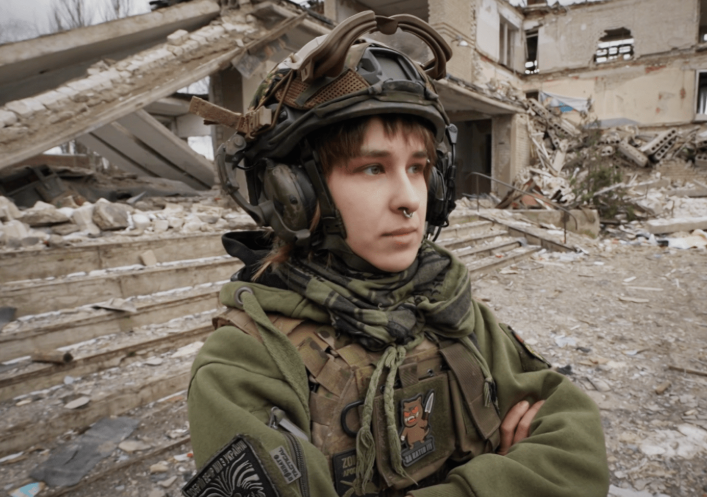
There are 55,000 women in the Ukrainian Armed Forces spread everywhere – including combat elite units.
Yesterday we summarized the fronts and it is my opinion that we have reached the beginning of the end. This period will have two pillars – one where Ukraine continuously advances and we are showered with good news, then a second where Putin presumably has no intention of crawling back into his hole and crying quietly. I see escalation as a given.
I recently deep-dived into the Leningrad military district because I believe that this old-new military district would be tasked with entering the Baltics – if it happens.
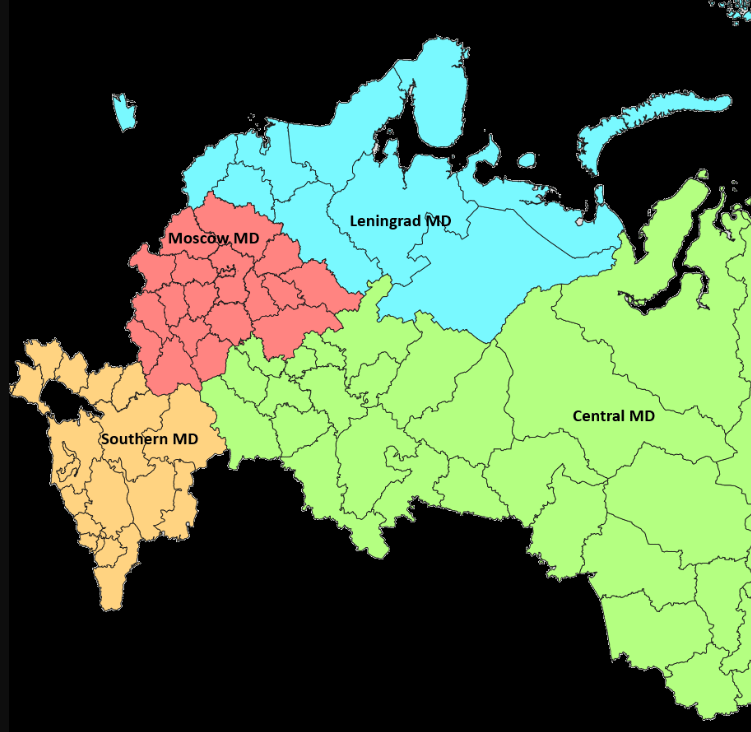
In 2024, the Western MD was scrapped and became the Moscow and Leningrad military districts instead.
There was something about this reshuffle that has been bothering me – they were supposed to set up new divisions, for example, and then they split the spearhead aimed at us in Europe into two.
Moscow’s military district roughly covers from the Belarus border down along Ukraine’s northern border – so Leningrad’s military district is from the Belarus border and northward, simplified.
Unfortunately, almost everything discussed about the new military district concerns what they are doing along the Finnish border, but they have built the same bases, depots, and barracks toward the Baltics in the Pskov area. In addition, train stations, tracks, and roads have been improved and newly built parallel to these new bases and depots.
For a couple of years, the Baltics have warned that they covered the train station in Pskov with camouflage nets and that artillery units passing through the town then do not appear in Ukraine. We are thus +2 years into an active preparation phase.
Since we in Europe after the Cold War understood that the Russians had parked all heavy equipment in barns and other buildings along the border so that the warning we thought we would get instead would have been much shorter, it is not unreasonable to believe that RU is trying to do it again.
In the past year, I haven’t really heard anything – my sources in the Kremlin were probably oversold as I didn’t get enough paid subscriptions here and couldn’t pay them.
To begin with, the entire cluster of units belonging to Leningrad MD is along the northern front against Ukraine except for the 14th AC which is down in northern Luhansk – but the 71st MRD included in it is at the northern front.
Then we have the 76th GAAD of course which fought at Pokrovsk but they are no longer at the front dying down there.
For everyone looking at the unit maps, you can see that RU has a lot of capability along the northern front, significantly more than the buffer zone they intend to seize.
My thought has been that Ukraine with its 6 ACs in the area is preparing something fun that RU is watching, but of course there is the possibility that RU units are there to mask their buildup toward the Baltics – that would be smart and has demonstrably worked if so.
The units belonging to Leningrad MD –
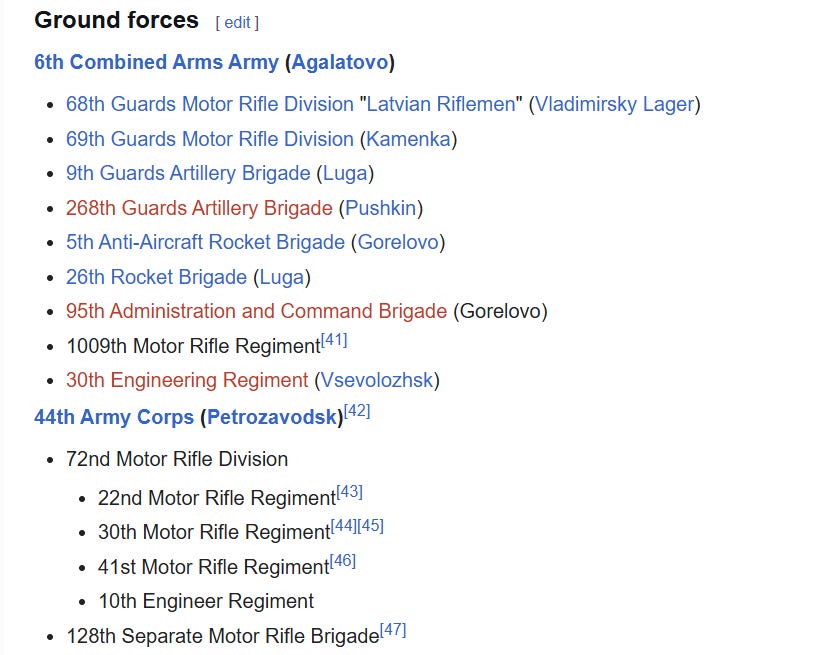
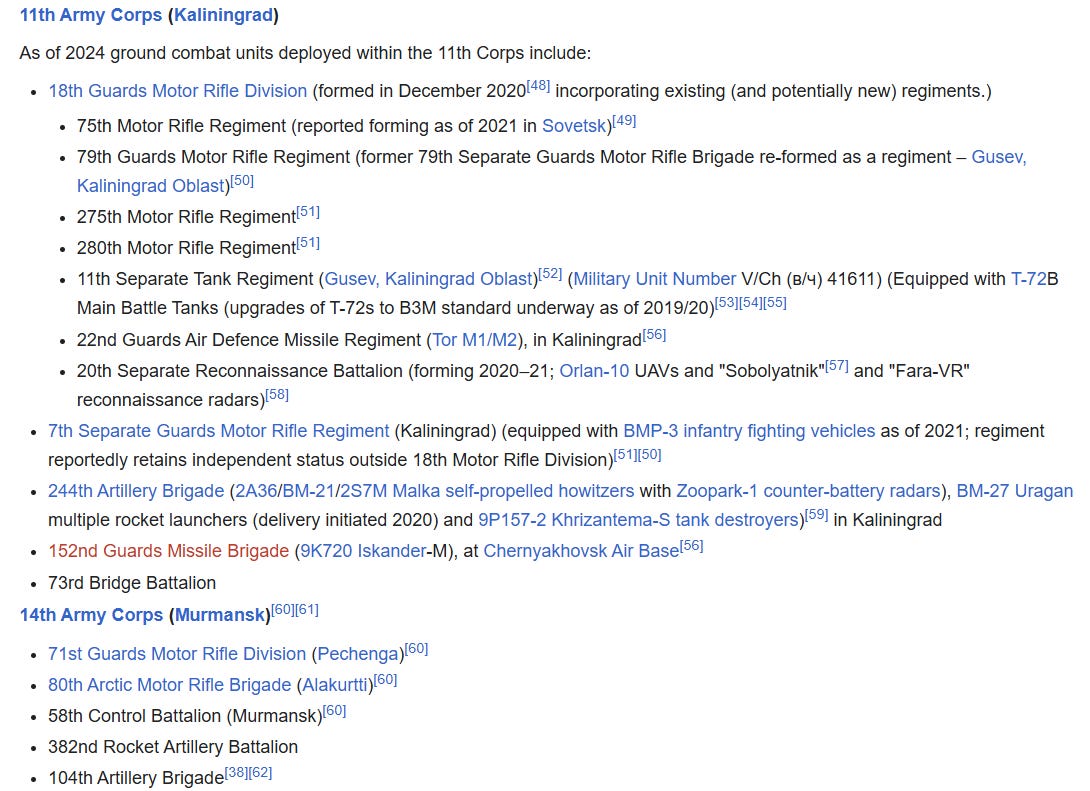
With this, I just want to shout out that absolutely everyone is completely wrong when they say “Russia has not built up any capability against the Baltics.”
1st CAA and 3 ACs are exactly 9 hours driving time by road from the eastern border of the Baltics. They are fully mobilized, trained, have combat experience, and have been in some kind of half-rest since around 2025 when it calmed down at the northern front, I don’t know exact dates and am too lazy to google it.
The command structure is fully staffed up to the MD commander.
The commander of Leningrad MD, Colonel General Yevgeny Nikiforov, is an old fox who started already in 2014 when they attacked Ukraine, has led the operation in Syria and most recently survived all purges of senior officers in Ukraine since 2022. Career in VDV where he commanded battalions and regiments.
He is probably considered competent by Russian standards, previously it was Lapin who is Ukraine’s best friend but since the turn of 2025/2026 this gentleman took over.
Besides the units we have listed, RU will latch onto the drone weapon from Rubicon whatever might be needed for a “special operation” which absolutely should not be confused with a war.
A bit about the units,
6th CAA.
Has fought in Ukraine since 2022 and actually has a Ukrainian as commander, Lieutenant General Sergei Storozhenko.
Built around two motorized divisions with army artillery.
44th AC
Built around a motorized division and corps artillery. The unit took heavy losses in the UA Kharkiv offensive 2022.
Newly established AC with a newly established motorized division and a commander who previously had a military base in Dagestan and then Ossetia – Major General Roman Vyazovsky.
Does not give a competent impression at all and the bar is set very low.
11th AC
Based in Kaliningrad and presumably a prioritized unit. Competent corps commander Lieutenant General Renat Chaliko.
14th AC
Built around their Arctic motorized regiments and presumably competent.
The commander is Major General Boris Fomichev and it is hard to find good information on him but he has previously led the Arctic brigades.
—
Since there are more units at the northern front than Leningrad MD, and also the North Koreans’ 11th AC which has now been heavily reinforced as secretly as RU could, you can probably pull units from the northern front without it collapsing.
Seems like there is a bit more connected to Leningrad in case of conflict – the 336th marine infantry has become the 120th marine division and is gone at Donetsk.
Marine Spetsnaz and combat divers at the Baltic Fleet, Northern Fleet, and Kaliningrad – don’t know where they are stationed.
Besides that, as previously said, there is a variety of special units for FSB, GRU, and SVR which fall under the early infiltration group and can be deployed if needed.
For example SOF Zenesh (which seems to belong to Leningrad MD) and Kubinka-2 at the northern front which falls under Russian SSO modeled after the West with operators.
2nd Spetsnaz brigade belongs to Leningrad MD, but the 45th Spetsnaz brigade is also at the northern front.
Going through the fronts, RU has pooled VDV, marines, reconnaissance, and Spetsnaz at focal points. The northern front should not be a focal point but has quite a lot of special units in the broader area.
Releasing units of course assumes that Ukraine is not putting everything on one card against Moscow at the same time which by definition makes E3’s desire for a ceasefire absolutely high risk.
Moving away the special units all else equal works perfectly fine already now.
If NK 11th AC has been reinforced now, you can also move away the equivalent of their numbers without the total decreasing. It is their “special forces corps” and the Ukrainians respect them even if I made it a thing to mock the tape worms.
Then UA has other focus areas and may pull away units needed for offensive operations elsewhere, it can become critical or there can be violent breakthroughs – who knows?
RU can also place training of new units in the area to be able to pull away others – we thought Ukraine would do that at the border with Belarus and have Europe’s armed forces as instructors but no one bit.
Ukraine absolutely must move capabilities over to Belarus to meet the threat that is not a threat but one never takes chances.
Overall, there are units under Leningrad MD that today can travel 9 hours under their own power up to the border with the Baltics without creating a vacuum.
We can assume that the chain of command has reconnoitered the terrain.
Ukraine is not all-seeing; if they see units being supplied with vehicles or starting to move at the northern front, it could be preparation for an attack southwards, movement down into Ukraine, Belarus, or towards the Baltics. If Russia keeps it somewhat secret, Ukraine can basically only say “a movement is underway.”
Europe will not start jumping up and down over troop movements at the northern front until we see them on the road passing Smolensk or Vitebsk – only then is it indisputable where they are heading a few hours before they reach the border with the Baltics.
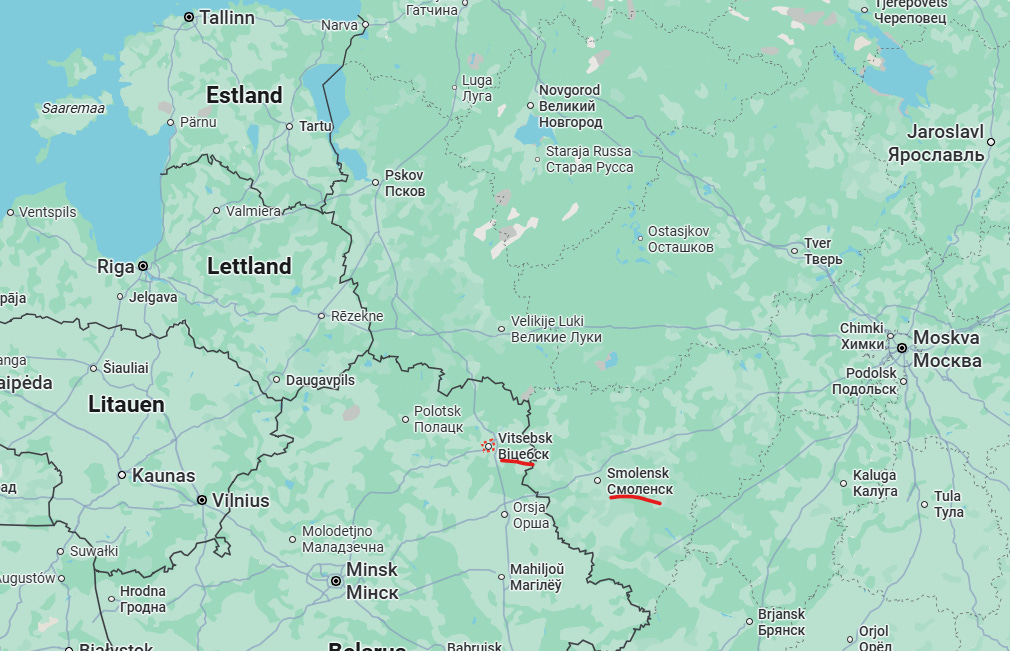
I think this is very important and still do not understand how the common perception can still be that Russia has not built up any threat against the Baltics. I almost get the feeling that we believe we will get a week’s warning or longer, preferably the same as in 2022 where everything is staged for months, so that we can be reactive in the way we have prepared for.
Considering how well Russia has managed to sneak in the capabilities they have brought into the overall Pskov area today, and the reinforcement of NK 11th AC, I don’t think there will be more warning than the Balts starting to scream about little green men and simultaneously the units from the northern front are on the move the same day or the day after.
Whether we manage to reinforce the Baltics before they have dug in along the Daugava remains to be seen. The Poles and Germans will have to get through a drone-saturated battlefield from Suwalki and northwards after they have mobilized.
They will have refugee flows, roads mined at distance, and clouds of drones to work through before finally trying to cross the Daugava. There will be no 9-hour driving time there when they have mobilized late.
If this now plays out, where the risk is probably over this fall when the mud season begins, I think the decision Europe’s leaders then need to handle is to retake all terrain north of the Daugava up to Tallinn but you know that from previous posts on the subject.
It could very well happen that the Poles simply roll over Kaliningrad and that our heavy attack quickly deals with the Baltic Fleet, but that does not change the fact that we still have to retake the area by force – Putin has shown great willingness to sacrifice lives and not give up terrain except when he loses it in a fair war so far.
How would such a war of aggression affect Putin – if he gets a good start it would absolutely be positive for him and take focus away from his upcoming crushing defeat in Ukraine.
Ukraine is lost to him anyway and his alternatives are escalation elsewhere or to leave Ukraine and take the full consequences of a crushing defeat without being able to dangle a single victory anywhere.
I know I keep drifting back to the Baltics but it is only because we are not preparing for peace.
Now the US is going to pull even more capability out of Europe. The total numbers are irrelevant because they are removing the spearhead and having thousands in the logistics tail left does not win any wars.
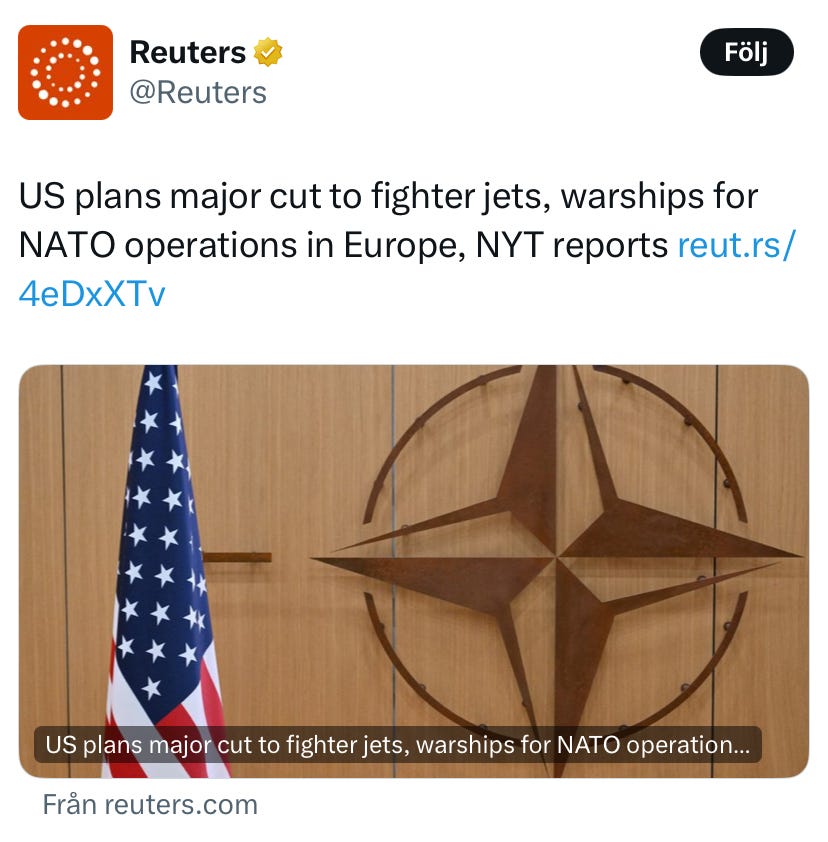
I don’t know exactly what the markers are here but if the American battalion from Estonia disappears without replacements showing up, it’s probably a serious situation.
Russia has apparently started bringing in capabilities into Belarus again.
If Russia can force Ukraine to stretch its defense out to the Belarus border, it naturally becomes easier for them to pull units from the northern front – everything is always relative.
The most relative thing is a paid subscription on Substack – don’t miss this great offer.
That Sweden has now, belatedly, spoken out is hailed as a great success – what we are actually doing is finishing a report this fall.
https://www.svt.se/nyheter/utrikes/avslojar-har-upprustar-ryssland-bara-kilometer-fran-natos-grans
If the Russians have not already dug in north of the Daugava, this has value; otherwise, it’s just a world record in paper shuffling.
There are occasions when The Phantom walks the city streets as an ordinary man, right?
The ONLY thing of value right now is to reinforce the Baltics so the Russian analysis group stamps a bright red no on the battle plan out of pure self-preservation.
That Putin will quietly accept total humiliation in Ukraine, which has now reached the beginning of the end, is incredible. Europe must prepare for the death throes; anything else is irresponsible and incompetent.
You know very well what I think about our elected officials, employees in key positions, and experts after 4.5 years, but right now it is a critical situation so we no longer have time on our side; Ukraine cannot buy us more time with its rivers of children’s blood.
Probably 2026 is the most important year for Europe after 2022; wrong decisions could have consequences for us for the next 70 years – good or bad.
The biggest threat right now – G7 where Russian media eagerly discuss that Trump will try to get Zelensky and Europe to agree to a ceasefire.
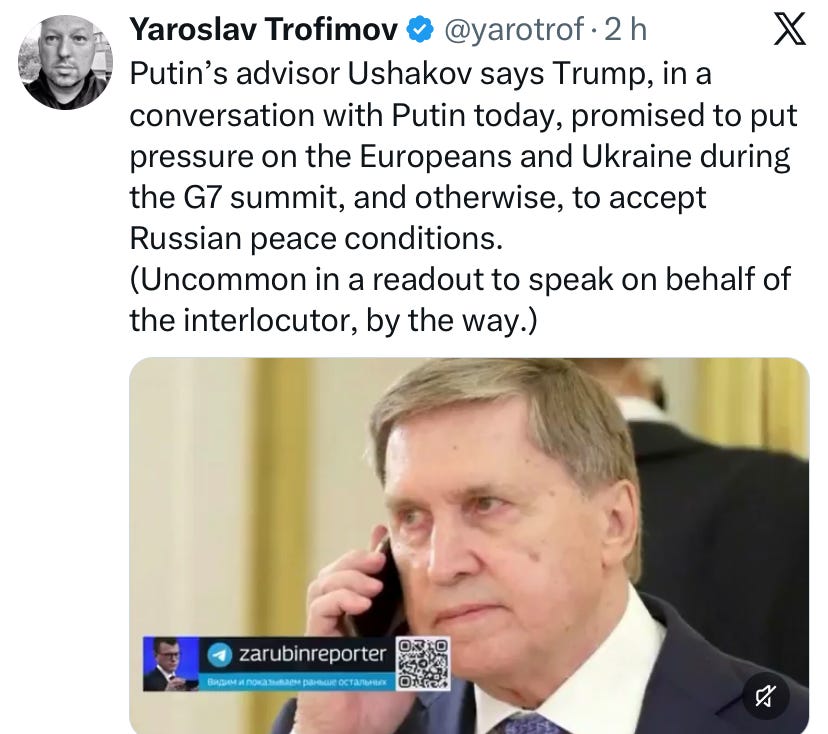
I want to argue that a preschool class just before lunch would easily come to the conclusion that a ceasefire in Ukraine catapults the probability of direct conflict with Russia in the near term to almost 1.
Even without a ceasefire, Russia has redundancy to open a conflict front against us, but it would naturally help if Ukraine were forced to sit on its hands when they start.


Don't forget to donate, Ukraine's cause is ours! Support Ukraine!


Thanks to Johan for another worthwhile yellow wall.
The effect of a ceasefire for this conflict and all of Europe is frightening, even though Ukraine might, on the other hand, see an opportunity to get more fighters on its side.
It was discussed, by the way, on Ukraine the latest from the Telegraph last Friday, I believe.
Now apparently both France and Germany want, on top of all the misery, to weaken Kaja Kallas because they don’t like her hawkish stance towards the Russian bastards. 😡
“Give diplomacy a chance”…
https://www.euronews.com/my-europe/2026/06/13/backlash-against-kallas-reveals-hard-truths-of-eu-foreign-policy
Russian losses in Ukraine 2026-06-16
Continued high losses of KWIA but artillery is unusually low compared to how it has looked recently. 50 cruise missiles is a lot but that is about where it usually is on the days Russia chooses to use them.
This is what the statistics for the cruise missiles look like (today’s report is not included, Ragnar has not yet uploaded today’s report), as you can see a larger number comes at fairly regular intervals and in between there are none at all.
SLAVA UKRAINI
Very good👍👍👍
AFU reports:
💥🔥👍✊
Alltid dessa fallande vrakdelar! 😄
** Drone attack sparks fire at oil depot in Russia’s Krasnodar Krai.
A fire broke out at an oil depot in Russia’s Krasnodar Krai overnight on June 16 after drone debris fell on the facility, local authorities said. **
https://kyivindependent.com/drone-attack-sparks-fire-oil-depot-russia-krasnodar-krai/
Kyiv Post rapporterar om samma sak:
** Ukraine Hits Krasnodar Oil Depot, Moscow Refinery Reportedly Burning in Massive Drone Raid
In brief: Ukrainian drones struck an oil depot in Russia’s Krasnodar region and reportedly targeted Moscow’s Kapotnya refinery, escalating pressure on Russia’s fuel infrastructure. The attacks come as fuel shortages spread across more than 25 Russian regions. Analysts say nearly one-third of Russia’s refining capacity – 2.14 million barrels per day – is now offline due to repeated Ukrainian strikes. **
https://www.kyivpost.com/post/78244
** Moscow’s most protected refinery is on fire. Kapotnya – surrounded by hundreds of Russian air defense systems – is burning today. Russia built layers of defense around Moscow precisely to prevent this. None of it was enough. ** Film:
https://bsky.app/profile/meanwhileua.bsky.social/post/3mof5etedvg23
** 💥 Ukraine struck the Moscow Oil Refinery. 12 million tons per year, 245,000 barrels per day output. ** En annan film:
https://bsky.app/profile/igorsushko.bsky.social/post/3mof4cmd2i22d
Det ser tyvärr inte ut som att man träffat huvudkolonnen, om den inte döljs av elden och röken förstås.
Men det brinner bra!
**More from Moscow 🔥🔥🔥🔥 15km to the Kremlin. The refinery supplies up to 40% of Moscow’s fuel market and about 70% of Moscow and the region’s gasoline needs.** Film.
https://bsky.app/profile/maks23.bsky.social/post/3mof7alw3t222
After the US capitulation in Iran, the risk is probably imminent that attention will once again focus on “Peace for our time” in Europe by trying to force Ukraine to capitulate to the “invincible Muscovites.”
Yes, there is probably a high risk of that.
Or Trump feels that he needs a comeback.
Maybe he chooses to go against Cuba, which should be considerably easier than Iran if he wants a win.
There is also a risk that he starts messing with tariffs again.
Saw something about him threatening France with 100% tariffs on wine, if France did not remove their 3% tariffs on IT technology (which I got the impression they had against all countries, not just the USA).
He could start with a goodwill gesture and remove the US’s 15% tariffs against the EU.
About Cuba…
https://bsky.app/profile/warmonitor.net/post/3mogxytcsjc2b
The risk is probably imminent that Trump will interfere in the negotiations again and try to save what can be saved for Putin and himself. It became a bit more urgent now that Europe has started to pick up the pace; it would be bitter for him if it were Europe that achieved peace.
Trump tends to pressure whoever he considers weaker, and now that Ukraine has shown that they probably hold the cards, maybe he will start pressuring Russia harder, one can hope.
Feel free to listen to Richard Shirreff: The former Deputy Supreme Allied Commander Europe for NATO, General Richard Shirreff, joins Maddie Hale to discuss Trump’s proposed Iran deal, why he believes it will be worse than Obama’s, whether the US has already lost the war, Europe’s message to Trump at the G7 meeting, the future of support for Ukraine, and growing concerns over the US military stockpiles.
https://open.spotify.com/episode/5cZ6hPFbTuSpPkyRRbFGS3?si=ugdbddfeQWyz1kVfaGzx3g
Interesting, must listen.
What has been rumored so far is that it is indeed worse than Obama’s, uranium enrichment is allowed to higher percentages. Release of frozen funds, etc.
Now Iran knows that they have control over Hormuz. The Islamists know that they have control over the population.
And. Iran has driven a wedge between the USA and Israel… I don’t think the USA will support Israel’s war plans any more times.
And what happens to the USA’s bases in the area?
It is said that discussions will continue for 6 weeks, so we don’t know what the final agreement is, but I assume it is not good for anyone other than Iran.
Intressant, börja Luka tappa tron på att husse Putin ska gå segrande ur det här?
** Lukashenko says Belarus poses no military threat to Ukraine, apologizes to Zelensky for past remarks.
Belarusian leader Alexander Lukashenko said that Belarus poses no military threat to Ukraine and apologized to President Volodymyr Zelensky for previous harsh remarks, according to an interview with Al Arabiya. **
https://kyivindependent.com/lukashenko-says-belarus-poses-no-military-threat-to-ukraine-apologizes-to-zelensky-for-past-remarks/
** Russia attacked Ukraine overnight with 2 Iskander-M ballistic missiles and 132 Shahed, Gerbera, Italmas and Parodiya drones. Ukraine says 114 drones were shot down or suppressed, while missiles and 16 strike drones hit 9 locations **
https://bsky.app/profile/noelreports.com/post/3mof5xogno22j
2029. NATO assesses that Russia will have built up its military enough to challenge the alliance again by then. But the risk of an invasion is small.
Russia’s war in Ukraine has cost an enormous amount of resources.
But NATO member countries now assess that Russia may have the capacity to challenge the defense alliance as early as 2029.
The assessment is shared, according to German representatives, by all 32 member states and underlies the extensive investments in rearmament that are now being carried out across Europe.
https://www.dagensps.se/varlden/natos-varning-ryssland-har-byggt-upp-sin-arme-inom-tre-ar
** The Mayor of Moscow says it was one of the largest attacks on the capital, with 60 drones show down. Around 50km away from the refinery, local chat sites in Elektrostal, in Moscow region, say the Wildberries warehouse (Russian equivalent of Amazon) has been hit with employees fleeing.**
https://bsky.app/profile/twmcltd.bsky.social/post/3mofdrapy7k2x
** Trump Says US Will Refocus on Ukraine War After Iran Crisis, Says Putin and Zelensky ‘Open’ to Talks
In brief: Trump said the US will refocus on ending Russia’s war in Ukraine after the Iran crisis, claiming both Putin and Zelensky are open to talks. He said he held “very good” calls with both leaders. **
https://www.kyivpost.com/post/78273
Russia should reach a settlement with Ukraine, says US President Donald Trump as the G7 leaders met Ukraine’s Volodymyr Zelenskyy in France.
– I will do everything I can, he says.
Earlier in the day, Zelenskyy and the other European leaders tried to convince Trump that Ukraine’s situation has improved in order to strengthen the country’s position ahead of future peace negotiations. After talks with Secretary of State Marco Rubio and Zelenskyy, Trump said:
– Russia should make an agreement.
On social media, Zelenskyy thanks the leaders for today’s talks and the “strong ideas on how Russia can be forced to peace.”
https://omni.se/a/wrKo4o
”
Vladimir Putin is being forced closer and closer to what he has long tried to avoid – a forced mobilization, writes DN.
If the recruitment rate to the army is not significantly increased, Putin will by this autumn at the latest be forced to choose between a partial mobilization and abandoning goals in Ukraine, according to Johan Huovinen, teacher at the Swedish Defence University.
Military expert Jörgen Elfving believes that Russia is “extremely reluctant” to mobilize. The war would simply become too tangible for the public, he says.
– It will likely affect the regime’s stability.
At the same time, the war’s stinging consequences for the Russian economy are becoming unsustainable, says Nigel Gould-Davies at the International Institute for Strategic Studies to CNN.
– The Kremlin is soon facing a decisive choice – whether to radically increase demands on Russia’s economy or scale back their war aims, he says.”
https://omni.se/militarexperter-tror-att-putin-snart-maste-valja-kriget-eller-folket/a/aJ4nk7
** 🇬🇧🇺🇦 London is preparing a large-scale attack on Russian energy revenues and at the same time is taking on the task of strengthening the Ukrainian energy system. ☢️A new package of restrictions against Moscow + two-year program of supplying enriched uranium to Ukrainian nuclear power plants.
In parallel, the United Kingdom is investing in Kyiv’s energy independence from Russian fuel. Starmer announce the allocation of £210 million. The funds will allow the British company Urenco to supply Energoatom with enriched uranium for the next two years. **
https://bsky.app/profile/theukrainianreview.bsky.social/post/3mofavmedy222
N Slobozhansky 3, S Slobozhansky 5 , Kupyansk 4, Lyman 23
 , Slovyansk 12
 , Kramatorsk 0, Kostyantynivka 12
 , Pokrovsk 25

 , Oleksandrivskij 4, Huliaipole 22
 , Orikhivsk 5
 , Prydniprovskij 1. Localized 116, Unlocalized 112
 , Total 228
 , Ratio unloc/loc 0.955
 .
.
https://x.com/coxoxoffoxoffic/status/2066807467820863943
Sorry, couldn’t help it! (Won’t do it again).
** ❗️Destruction of another 🇷🇺Russian EW (electronic warfare) complex “Volna Kupol Garant”, which suppresses Starlinks, by the forces of the 🇺🇦422nd Separate Unmanned Systems Regiment. **
https://bsky.app/profile/militarynewsua.bsky.social/post/3moffs443pk2o
Russian pressure did not increase significantly despite a dip every other day yesterday, which strengthens the downward trend. Ukrainian pressure (unlocalized combat engagements), on the other hand, increased, and the unlocalized and localized attack pressures are currently almost identical. Ratio: 0.95.
N Slobozhansky 3, S Slobozhansky 5↘️, Kupyansk 4, Lyman 23💥↗️, Slovyansk 12💥, Kramatorsk 0, Kostyantynivka 12💥, Pokrovsk 25💥💥↘️, Oleksandrivskij 4, Huliaipole 22💥, Orikhivsk 5↗️, Prydniprovskij 1.
Localized 116, Unlocalized 112↗️, Total 228↗️, Ratio unloc/loc 0.955↗️.
👍
Since I did not upload an image but pasted a link, editing worked after posting. Chrome/iPhone.
This graph on the computer, where you can see the end without a big cross, is worth printing and hanging on the wall. The trend is crystal clear; if you could have bought shares in Ukraine’s defense forces, a 10x would have been within reach, and soon.
Have thought about that too. This click-away cross ends up right at the latest event that is to be illustrated.
** Ukraine Preparing to Arm F-16 Fighters With German IRIS-T Missiles **
https://united24media.com/war-in-ukraine/ukraine-preparing-to-arm-f-16-fighters-with-german-iris-t-missiles-19857
Good with plain language without loopholes.
It’s really important not to blink first.
Yep, then you’re burned.
Why do we think these statements are coming now 🧐
We’re not supposed to escalate the negotiation technique, right?
Hopefully clear-sighted military personnel who will not allow politicians to carry out “Peace for our time” with impunity.
Does the blog have German readers, perhaps? 🙂
Good that someone is starting to tell what is going to happen.
Also applies to Estonia – good.
Then we also get 600 gerans over us every other day but good that Germany is clear.
risk – no exactly like this.
Why not send the brigades into the Baltics?
Well, that would be the best.
It is up to the Russian to weigh the pros and cons. Is it sensible to lose military hardware and infrastructure from the Black Sea to Murmansk in order to take land in the Baltics, or to terrorize civilians around the Baltic Sea.
The will to resist has not exactly diminished when Russia has terror-bombed civilians in Ukraine for 4 years. Instead, it is Ukraine that has taken determined steps over the West’s idiotic red lines and taken the war to Russia.
Russia should not think they have exclusive rights to escalation.
Edit. Now, of course, Putin is the one who decides, and since he does not have the whole picture, and will not survive a capitulation, he will drive it to the wall until society can no longer handle it and someone gives Putin the teacup or flight he deserves.
Yep – a typical despot exit is what we will see
Have you seen Lyman?
looks good
The head of the dragon.
Off-topic, A(I?): it’s hardly possible to do ctrl-f to search for a text in a document without getting a long analysis and ten suggestions..,
Death to AI!✊️
I saved 70,000 SEK 👍
RU must mobilize selectively.
Millions of Russians with weapons are a greater threat to Putin than Ukraine
One end of the line in Peskov, the other, outgoing end, in Pokrovsk, Lyman and Huliaipole
Wondering if Putin is trying to increase the threat against those who oppose him?
“The Putin-critical Russian artist Semyon Skrepetsky has been shot dead in Poland, international media report. The murder took place in a parking lot in the small town of Biala Podlaska on Monday.
The 44-year-old was first shot twice from a distance.
– When the victim fell to the ground, the perpetrator approached and fired three more shots before quickly fleeing the scene, says prosecutor Marcin Kozak.
Skrepetsky, whose real name was Robert Kuzovov, participated just three days before the murder in an installation in Berlin. He displayed one of his most famous works depicting a caricature of Joseph Stalin holding Vladimir Putin as the Christ child.
Two Belarusian citizens have been arrested but have not yet been formally charged with any crime.”
https://omni.se/putinkritisk-konstnar-ihjalskjuten-i-polen/a/V6G7v3
Guaranteed 100%
Definitely 💯
Off-Topic, more nuclear power!
I would like to know what the government support actually entails? I know it was written about earlier but then it sounded like proposals. Does anyone know what it looks like? It didn’t turn out as was talked about, I hope, with a promised minimum price?
“The company Nordic Baseload Power has applied for government support to build two new boiling water reactors in Barsebäck, reports TT. This is the fourth application for support for new nuclear power that the government has received.
According to the application, the reactors are to annually produce electricity equivalent to the annual consumption of around two million households.
– Sweden needs more stable electricity production. That is why it is positive that the interest in investing in new nuclear power continues to be strong, says Minister for Financial Markets Niklas Wykman in a press release.”
https://omni.se/foretag-vill-bygga-karnkraft-i-barseback-positivt/a/Arp1j5
Well, we wouldn’t provide any support, would we?
German Uniper, which owns Barsebäck, will not grant access to the Swedish company that has now applied to build new reactors at the nuclear power plant.
https://www.di.se/mobil/nyheter/uniper-sager-nej-till-nya-planerna-vid-barseback/
** ❗️Strikes by the 🇺🇦Unmanned Systems Forces at operational depth: against 🇷🇺Russian air defense systems, radars, deployment sites, repair workshops, and logistics. ** Film:
https://bsky.app/profile/militarynewsua.bsky.social/post/3mog76fxmm22z
** ❗️A Ukrainian FPV drone attacks two Russian soldiers who climbed a tree to install communication equipment in the Donetsk direction. ** Film:
https://bsky.app/profile/militarynewsua.bsky.social/post/3mog65uhsek2z
Off-Topic, the war in Iran
“USA will allow Iran to immediately start selling oil and fuel as part of the peace agreement, according to sources with insight to the Wall Street Journal.
The purpose is to give Tehran a financial incentive to end the conflict, according to the sources.
The provision for exemption from sanctions on oil sales will also cover banking services, transportation, and insurance needed to facilitate the sales.”
https://omni.se/kallor-avtalet-tillater-iran-att-omedelbart-borja-salja-olja/a/6qXaO3
Hmm, I suppose it is a similar agreement that will be presented to Putin.
Surely the sanctions against Russia will eventually be lifted after the end of the war, but it must not happen without concessions. The income must not be used to build new forces to terrorize its surroundings.
If warning shots were fired at the ship, there must be consequences.
“A Russian frigate has fired warning shots at a civilian sailboat in the English Channel, reports the British news agency Press Association according to several media outlets.
The incident is said to have occurred between the British Isle of Wight and French Normandy.
Sky News writes that the shots were fired when the sailboat came close to the Russian ship. The shots are said to have been fired from a distance of 450 meters.
The British Ministry of Defence writes in a comment that it is ‘investigating reports of an incident in the Channel.’
There are no reports of injured persons or damage to the sailboat.”
https://omni.se/ryskt-fartyg-avfyrat-varningsskott-i-engelska-kanalen/a/5pjaK1
On international waters, the navy is allowed to fire warning shots after escalating from radio calls, maneuvering, visual warnings. I assume this happened in British waters, then it is still okay, but the UK has the right to reject the ship, both peacefully and with increasing amounts of force.
Operation Zelööwe 😳
Zelensky is joining the G7 ✊✊✊
How many billions does the USA pay to Iran?
Does anyone know?
Israel’s situation became terrible.
I never thought this far.
Devastating for RU, no drones, radio, orders – nothing
😍
Really nice. It seems like they have a proper shooting range on the logistics, so fuel is bound to become a scarce resource sooner or later.
Soon they will spill the foul vodka in the generators, then there will be a mutiny.
She will have to pay for this but very good.
As I wrote this morning, apparently both France and Germany want to weaken Kaja Kallas on top of all the misery because they do not like her hawkish stance towards the Russian bastards (and obviously also China). 😡
“Give diplomacy a chance”…
https://www.euronews.com/my-europe/2026/06/13/backlash-against-kallas-reveals-hard-truths-of-eu-foreign-policy
They are so scared… but being called is no obstacle to diplomacy….
For diplomacy to work against an opponent like Russia or China, one must be able to show that they have something to lose by not taking the diplomatic route. You can’t just please the other side, then you lose.
Hawks are needed when facing undemocratic opponents.
Completely agree 💯
Time for diplomacy is not now.
In any diplomacy, the demands must be absolutely maximalist.
A bit like the Allies’ demands on the Axis powers back in the day.
Good, show the world what China stands for.
👍
Article in SVD
Just kilometers from the Russian border, NATO is testing new types of drones – in terrain where they may be used in actual combat. And Russia responds with a countermeasure.
Therese Larsson Hultin
Published 08:25
MISSO Reddish-brown soil breaks against the greenery of blueberry bushes in the sun, and there is a strong scent of pine. For those who close their eyes, it is an idyll. But between the tall trunks runs a spiderweb of newly dug trenches, drones buzz constantly, and bursts of gunfire are fired at regular intervals.
We are in southeastern Estonia. Here, 12,000 soldiers from a long list of NATO countries have gathered for the Spring Storm exercise. In the scenario, Russia has attacked and the defense alliance responds. Right at one of the places topping the list of possible Russian attack points.
– We are 28.7 km from the border. Of course, it feels serious to be so close to Russia, says Lieutenant Colonel Lauri Teppo, who leads the Estonian infantry battalion.
At the Spring Storm exercise in Estonia and northern Latvia, large numbers of drones of various types are tested. Here by British soldiers.
At the Spring Storm exercise in Estonia and northern Latvia, large numbers of drones of various types are tested. Here by British soldiers. Photo: Therese Larsson Hultin
He explains that the exercise is based on lessons learned from the battlefields in Ukraine – which have then been adapted to the Estonian forests. One of the most important goals of this year’s edition of Spring Storm is to test new technology. Defense industries from several countries have delivered new types of drones and unmanned ground vehicles. Now they will be stress-tested in reality to evaluate what should be procured.
– As you see and hear, the drones are constantly present. We teach the soldiers to handle a three-dimensional battlefield and the fact that the enemy can constantly monitor them, says Lauri Teppo.
He adds bluntly that “we will not get closer to war-like conditions than this in peacetime” and notes that despite all the new technology, the kilometers-long trenches winding behind him are still needed.
That is something they have also learned from Ukraine.
Video games under the spruce branches
We travel another twenty kilometers closer to the Russian border. Passing the American troops and moving towards the British and French. Under a spruce, a soldier from the 2nd Scottish Battalion sits cross-legged. In his hands, he holds what looks like a game console. The combat helmet has been removed to make room for the FPV goggles that show the camera image from the attack drone he is controlling. Next to him, a colleague kneels and controls a surveillance drone operating in tandem with the attack drone. At the same time, a third heavily armed soldier stands guard.
Just before, we saw some French soldiers demonstrate how a drone weighing barely 1.5 kilos, which costs no more than just over 3,000 SEK to build and that “anyone can assemble,” flew over an open field and blew up a car.
A game console in the forest? No, this is used to control a drone.
A game console in the forest? No, this is used to control a drone. Photo: Therese Larsson Hultin
A little further away, another Brit sits on a stump. His right hand holds the automatic rifle ready to fire, the left controls the ground drone that quickly moves towards the enemy.
– That one is absolutely fantastic. It is a new kind of UGV, Unmanned Ground Vehicle, that we have just received and that gives us completely new possibilities, explains the commander of the Scottish battalion.
Warfare in rapid change
In the years since Russia’s full-scale invasion of Ukraine, it has become clear how unmanned vehicles have gained increasing importance in the war.
The development has gone at a furious pace. Especially in the past year. Some types of drones have become more advanced, while others have become significantly simpler and can be mass-produced. In factories, or at home at the kitchen table from parts found on the internet.
This has had major effects on warfare. The battlefield can be constantly monitored, and drones costing a few thousand kronor can take out weapons systems worth millions.
In recent weeks and months, Ukraine has repeatedly shown how they can strike targets in Saint Petersburg or Moscow, deep inside Russia, with the help of drones.
The defense minister was dismissed
But the Ukrainian drones have not only affected Russians. Several times during the spring and early summer, they have entered the airspace of both the Baltics and Finland. In March, a Ukrainian drone hit – and damaged – the chimney of a power plant near Narva in northeastern Estonia. In early May, at least two flew into Latvia, where they crashed in an oil depot area.
No one was injured, but the criticism that a NATO country on Russia’s border failed to detect, stop, or warn about the drones was harsh, and the country’s defense minister Andris Sprūds had to resign. The resignation was followed by a government crisis and led to the fall of the entire Latvian coalition government.
From Kiev, it was reported that the drones were on their way to targets in Russia but that the navigation system was jammed by Russia.
1/3
French soldiers a few kilometers from Russia. Corporal Hugo shows a drone that costs about 300 euros to build.
French soldiers a few kilometers from Russia. Corporal Hugo shows a drone that costs about 300 euros to build. Photo: Therese Larsson Hultin
2/3
An attack drone about to take out a car.
An attack drone about to take out a car. Photo: Therese Larsson Hultin
3/3
Estonian drone operators. Around 500 drones are used in the exercise. Photo: Therese Larsson Hultin
This is called jamming in NATO language. Spoofing is when you take control of the drone, something the Russians constantly try according to several soldiers and officers we meet during Spring Storm.
That Russia jams NATO’s drones is confirmed by Colonel Aron Kalmus, who leads the exercise.
– Russia spoofs, they jam, they use the whole range against us, so we have to be alert. It is actually good because we learn from it and it becomes realistic, even though of course it is not okay that they behave like this in peacetime, says Colonel Kalmus.
Better than in Sweden
He talks about a “revolution” in electronic warfare and what has been exercised in Estonia and northern Latvia in recent weeks. Besides the approximately 500 drones the countries have tested, AI has been integrated into what Aron Kalmus calls “the kill chain” – that is, the sequence of events from when a target or threat is detected until it is engaged and neutralized.
In addition, NATO countries have flown over the area and carefully studied the electronic footprints their own units leave, and their heat signatures – all to make it harder for Russia to detect the troops.
Aron Kalmus says he is proud of the rapid development in the drone field.
Aron Kalmus says he is proud of the rapid development in the drone field. Photo: Therese Larsson Hultin
Improvements are needed. In the weeks before Spring Storm, a large military exercise was conducted in Sweden, where Ukrainian drone operators participated on the opposing side. The result was a Ukrainian rout and showed how quickly drones can detect and take out units that are not sufficiently protected.
Ukrainian drone operators are also participating here. Do you expect another rout?
– No. NATO is behind in development, but I am proud of how incredibly fast we learn certain things. We had Ukrainians here already at the beginning of the year who helped us, and the gap to their level is no longer as big, says Kalmus.
– That is partly why we have civilian companies at the exercise testing their equipment. I know several countries have been criticized for not learning fast enough, but I can assure you that we do. And it’s not just us Estonians but other allies as well.
Canceled CV-90 for drones
But an electronic revolution costs money. Estonia has therefore not only increased defense spending to 5.4 percent of GDP by 2026. In April, the government in Tallinn stopped a procurement program worth over five billion kronor that among other things would have gone to new CV90 armored vehicles from Sweden, to instead invest in air defense, drones, and other unmanned systems.
At the same time, Aron Kalmus is clear that NATO countries must think smart. It is not possible to spend too much right here and now. Because development is moving far too fast.
– Whatever we do with unmanned systems, it will be yesterday’s technology tomorrow. Especially when we talk about frequency management, jamming, and the technology used in drones today.
– In three months, six months, the systems must be upgraded. So there is no reason to buy large quantities now, because they will be outdated when delivered. It is a waste of taxpayers’ money, says Colonel Kalmus.
Soldiers from the 2nd Battalion in The Royal Regiment of Scotland.
Soldiers from the 2nd Battalion in The Royal Regiment of Scotland. Photo: Therese Larsson Hultin
Therese Larsson Hultin
Therese Larsson Hultin
Svenska Dagbladet’s foreign analyst. She mainly writes about politics and…
https://www.svd.se/a/6qByEe/svd-i-estland-nato-testar-dronare-vid-ryska-gransen
Looks like they have picked up on the drone side in the right place, 👍, with Russian presence, a bit like the air force testing the enemy’s radar system and response from enemy aircraft, through border provocations.
Agree. Good that one, it seems, prepares oneself and also has a willingness to learn including testing the enemy’s systems/response.
👍✊️
Wondering if they are sneak-reading here? Seems almost like it. Positive!